Armour Research Reactor
A 1958 film about the first privately owned reactor dedicated to industrial research

By Dr. Nick Touran, Ph.D., P.E., 2025-03-06, Reading time: 22 minutes
The Armour Research Reactor was a small homogeneous-type nuclear reactor with uranyl sulfate fuel dissolved in water. It was installed at the Illinois Institute of Technology in Chicago. This film, recorded in February 1958 and digitized in 2025, shows the core construction, reactor controls, shield, and various applications of the reactor.
Catalog description: This film shows the design, fabrication, and operation of the first private nuclear energy reactor designed specifically for industrial research — the 50,000- watt solution type reactor built by Atomics International for the Armour Research Foundation, Chicago.
This is film 88092 in our catalog.
Show transcript
| 00:08 | The Armour Research Reactor, located at the Illinois Institute of Technology in Chicago, |
| 00:28 | is the world's first private nuclear reactor designed specifically for industrial research. |
| 00:36 | Construction costs for the reactor were borne jointly by the Armour Research Foundation, |
| 00:40 | which serves as owner and operator, and by 24 private industrial organizations. |
| 00:48 | This nuclear reactor was designed and built by Atomix International. |
| 00:52 | It opens an entirely new field of research for industry by providing a continuous on-the-spot |
| 00:57 | source of neutrons, high-energy gamma rays, and radioisotopes. It is a |
| 01:07 | homogeneous solution type. The fuel is in the form of uranyl sulfate dissolved in |
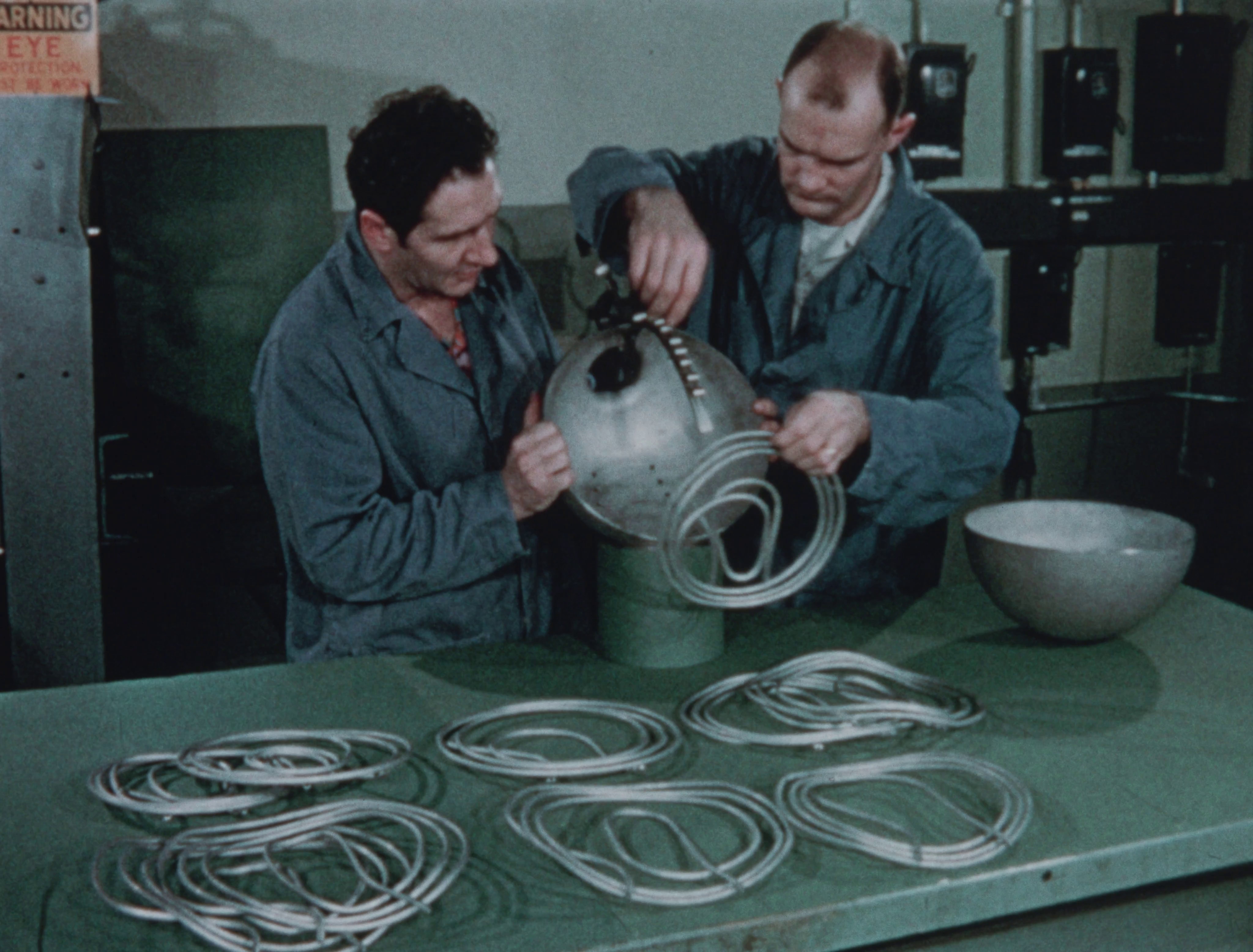
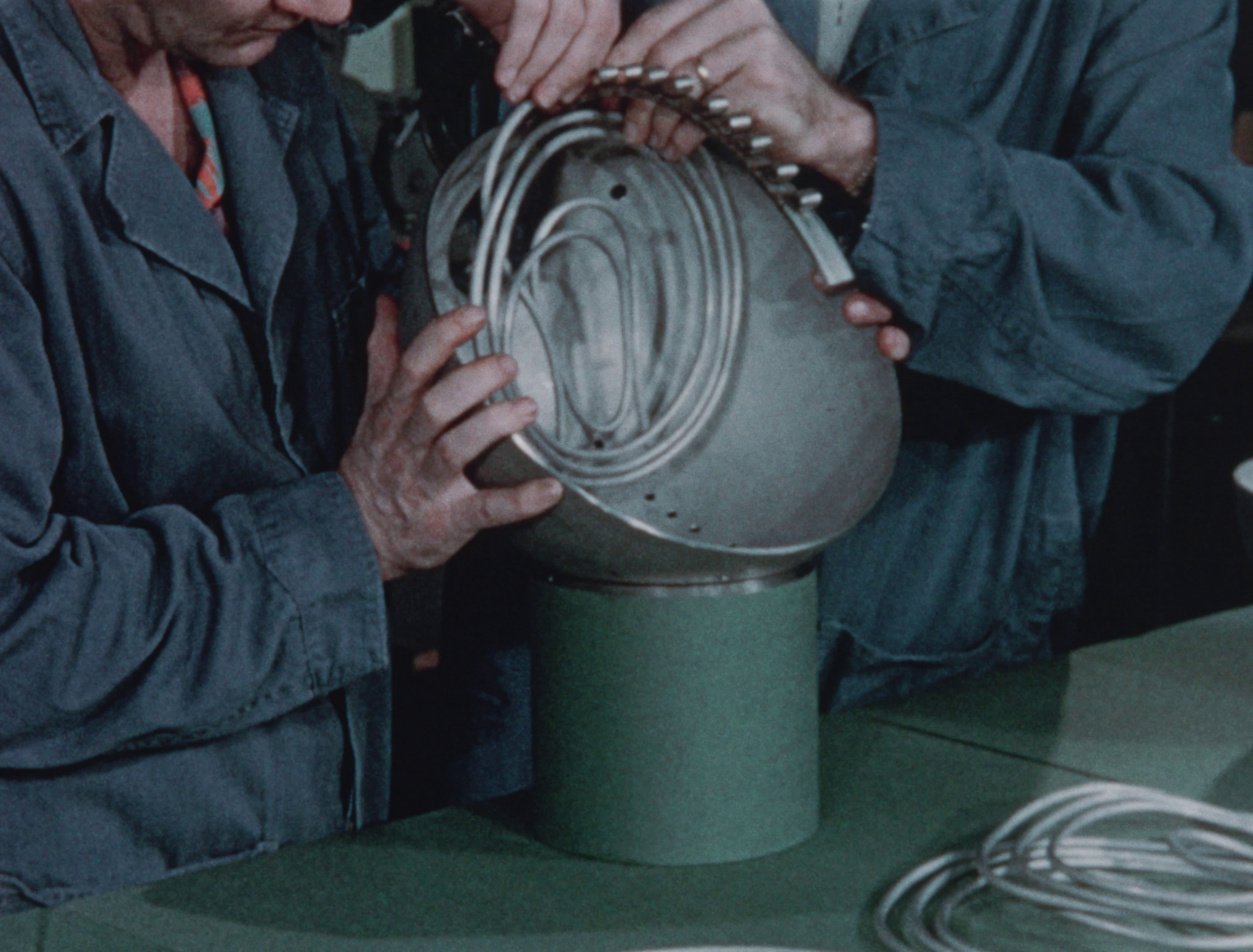
| 01:13 | distilled water and contained in a stainless steel spherical core. Cooling |
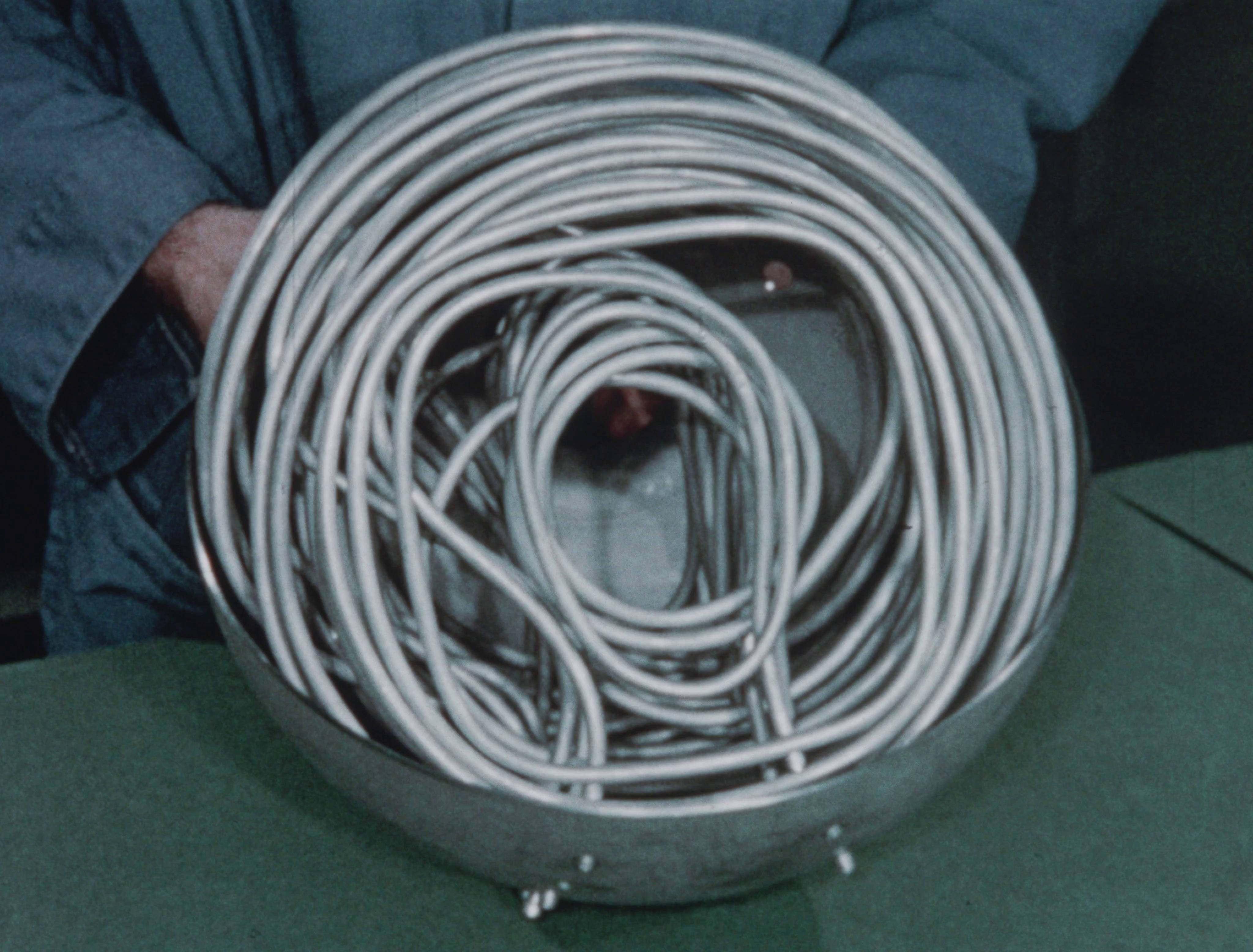
| 01:23 | for the core is provided by ten sections of stainless steel cooling coils |
| 01:27 | located within the core. The sections are connected in parallel and have a total length of 90 feet. |
| 01:36 | Distilled water serves as coolant and is continuously circulated through these coils. |
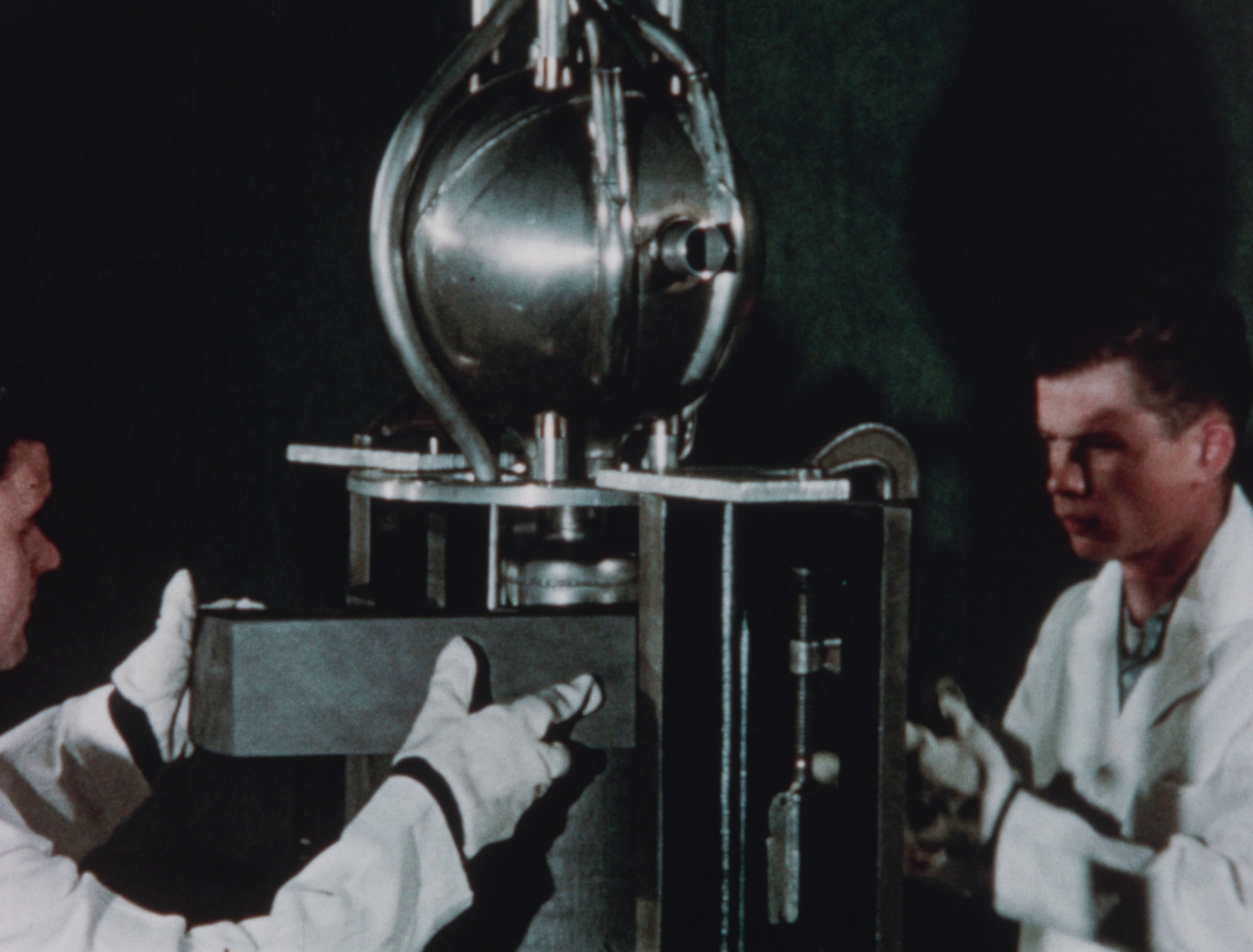
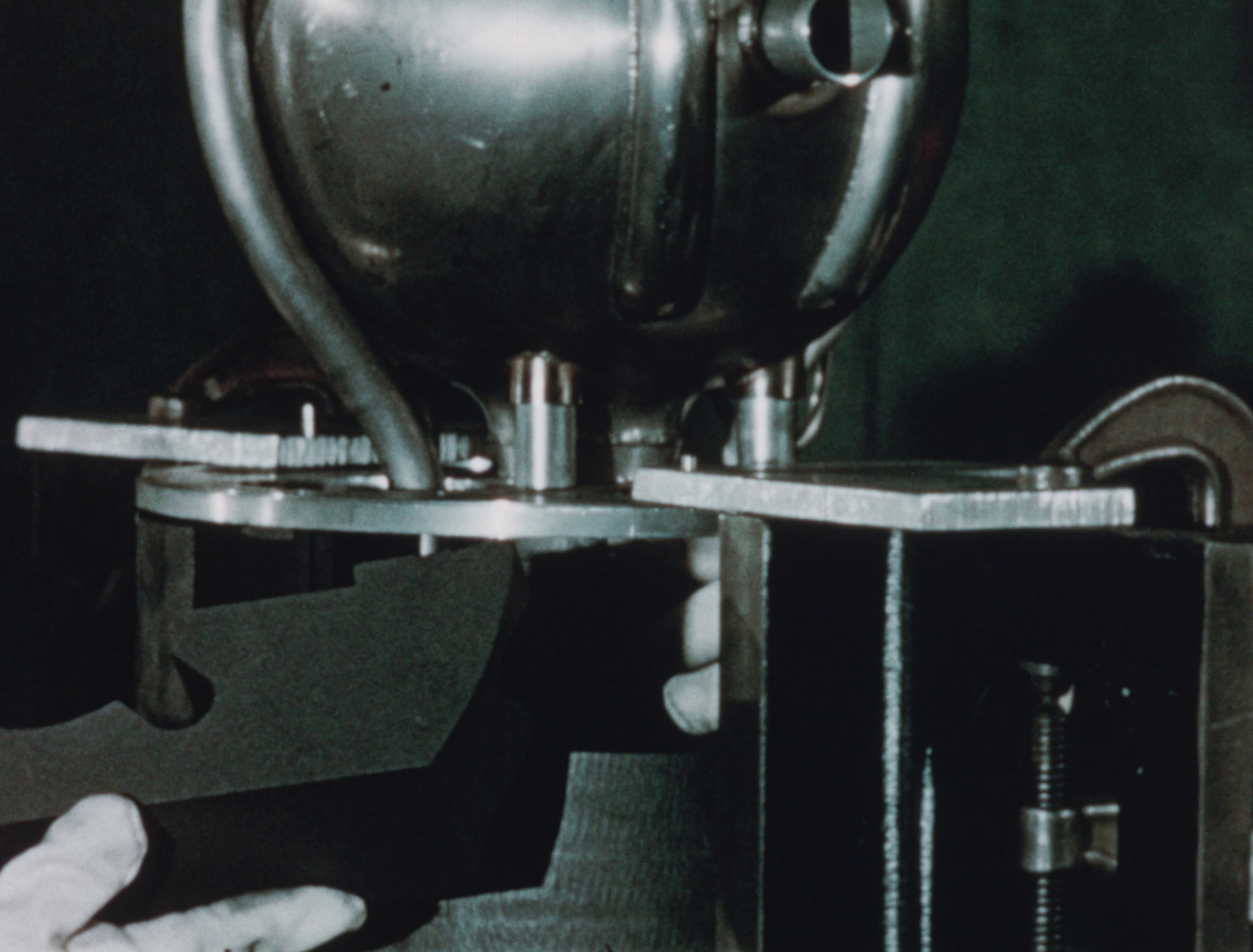
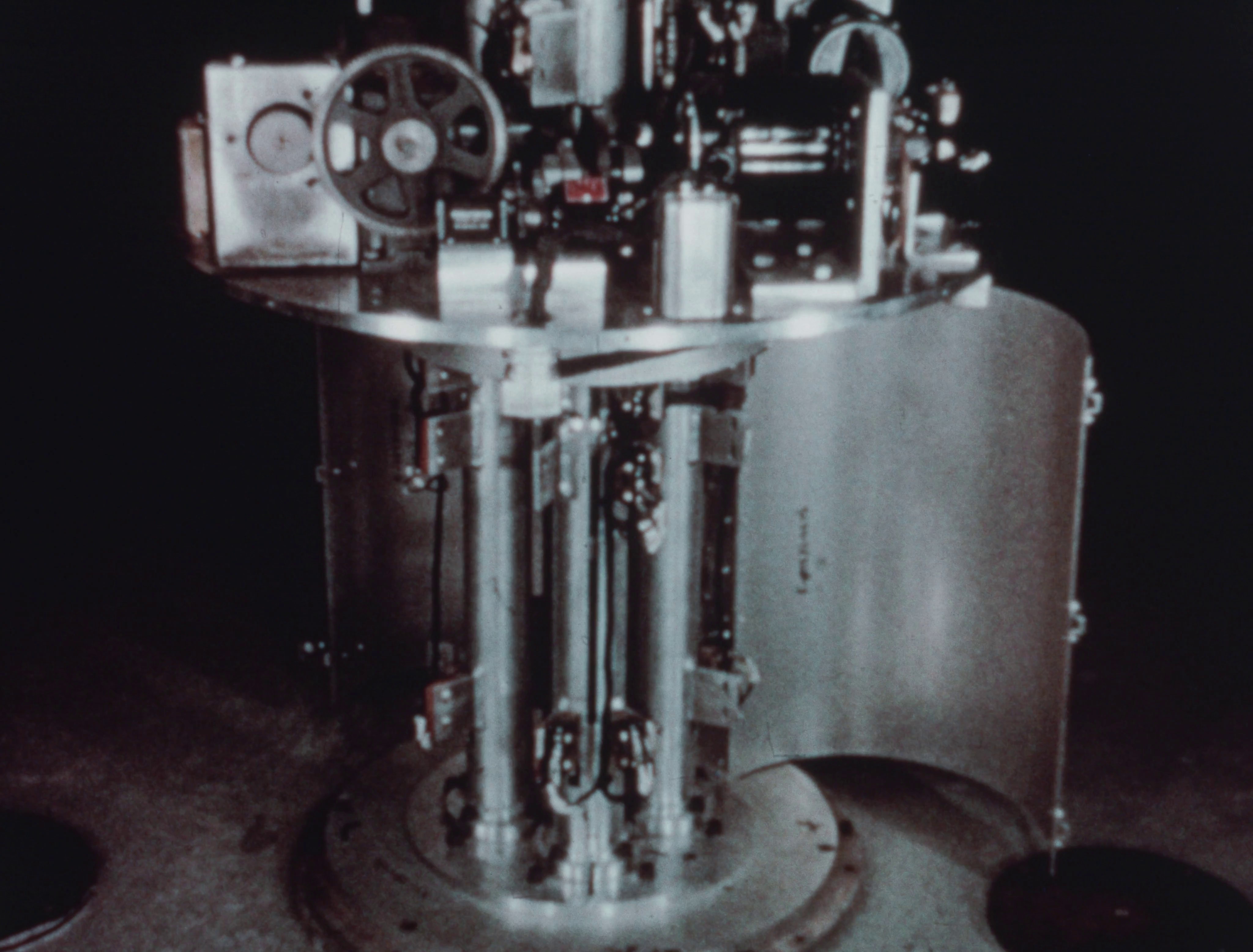
| 01:47 | During core assembly, a series of tack wells was made to hold the two core sections rigidly in |
| 01:54 | place. A shielded arc welder was then used to fuse the seam together without the use |
| 02:03 | of filler rod. A stainless steel backup was drawn up into the weld, ensuring 100% penetration. |
| 02:12 | Two additional weld passes made with filler rod completed the seam welding process. The |
| 02:22 | The core and fuel solution overflow assembly was inverted to facilitate installation of |
| 02:27 | the graphite reflector. |
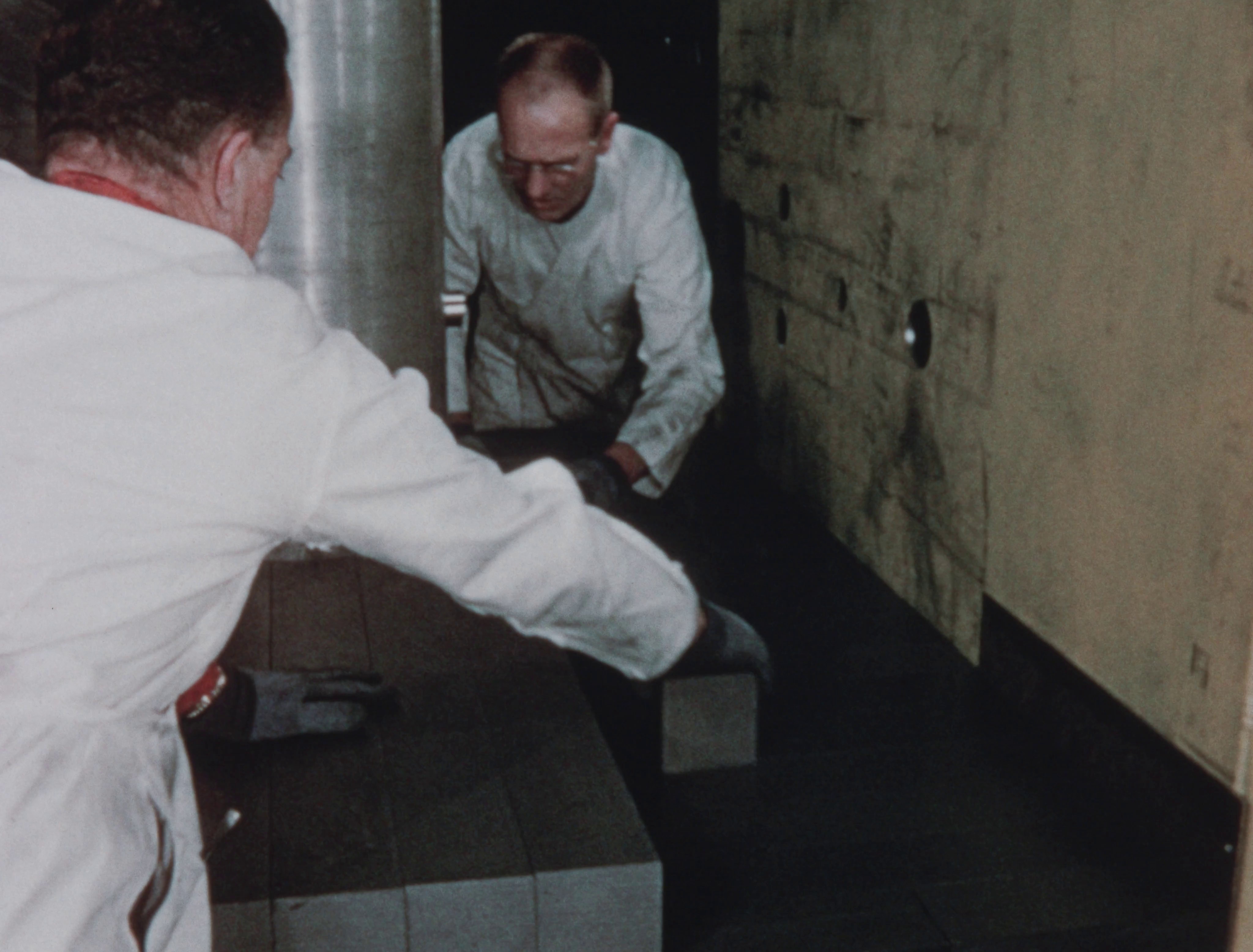
| 02:29 | The graphite sections were hand-cut to ensure a close fit. |
| 02:35 | After each block was individually marked and cut to size, assembly of the reflector was |
| 02:40 | fast and precise. |
| 02:47 | The tight fit around the core ensures a maximum of reflecting material in the most important |
| 02:52 | region for high reactor efficiency. A tube which extends through the center of the core |
| 02:59 | permits specimen exposure in the region of maximum flux density. Special safety features |
| 03:06 | are included to ensure completely safe operation in densely populated areas. |
| 03:20 | One example is this aluminum outer envelope, which encloses the core and its associated |
| 03:24 | piping. |
| 03:25 | If maintenance should be required, the entire core unit can be removed and reinstalled. |
| 03:37 | The neutron reflector consists of a stack of four-inch square graphite blocks which |
| 03:41 | have a high density and a very low percentage of boron. |
| 03:46 | The blocks were stacked in layers and surround the core assembly to form a reflector five |
| 03:52 | feet high, five feet wide, and six and a half feet long. |
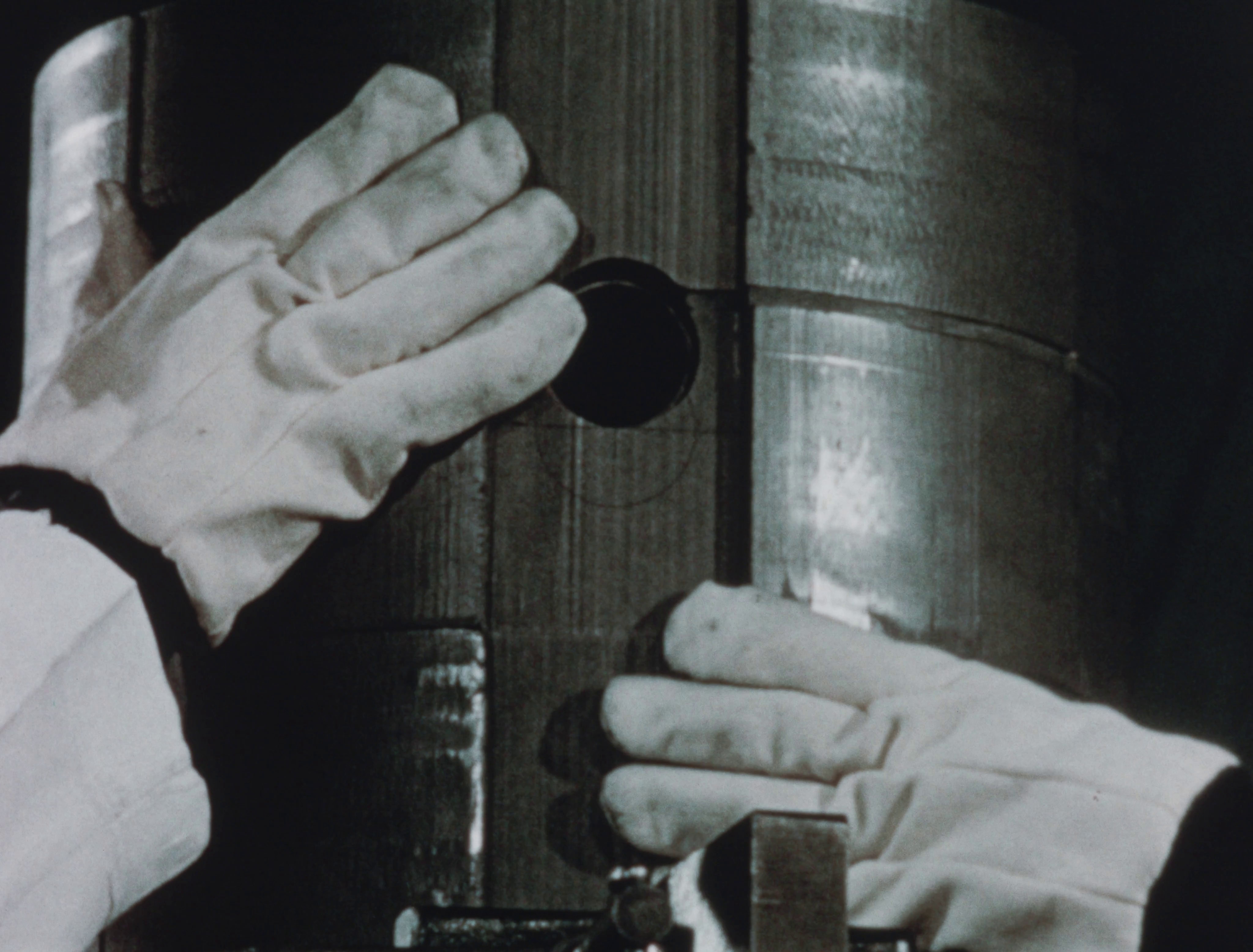
| 04:03 | The exposure ports were plugged with wooden packing dowels prior to shipment to the reactor |
| 04:08 | site. |
| 04:09 | This assured proper alignment of the moderator blocks during transit. |
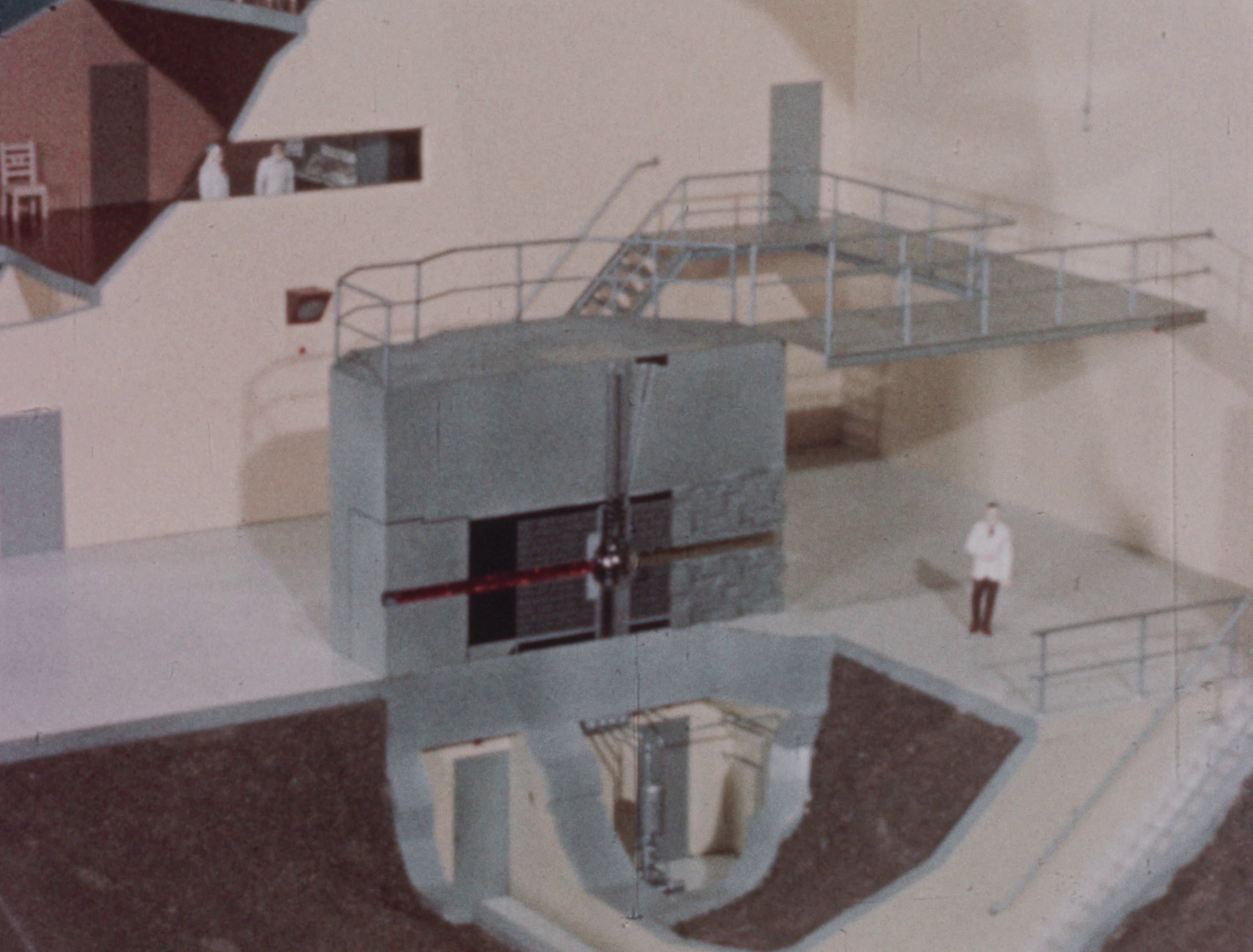
| 04:24 | Biological shielding is provided by a five foot thick wall of high density iron ore concrete. |
| 04:31 | A single bucket contains one cubic yard of dense concrete, which weighs over 6,000 pounds. |
| 04:43 | The dense concrete surrounds the reflector assembly and sub-pile room. |
| 04:55 | The total weight of the reflector assembly is 10 tons. |
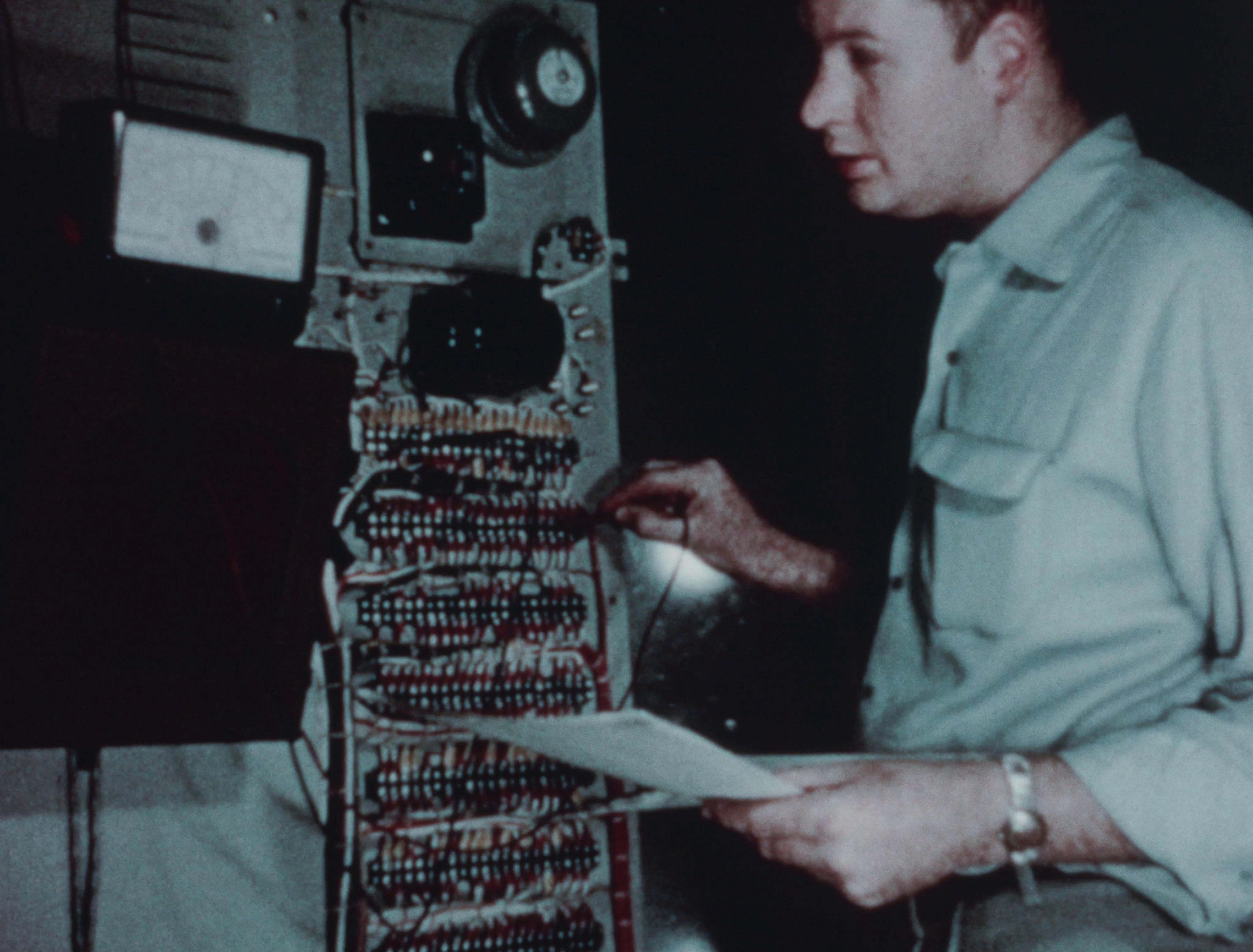
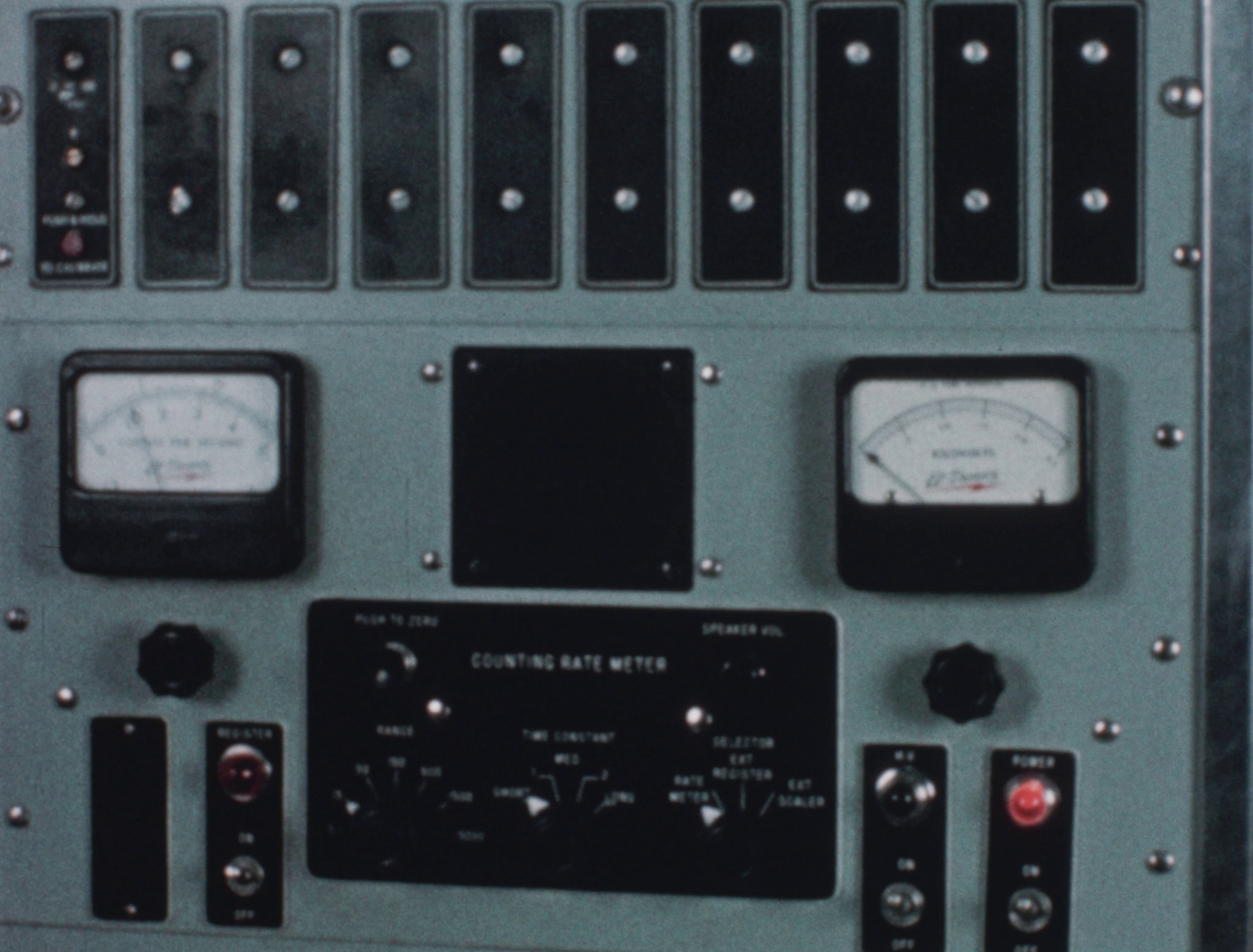
| 05:05 | The instrumentation system which terminates in the control console |
| 05:08 | consists principally of circuits to monitor and control reactor power |
| 05:12 | and to display information on the performance of the gas handling and cooling systems. |
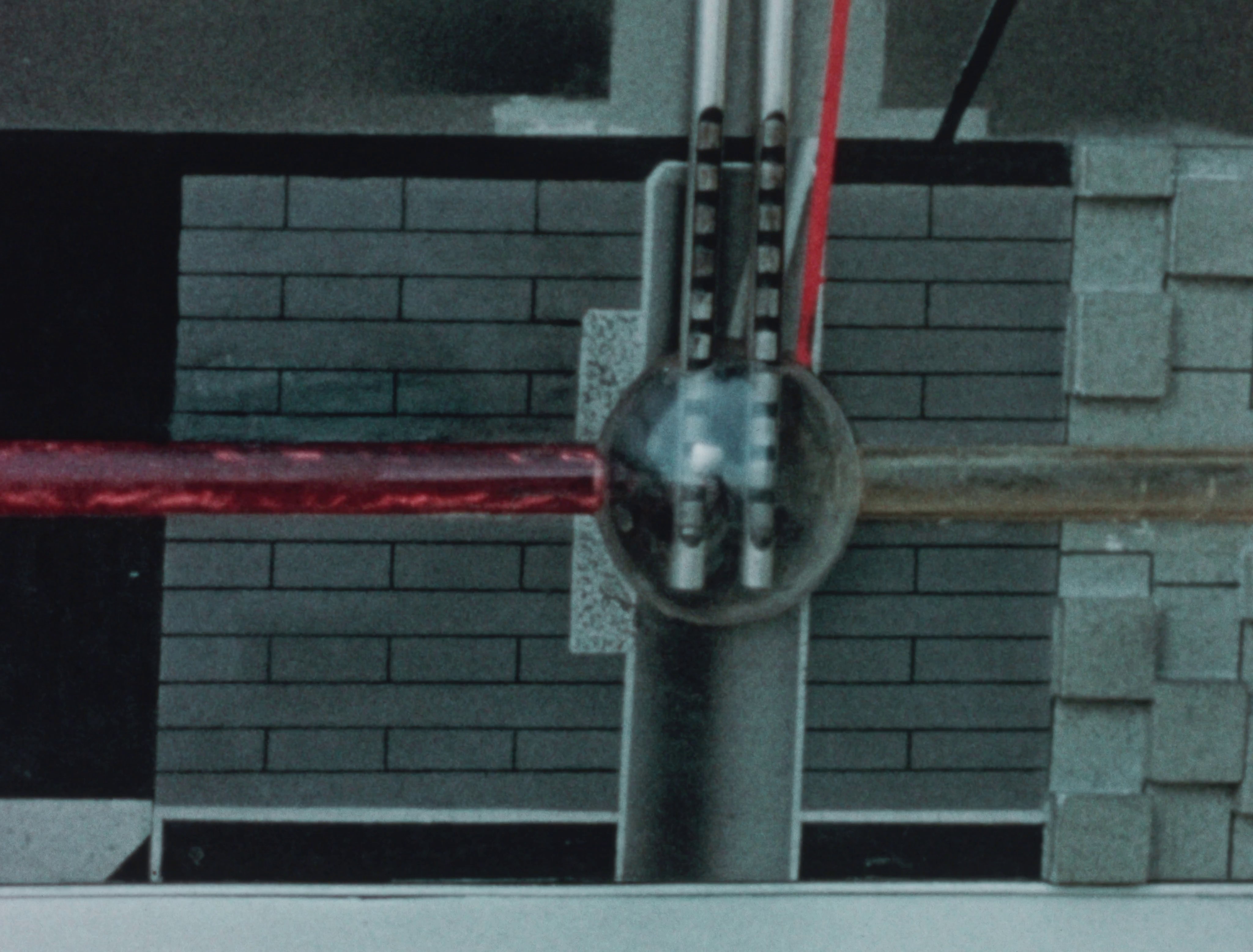
| 05:16 | Four vertical control rods are provided for power level regulation and shutdown of the |
| 05:30 | reactor. |
| 05:31 | The rods are made of boron carbide encased in stainless steel. |
| 05:37 | They travel in sleeves extending through the spherical core. |
| 05:43 | As the rods are lowered into the core, the boron absorbs neutrons and the chain reaction |
| 05:47 | cannot be maintained. |
| 05:49 | Thus, the reactor is stopped. |
| 05:55 | By removing the rods, fission is increased and sustained at the desired level. |
| 06:03 | Reactor power level can be controlled either by automatic or manual operation of the control |
| 06:07 | rods. |
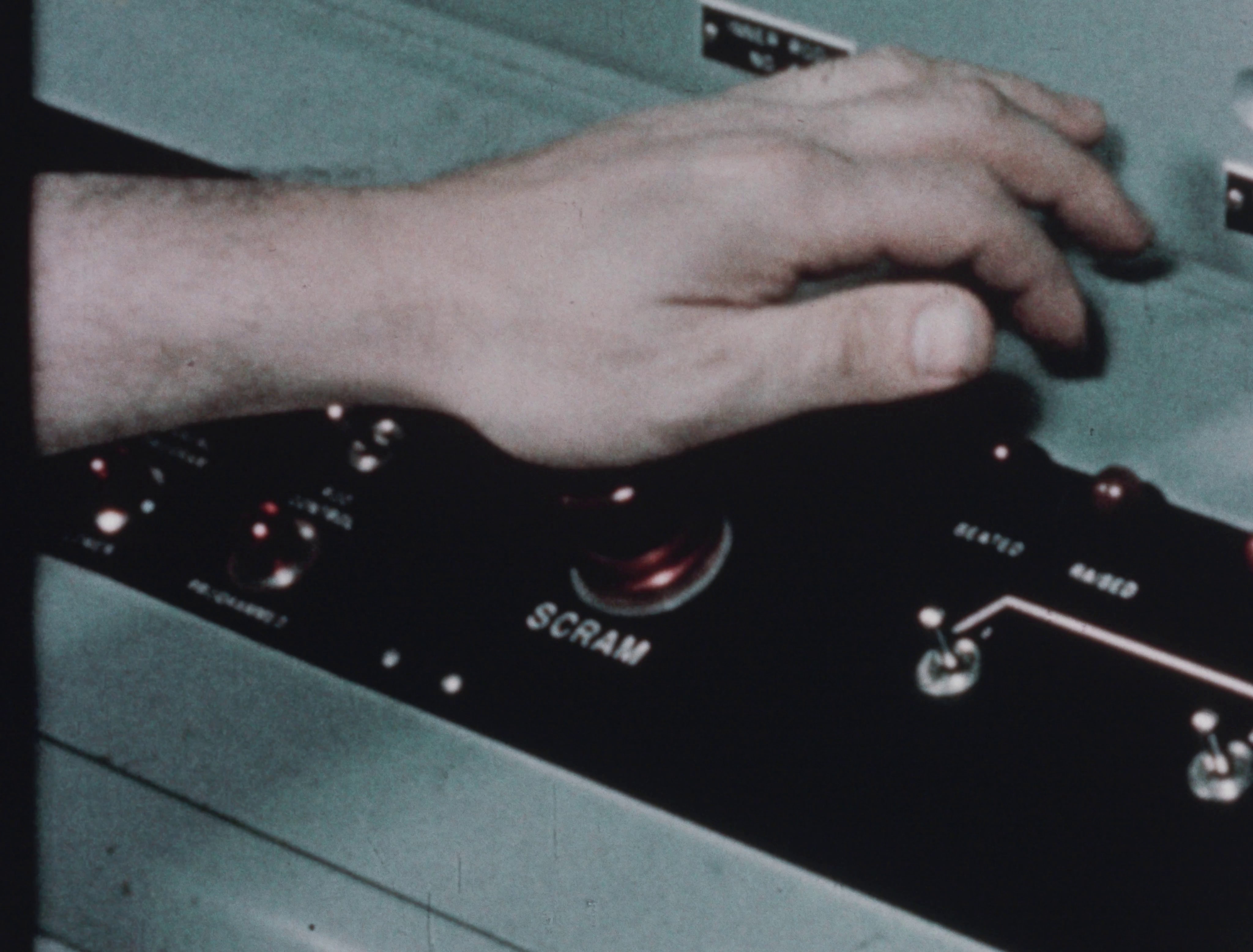
| 06:09 | To stop or scram the reactor, power to electromagnetic rod couplings is cut and the rods fall by |
| 06:16 | gravity to the core. |
| 06:19 | The rods are also dropped automatically by the action of any of the reactor scram circuits |
| 06:24 | or by power failure. |
| 06:32 | Reactor fuel is urinal sulfate dissolved in light water. |
| 06:36 | The uranium is 88% enriched in the 235 isotope. |
| 06:46 | The solution water forms the moderator for slowing down the fission neutrons. |
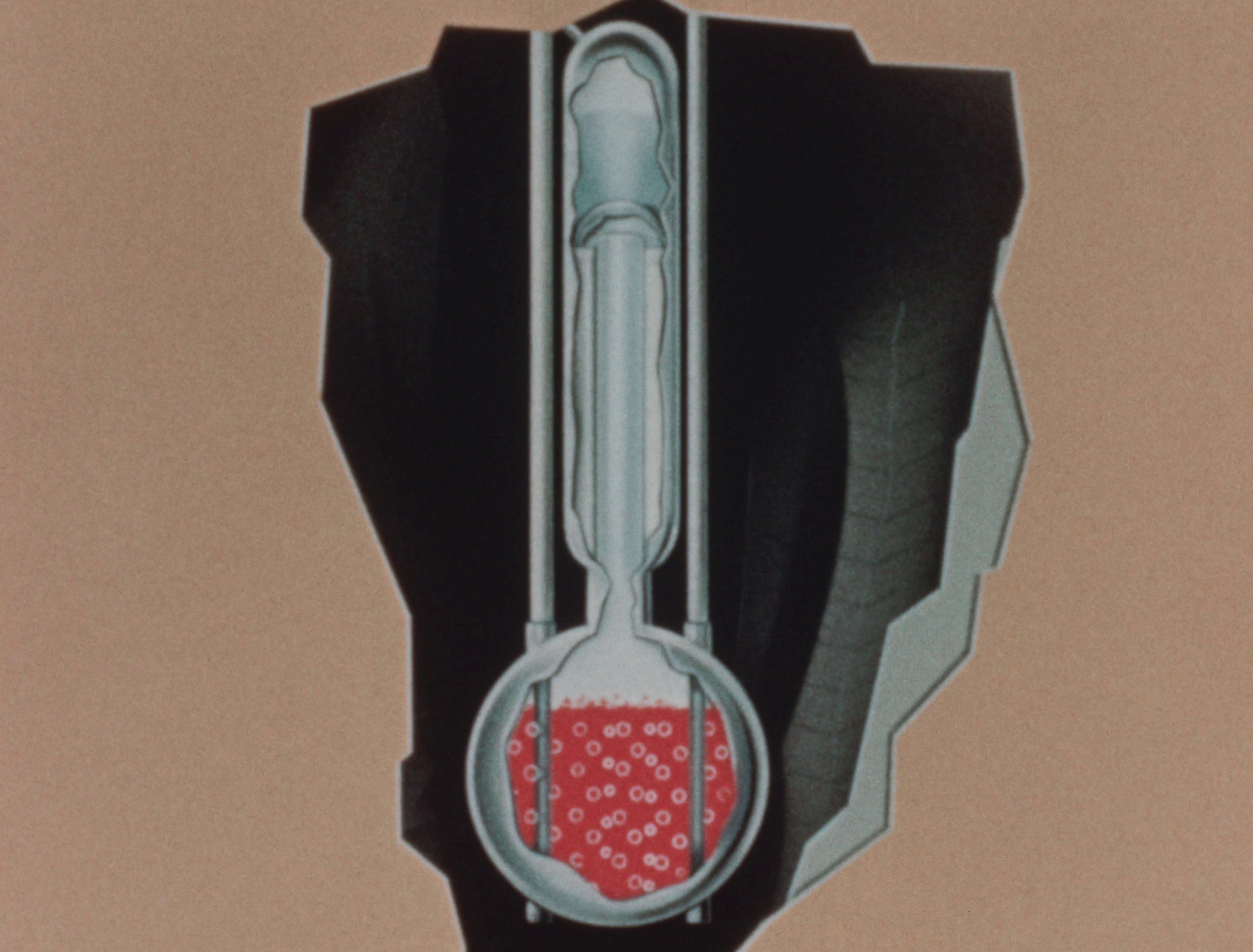
| 06:57 | An inherent safety feature acts to shut down the reactor in the event of an abnormal power |
| 07:01 | rise even if its mechanical devices should not function. This feature results from the |
| 07:08 | negative temperature coefficient and negative gas coefficient. Fuel solution temperature |
| 07:15 | increase is indicated by a shift from yellow to red. The negative temperature coefficient |
| 07:21 | results from the expansion of the fuel solution as its temperature rises. When the solution |
| 07:26 | expands, the reactor becomes less reactive due to its change in geometry and reactor |
| 07:32 | power is decreased. The negative gas coefficient results from the radiolytic decomposition |
| 07:39 | of the water, producing hydrogen and oxygen. These gases expand the solution to a subcritical |
| 07:45 | state which also shuts the reactor down. If a power surge should ever be great enough, |
| 07:56 | It would force a portion of the solution into the overflow chamber above the core. |
| 08:01 | It would leave the reactor in a sub-critical state |
| 08:04 | and the appropriate corrective action could be taken. |
| 08:11 | The solution would then drain slowly back to the core |
| 08:14 | and the reactor could be started once again. |
| 08:24 | The shutdown mechanism just demonstrated will operate only in the event that all mechanical control and safety systems should not function. |
| 08:40 | The horizontal thermal column is five feet square and is shielded by a motor driven dense concrete door. |
| 08:46 | The door weighs 40,000 pounds and has limit switches to stop the in or out travel. |
| 08:59 | Large specimens as well as special test equipment can be placed in this exposure facility. |
| 09:06 | In this experiment, the reactor is being used to study the effects of slow neutron bombardment |
| 09:11 | on a laboratory test moderator. |
| 09:22 | A fast neutron beam is also available when graphite stringers are removed from the center |
| 09:27 | of the thermal face. |
| 09:34 | With the test equipment in place, the reactor is ready for start-up. |
| 09:45 | Since radioactive materials are present in the reactor and are handled in the experiments, |
| 09:50 | a positive means for controlling the atmosphere in the reactor room is provided. |
| 09:55 | The concrete room walls are coated with the plastic paint to prevent the passage of gases. |
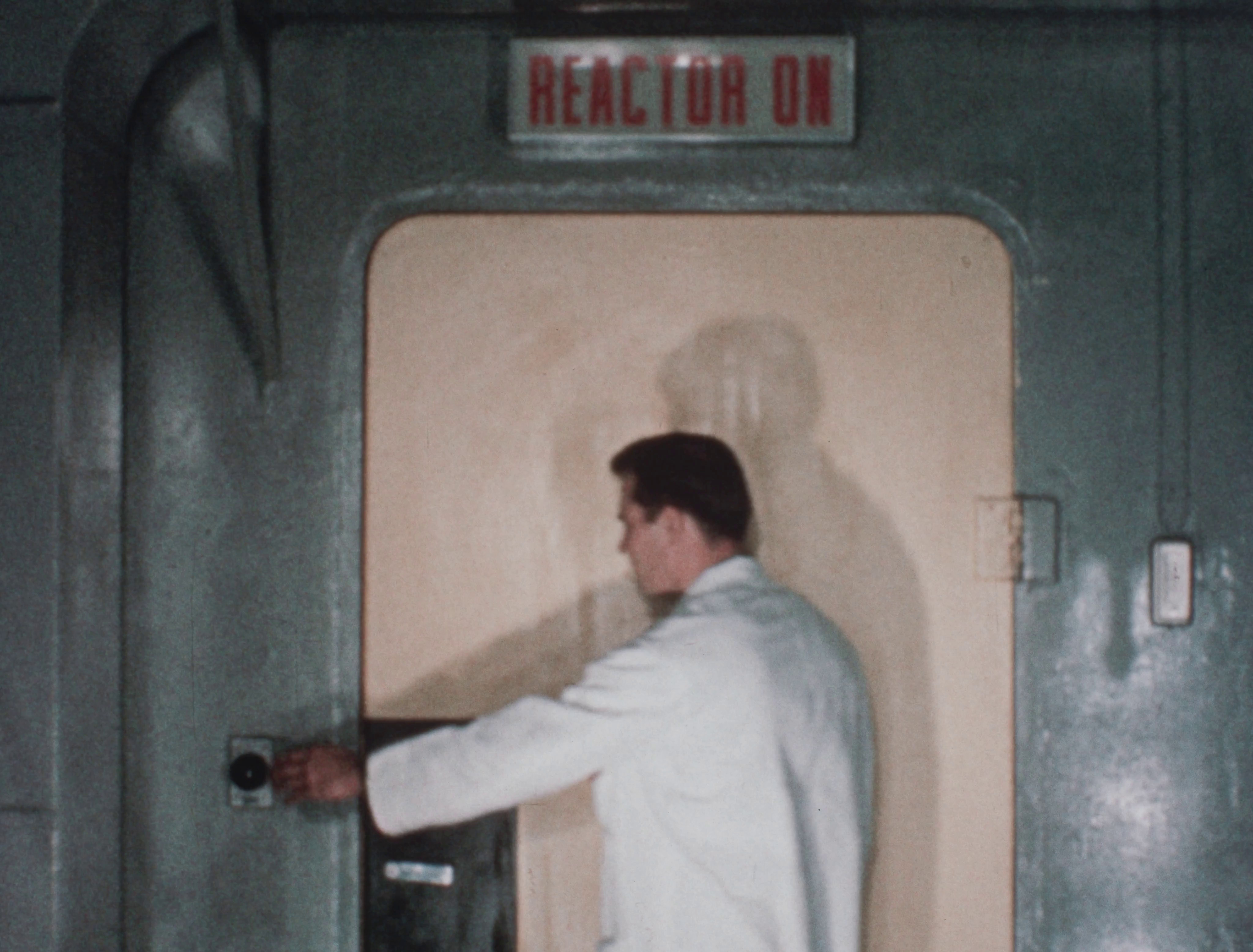
| 10:02 | Specially designed gas-tight doors seal the reactor room. |
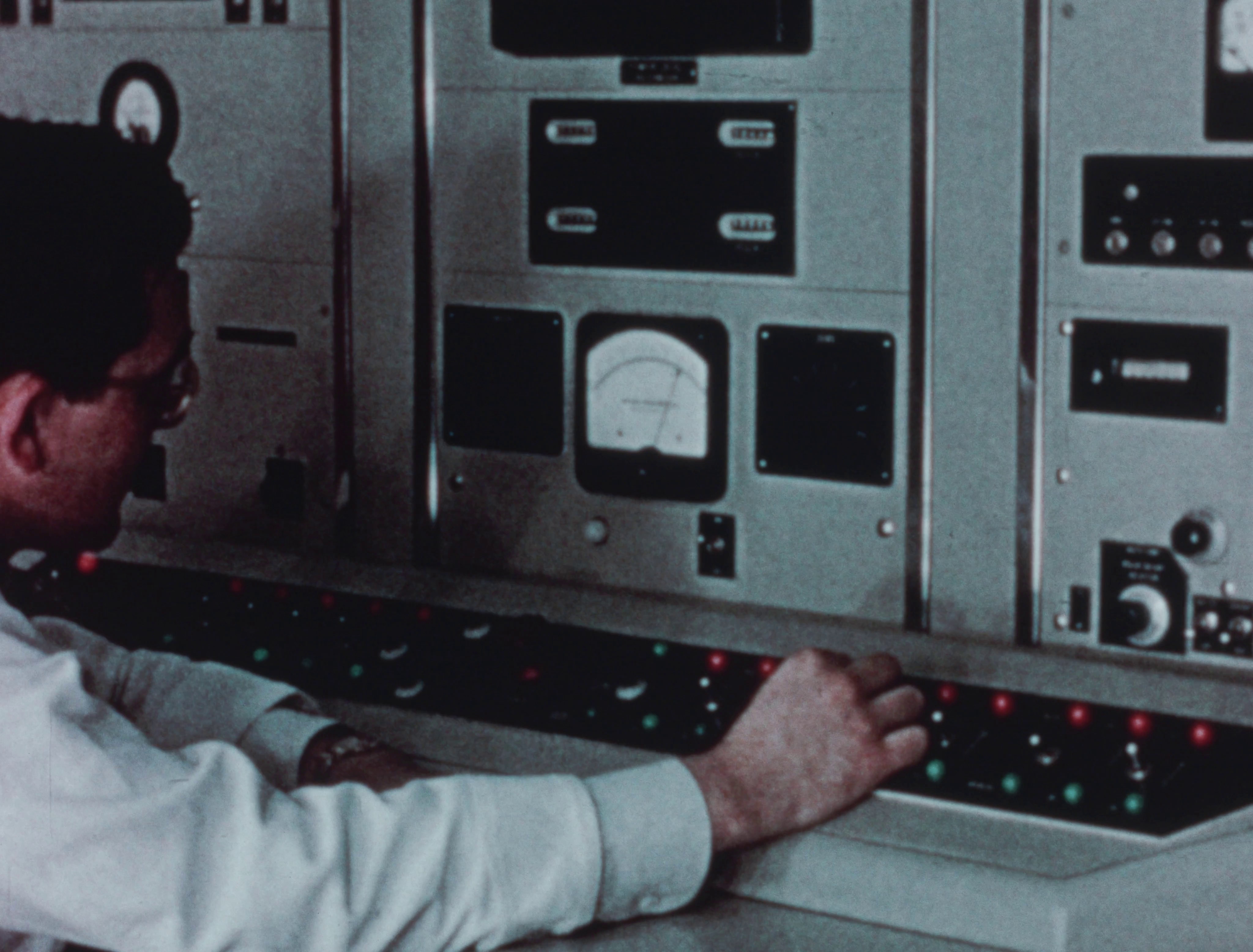
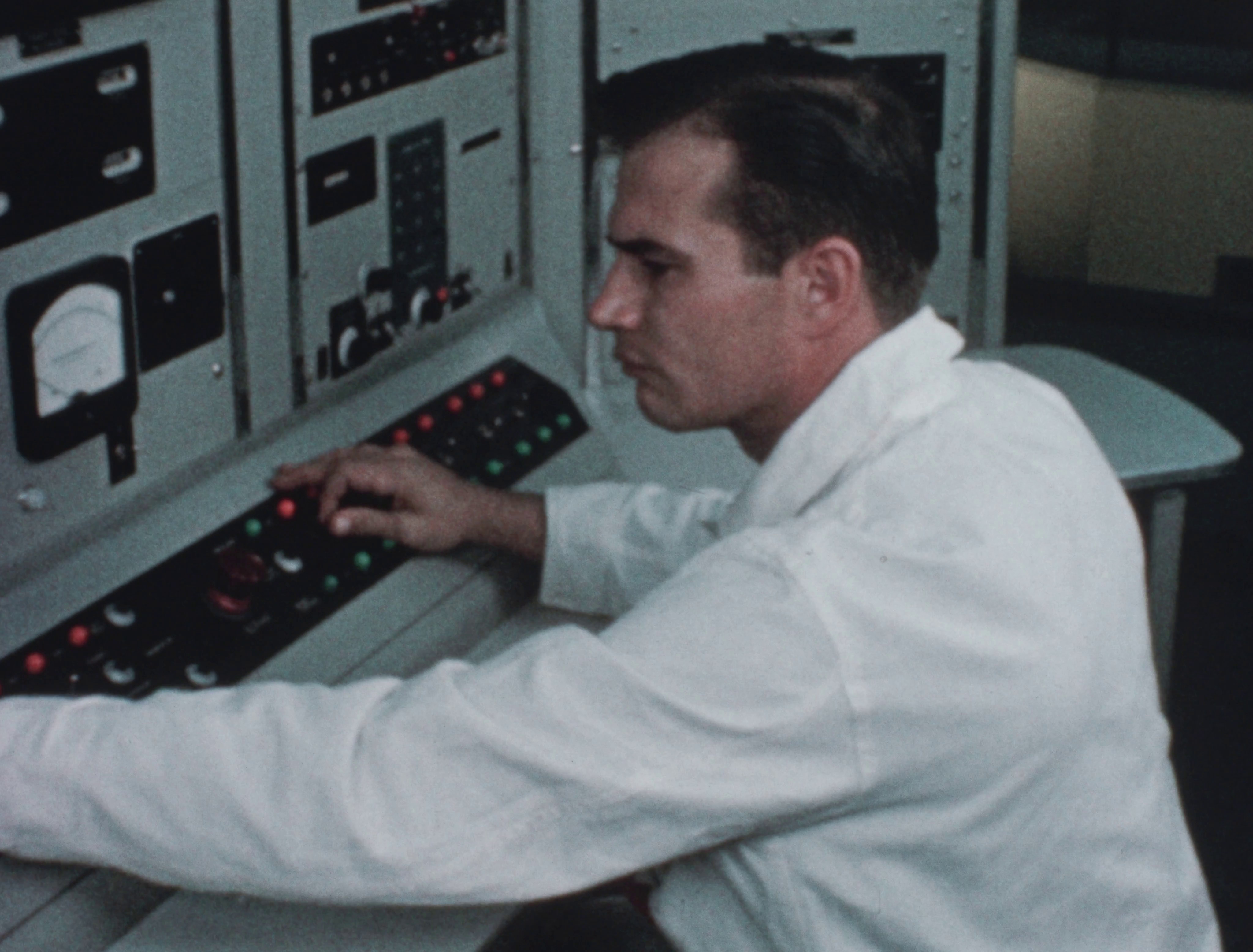
| 10:17 | From the control console, the operator monitors and controls the complete operation of the reactor. |
| 10:24 | A check is made of the various instruments which display control rod position, |
| 10:28 | position, cooling system temperatures, gas handling system pressures and other |
| 10:33 | information required for efficient and safe reactor operation. As control rods |
| 10:40 | are withdrawn from the core, the fission chain reaction begins. |
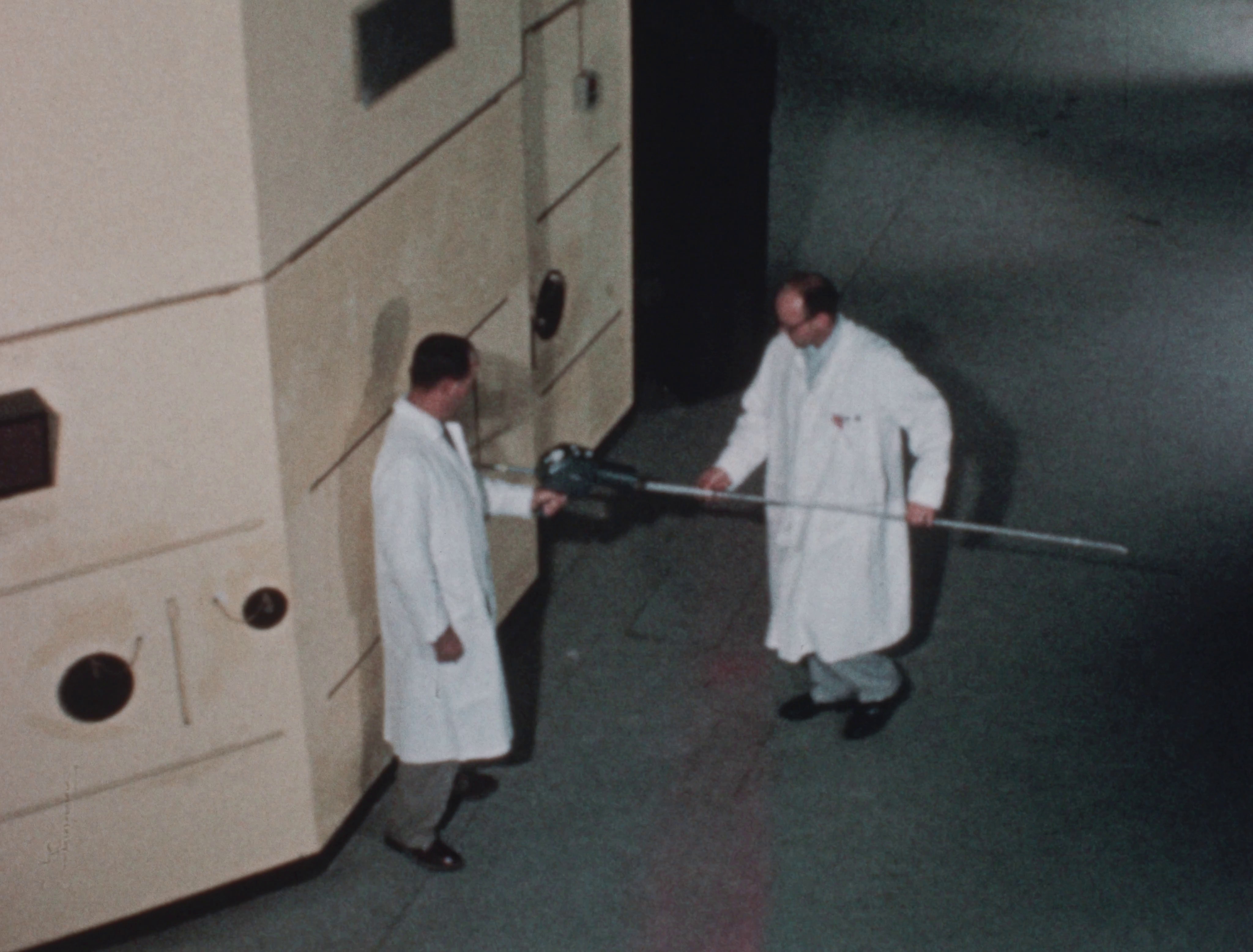
| 10:47 | Technicians in the control room and on the reactor floor talk with each other |
| 10:51 | over an intercommunication system. In this way information presented on |
| 10:56 | monitoring equipment set up adjacent to the reactor may be instantly and |
| 11:00 | continuously compared with control console data the heavy concrete |
| 11:08 | biological shielding which surrounds the reactor permits personnel to remain in |
| 11:13 | the reactor room during operation there are 18 tube type exposure facilities in |
| 11:19 | the reactor consisting of metal tubes which extend through the concrete shield |
| 11:23 | to the immediate vicinity of the core. Each tube facility is equipped with a |
| 11:29 | graphite reflector plug and a dense concrete and steel shielding plug. Access |
| 11:39 | is gained to the region of maximum flux density through a central tube facility |
| 11:44 | which extends through the center of the core. Nuclear reactors have a variety of |
| 11:52 | of practical applications. |
| 12:03 | A complete listing of the many uses of radioactivity in radiation would run into the thousands. |
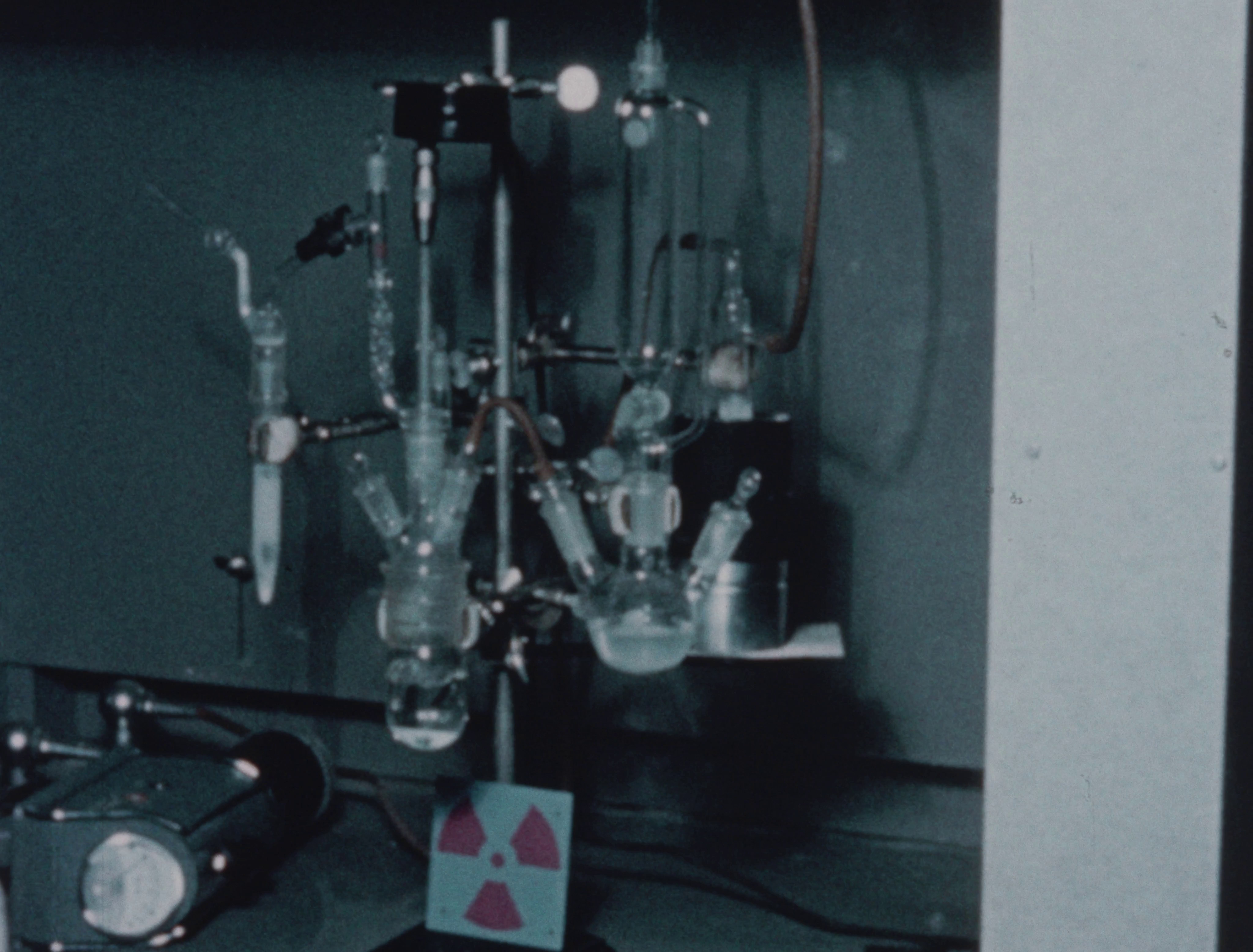
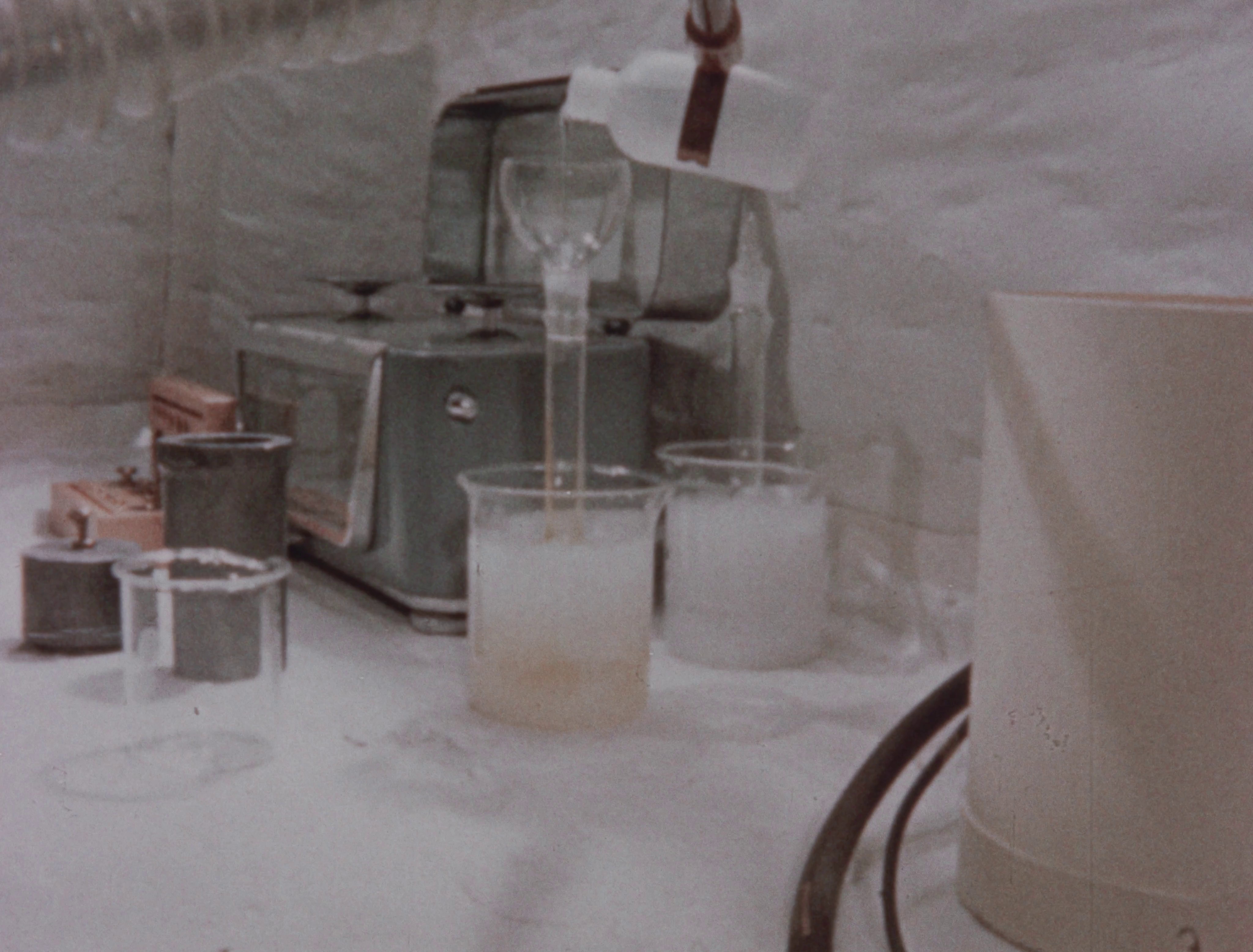
| 12:13 | Among the current applications is the development of new chemical processes and products. |
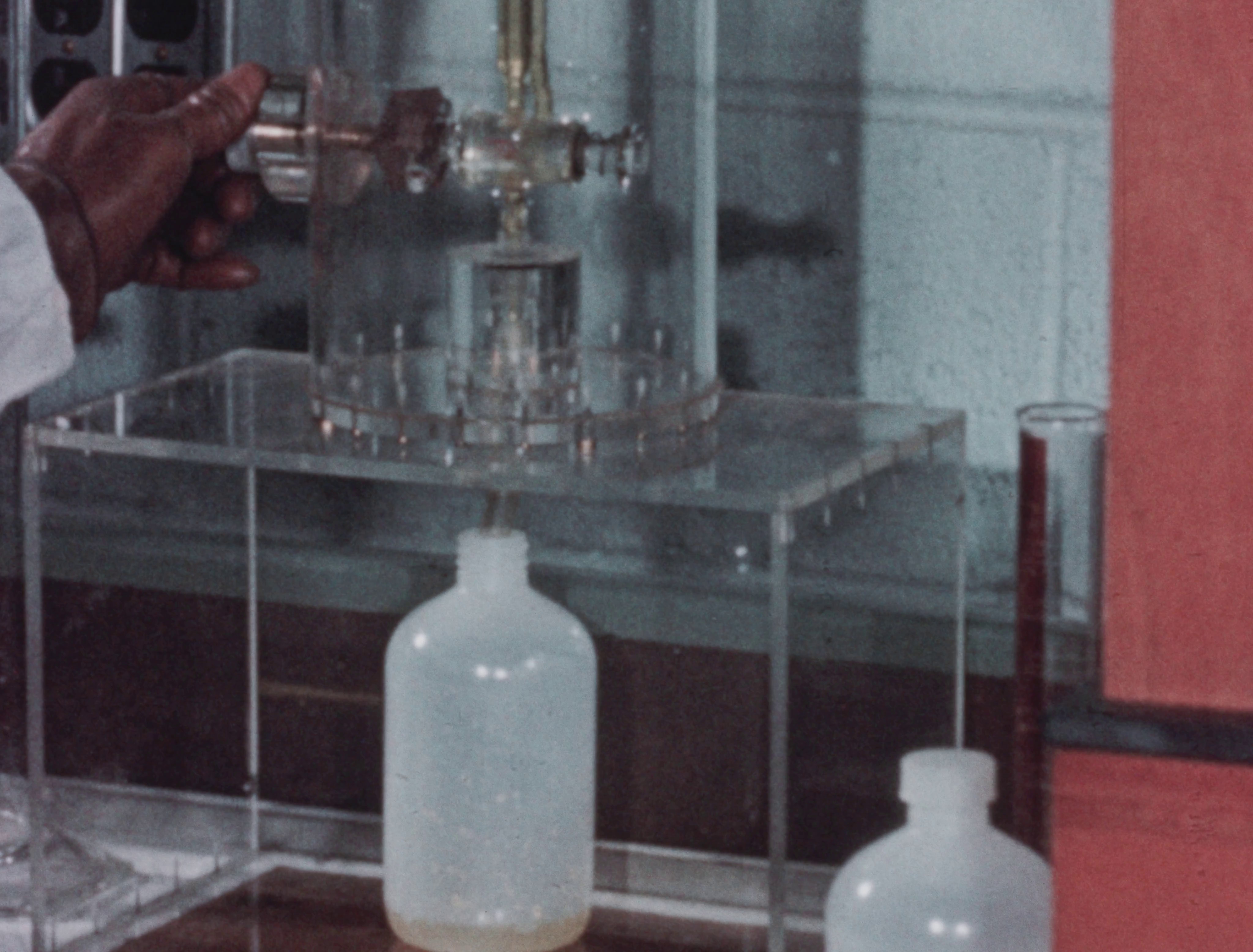
| 12:18 | Here, a radioactive carbon isotope is being transformed from radioactive carbon dioxide |
| 12:25 | gas to a radioactive organic liquid. |
| 12:29 | This is a useful tool for research on plastics, synthetic fabrics, and pharmaceutical products. |
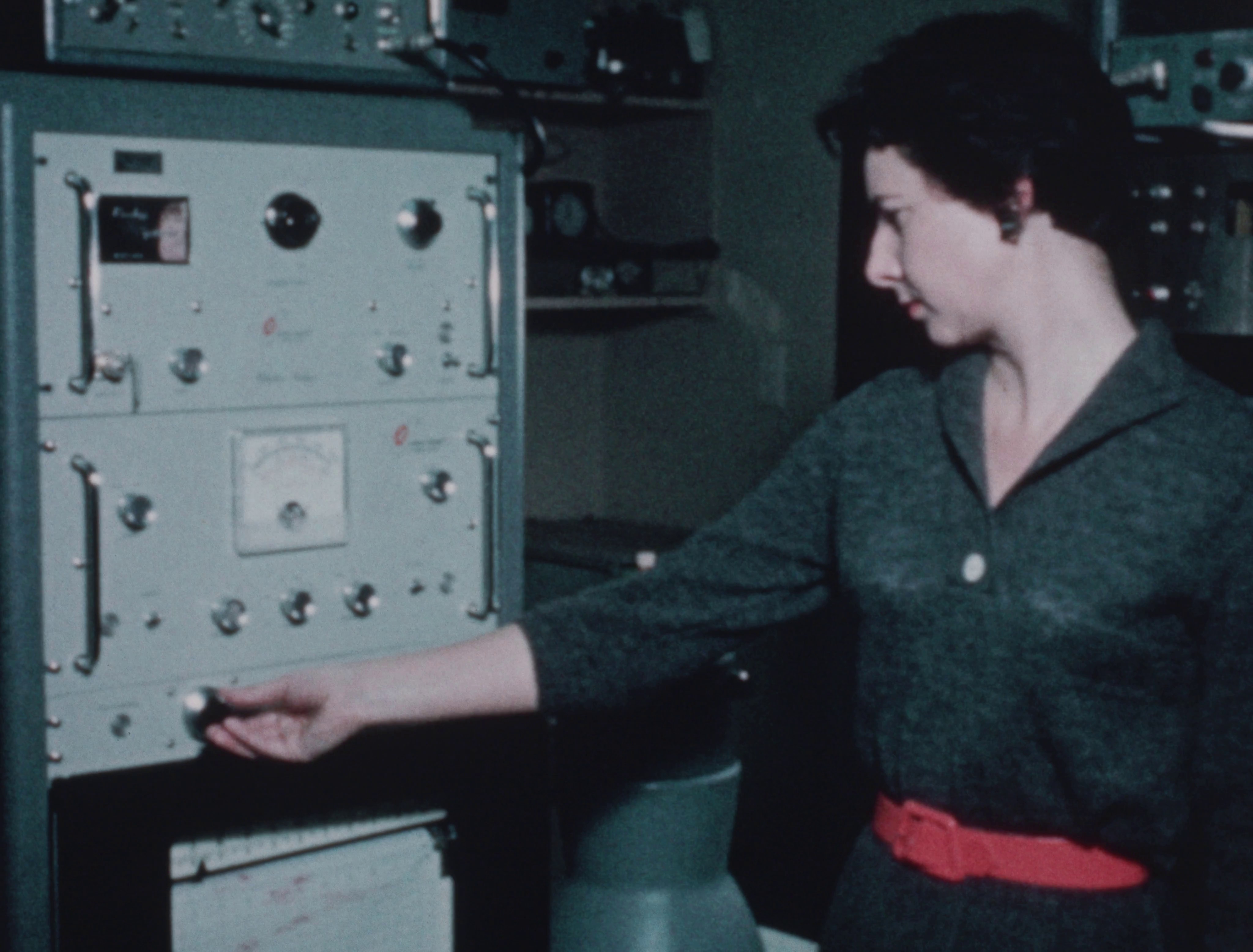
| 12:38 | A laboratory technique known as activation analysis is coming into widespread usage. |
| 12:44 | Impurities too small to be detected by chemical or spectroscopic analysis can be detected |
| 12:50 | by irradiating a small sample of material, and then measuring the activity thus produced. |
| 12:57 | By studying the gamma energies emitted, impurities present are identified and analyzed. |
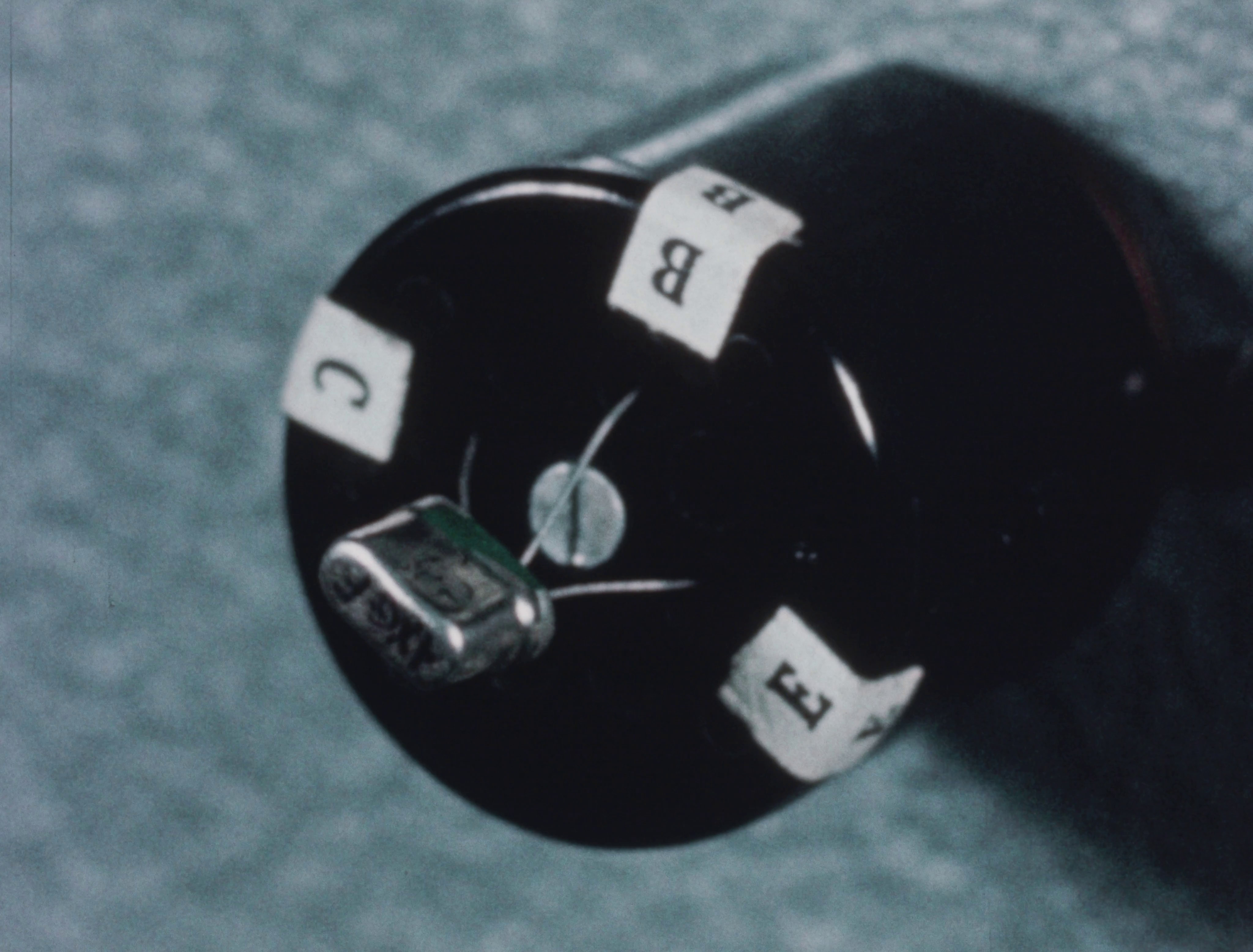
| 13:06 | The effects of radiation on transistors and semiconductors is being studied. |
| 13:11 | A transistor which has been irradiated in a reactor undergoes a series of stability tests. |
| 13:18 | Research of this type plays an important part in the development of new materials and techniques for electronic applications. |
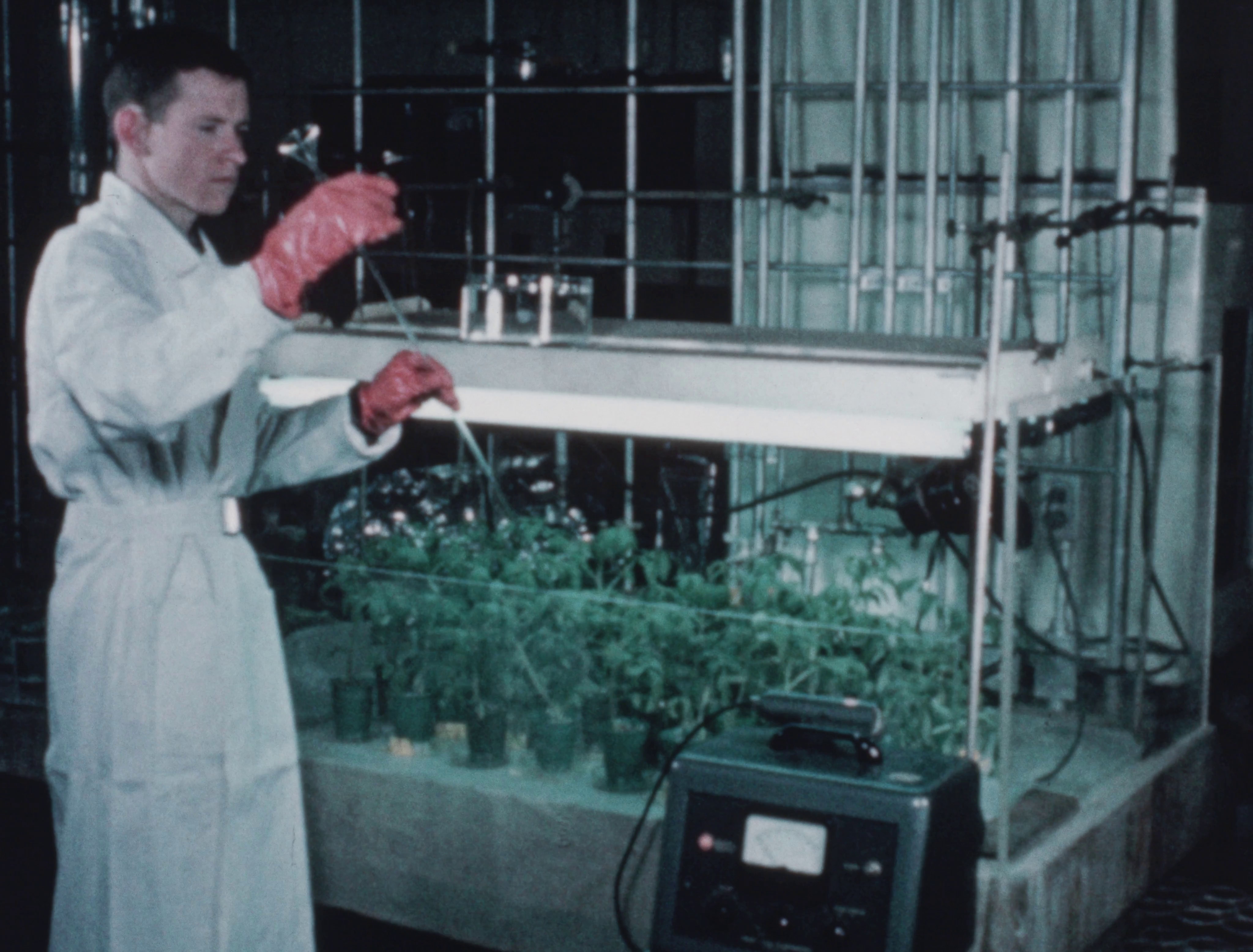
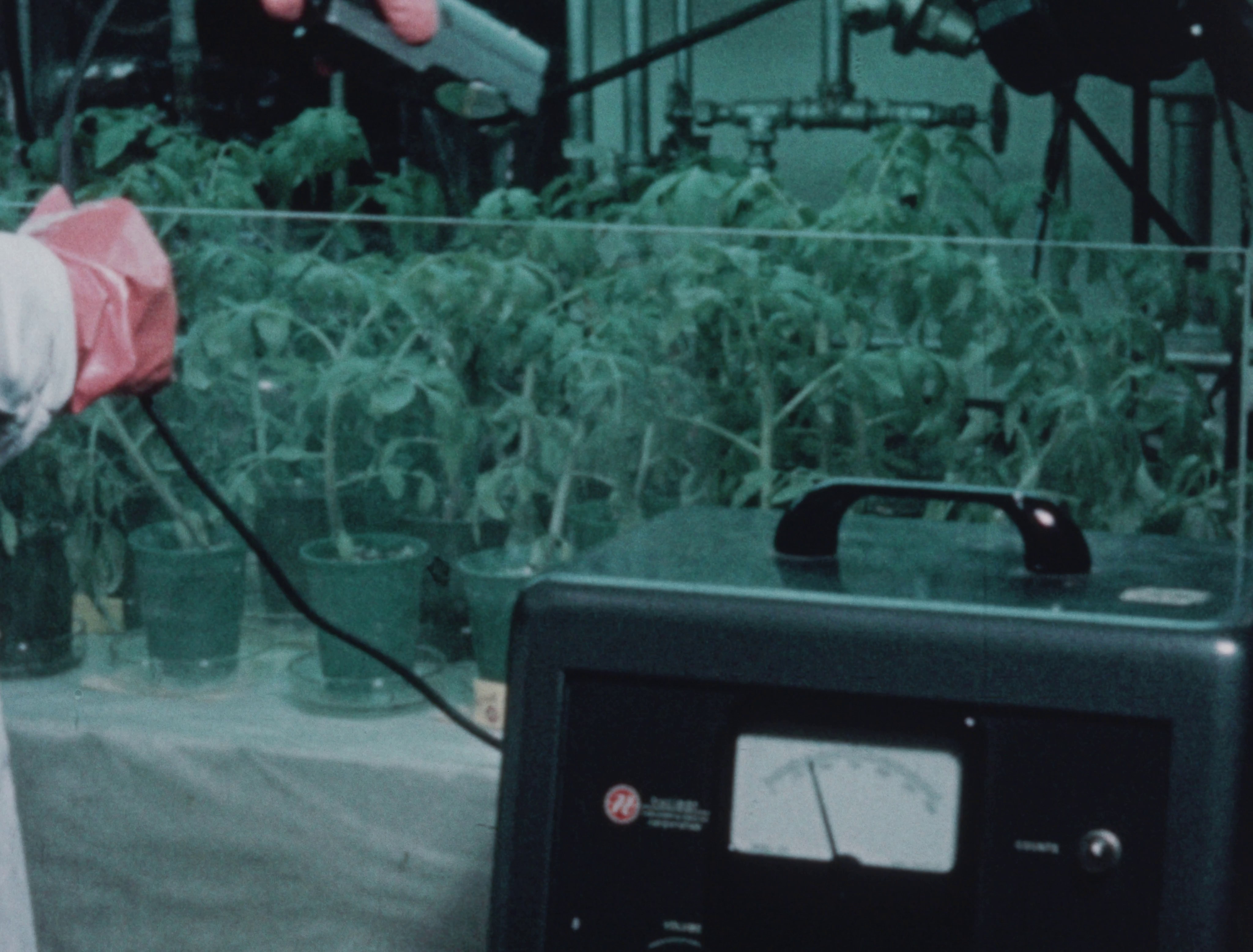
| 13:29 | In the field of botany and agriculture, extensive research is being conducted with the aid of radioisotopes. |
| 13:36 | Here, an analysis is made on the absorption of radioactive phosphorus into the structural |
| 13:42 | components of tomato plants. |
| 13:45 | This is a study of drought resistance, protein formation, and growth itself, as affected |
| 13:51 | by water shortage. |
| 13:54 | Without the aid of radioisotopes, many phases of this work would be impossible. |
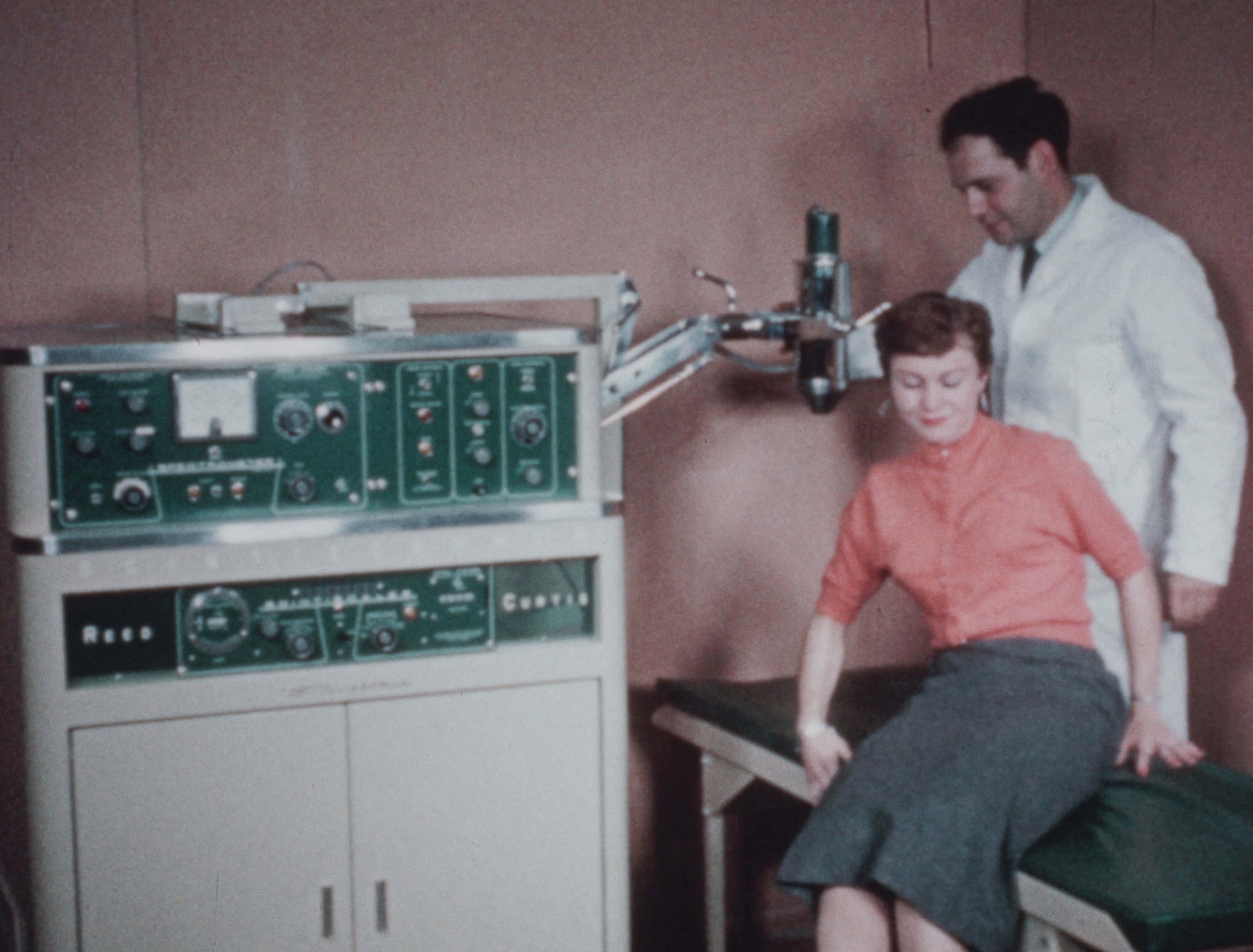
| 14:05 | Radioisotopes are also playing an increasingly important part in modern medicine. |
| 14:11 | This patient is being given a diagnostic test of the thyroid. |
| 14:15 | Before this test, she drank a solution containing a tracer amount of radioactive iodine. |
| 14:22 | A scintillation counter above the area of the thyroid will pick up the extremely low-level gamma rays |
| 14:27 | emitted by the iodine, now localized in the thyroid. |
| 14:35 | The impulses from the scintillation counter are sent to a recording chart to |
| 14:40 | indicate exactly how the thyroid is functioning. Prior to the use of |
| 14:46 | radioisotopes, such a diagnosis was difficult and frequently required |
| 14:50 | surgery. |
| 14:56 | In addition to present-day applications, many future benefits from research |
| 15:01 | reactors can be anticipated. By providing an immediate source of neutrons, gamma |
| 15:06 | rays and radioisotopes, this nuclear reactor brings to industry a new and |
| 15:12 | valuable research tool. As the focal point of an intensive research program |
| 15:18 | stimulated by the enthusiastic support of private enterprise, this reactor |
| 15:23 | establishes a new concept in the rapidly expanding field of industrial research. |
A very special thanks to Veriten for sponsoring the digitization of this film. They actually did a whole Gener8 podcast episode where you can along with the hosts and Nick.
The Armour Research Reactor (ARR)’s license application was submitted on Jan 7, 1955. The construction permit was issued on March 28, 1955, and the license was issued on December 5, 1958 (ref). It went critical on June 24, 1956, and operated until 1958 at 10 kW before uprating. It was shut down in 1967 and the license was terminated on April 28, 1972. The reactor was a L-54 model from Atomics International.
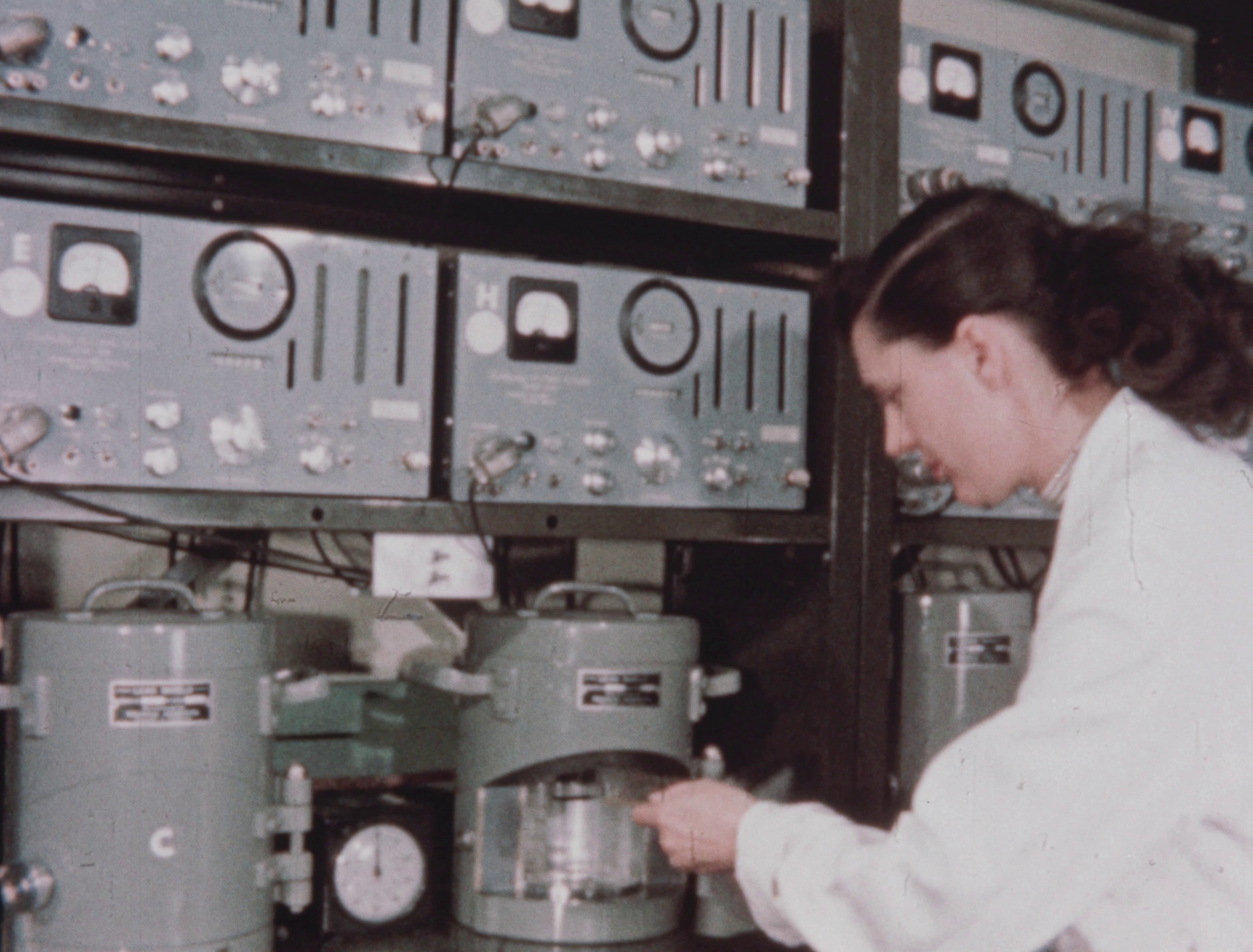
Stills from the film




See Also
- Armour Pamphlet – an amazing pamphlet describing the reactor
- Armour Archive Clippings – more archival Armour info
- Reiffel, The First Industrial Research Reactor Facility Design, Operational Experience, and Research Programs – a June 1958 paper from the 2nd UN International Conference on the Peaceful Uses of Atomic Energy (Atoms for Peace) that describes the reactor history and numerous challenges encountered after first turning on the reactor
- Picture of sign announcing the reactor
- Federal Register May 6, 1961 announcing license change to 75 kW – See page 19 of the PDF
- Aqueous Homogeneous Research Reactors – An Atomics International pamphlet that also shows the ARR
- Our Digital Reactor History Museum
- Our Reactor Development History Page
- Our Old Videos page with a running list of the available and yet-to-be-scanned films out there.
If you’re interested in helping to get some of these scanned, check out our digitization GoFundMe and/or contact us!
About Dr. Nick Touran, Ph.D., P.E.
Nick Touran is a nuclear engineer with expertise in advanced nuclear reactor design, reactor development, and the history of nuclear power. After getting a Ph.D. at the University of Michigan, he spent 15 years at TerraPower in Seattle working on core design, business development, software development, and configuration management. He is now a consultant involved in advising and assisting numerous reactor development and deployment efforts. He is also a licensed professional engineer in Nuclear Engineering.
Nick has been active in public education around nuclear since 2006 as the founder of whatisnuclear.com. He has spoken at numerous institutions, schools, and public events, and was once featured on NPR’s Science Friday. Recently, he has coordinated the digitization of over 45 historical nuclear films.
Reader comments