Restoration of the NRX Reactor
The world's first nuclear meltdown

By Dr. Nick Touran, Ph.D., P.E., 2024-11-13, Reading time: 31 minutes
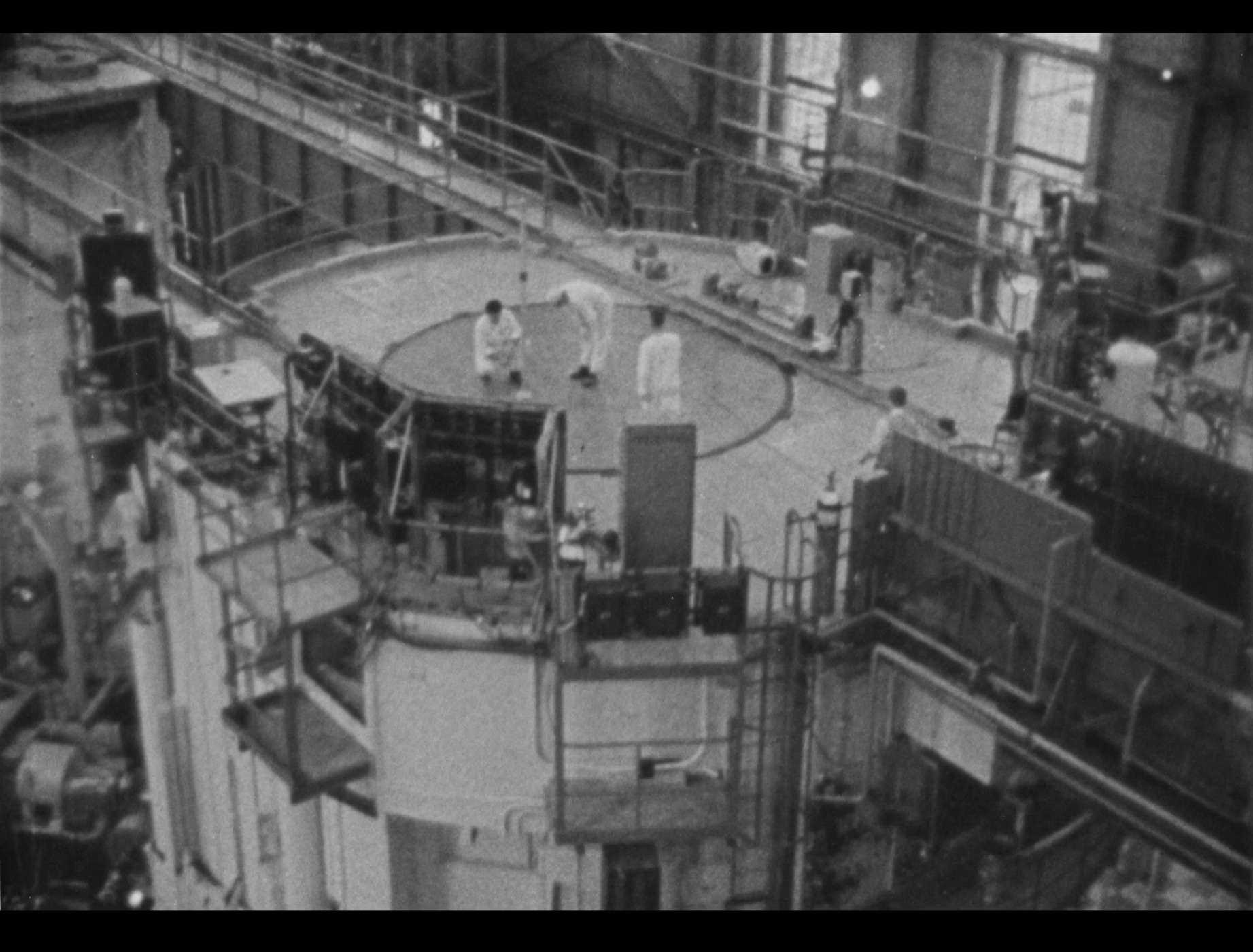
On December 12, 1952, the NRX reactor in Ontario, Canada suffered an accidental runaway. The increased power caused the fuel to heat up such that some of it melted, thereby becoming the first ever nuclear meltdown in history. Highly radioactive material spilled into the basement, and around 1 million gallons of water containing 10,000 Ci of fission products had to be disposed of. The NRX was restored and turned back on with improved safety systems and uprated power. It operated until 1993.
I recently found this film summarizing the accident and cleanups. I got it scanned, and have posted it online here.
(If you’ve heard of the reactor accident that Jimmy Carter helped with while he was in the Navy, this is it. Does anyone see young Jimmy Carter in the footage?)
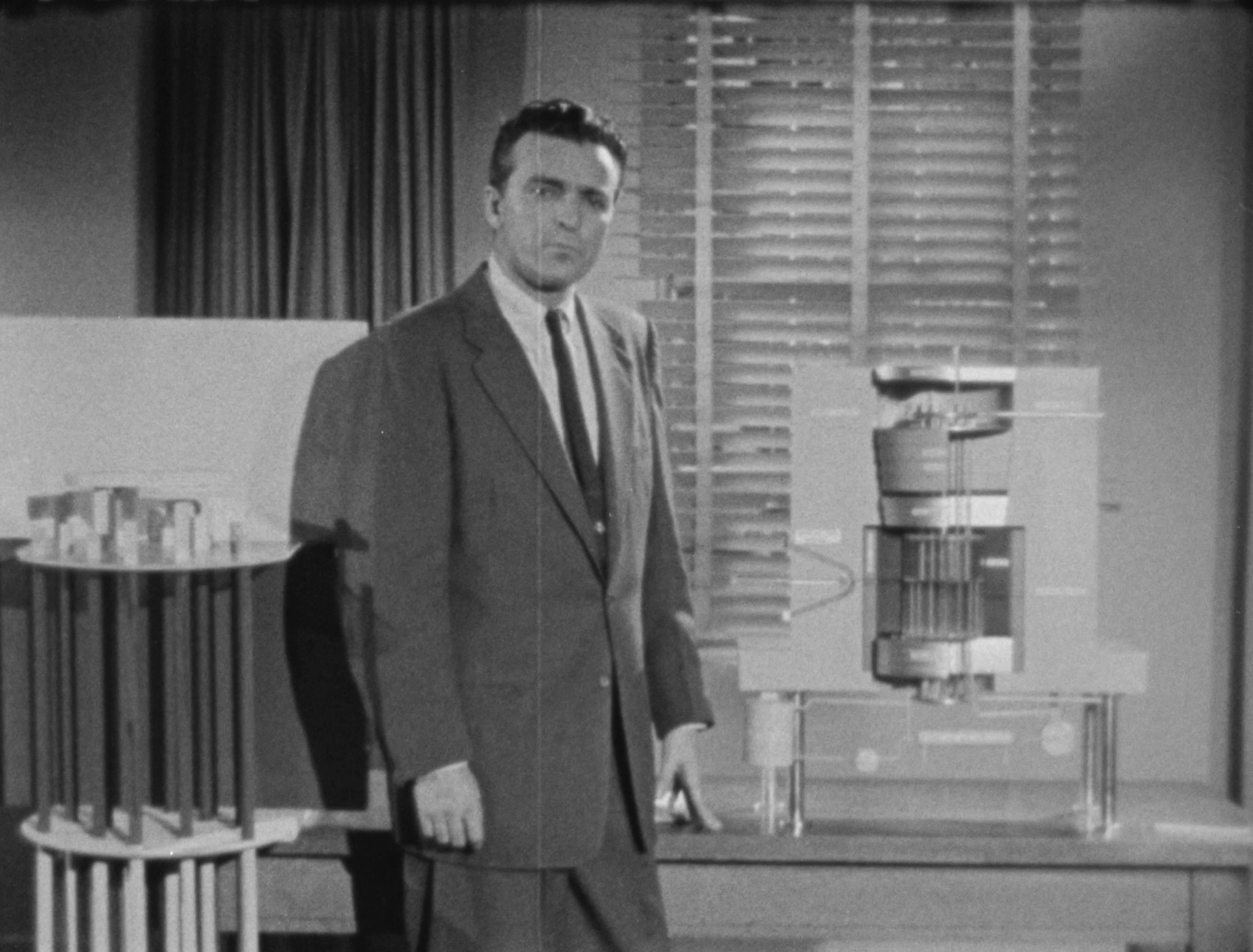
Catalog description: This film discusses the 14-month repair and restoration of the NRX Reactor at Chalk River, Ontario, following a rapid super operational power level excursion (the first nuclear reactor runaway in history) and describes the 1959 safety system of the 40-Mw reactor. Film footage made during actual restoration is supplemented by studio explanation with a reactor model. Depicted are the unusual and hazardous problems complicating repairs: high levels of radioactive contamination in work areas; continuation of water cooling on high irradiated fuel rods to prevent auto-ignition; creation of disposal facilities in subzero weather for a gross quantity of cooling water mixed with highly active fission products; corrosion-inhibiting preservation of irradiated fuel rods; decontamination of large pieces of equipment and reactor components; and rebuilding a reactor that had not been designed initially for major repair. Illustrated are unique methods and tools for locating radioactive products lodged in piping and auxiliary equipment, snaring and removing broken pieces of radioactive fuel rods, suppressing large areas of residual building contamination, and removing and decontaminating equipment, shielding, and heavy water. In addition to persons interested in nuclear reactors, the film has particular value to reactor technology and operation for assessing safety system failure and associated problems and hazards of returning a reactor to operation.
This is film 88248 in our catalog.
Show transcript
| 00:00 | In the Dominion of Canada the Province of Ontario at Chalk River the Government |
| 00:12 | of Canada established the first nuclear reactor station outside the United |
| 00:17 | States. And it was here that the famous NRX reactor began operating in 1947. The |
| 00:27 | The NRX was designed for experimental purposes, to convert normal materials into radioisotopes |
| 00:34 | and to discover better fuels for more efficient reactors. |
| 00:40 | Mechanical failure, compounded by human error, resulted in a serious power excursion in the |
| 00:47 | reactor in December of 1952, the first major runaway of an atomic reactor. |
| 00:55 | This is a film record of how the NRX was restored to operation. |
| 01:29 | There was no prototype for this kind of reactor. |
| 01:32 | Its unusual vertical configuration allows the shutoff rods to drop by gravity. |
| 01:38 | In order to get a clear idea of what went wrong, where the damage occurred, and what had to be done about it, |
| 01:46 | let's review the main components before the accident. |
| 01:51 | The diameter of the reactor is 34 feet, and it rises 30 feet above the main floor. |
| 01:59 | This inner tank, or calandria in the reactor, is made of aluminum and holds 3,300 imperial gallons of heavy water. |
| 02:06 | That's about 18 tons. |
| 02:10 | Helium gas fills the space above the heavy water. |
| 02:13 | The tank can accommodate 176 fuel rod assemblies, |
| 02:17 | each 32 feet long and containing 120 pounds of natural uranium. |
| 02:22 | Twelve shut-off rods, filled with boron carbide, |
| 02:25 | operate in sequence in banks of 4, 3, 2, 1, 1, 1, |
| 02:33 | and a steel rod filled with slugs of cadmium provides fine control. |
| 02:40 | Below the top cooling water header and master plate |
| 02:43 | are four concrete shields to reduce the radiation to biologically safe levels |
| 02:48 | and three water-cooled shields to remove heat. |
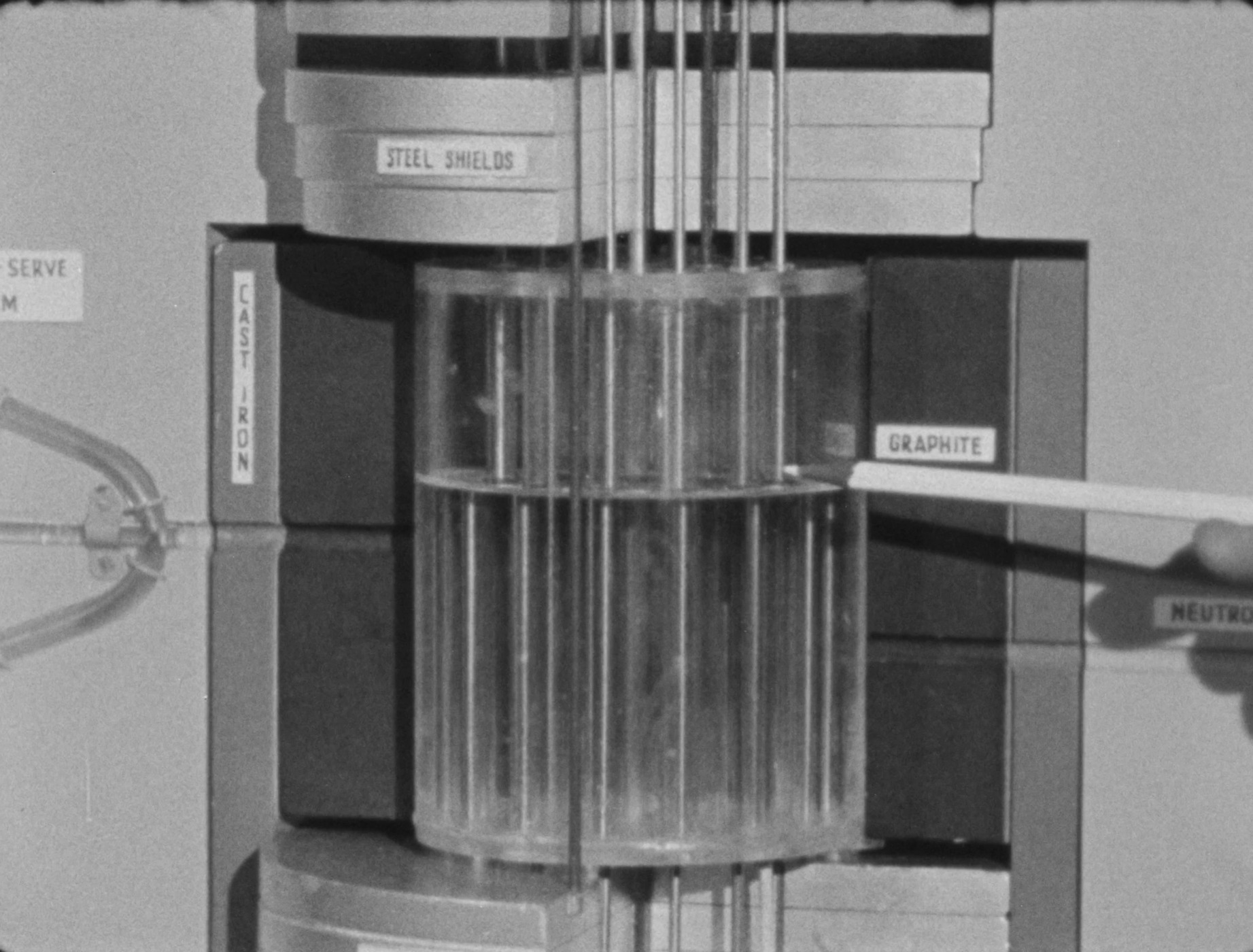
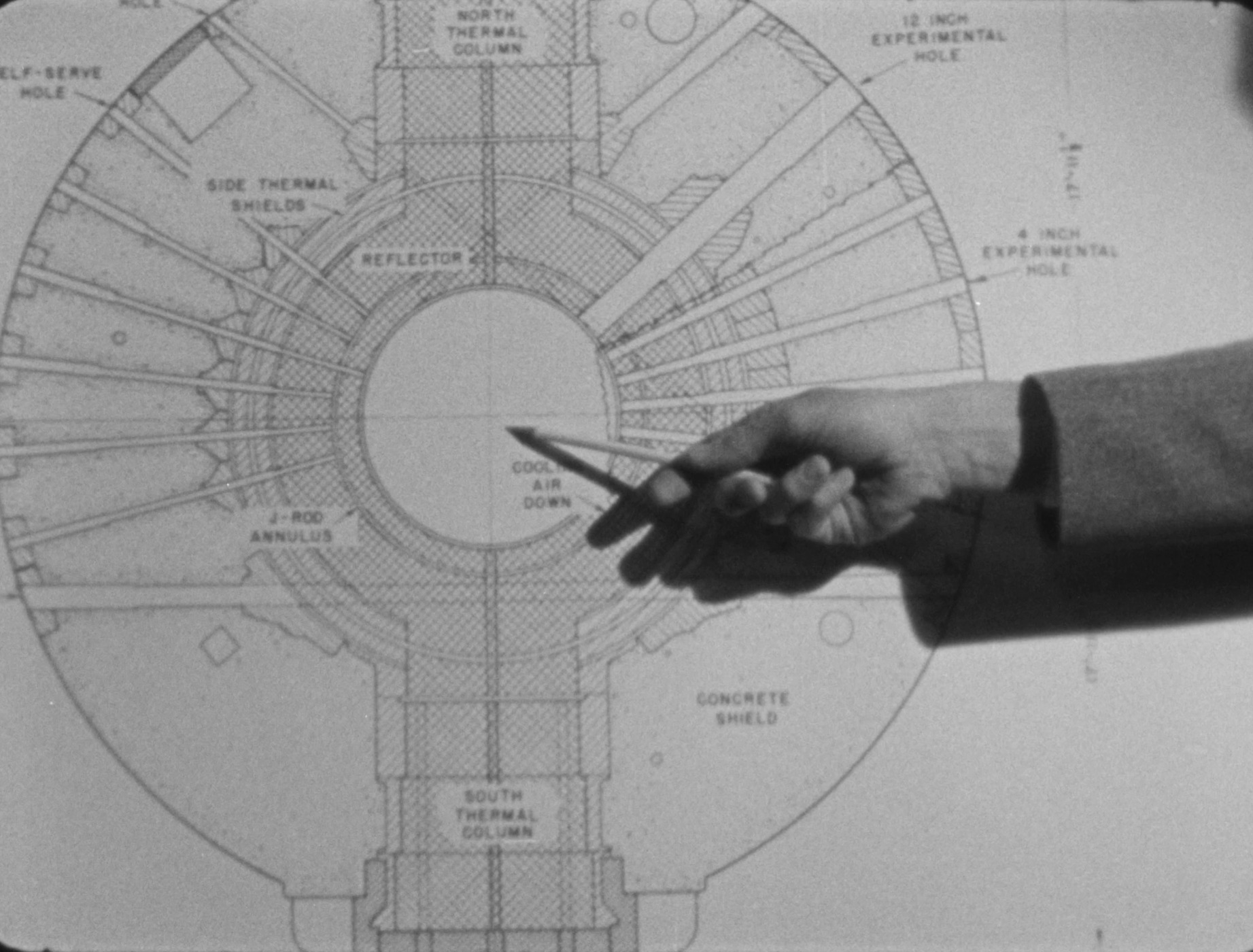
| 02:52 | Below the Calandria, there are four water-cooled steel shields, and this lead masonite shield. |
| 03:02 | Surrounding the Calandria is graphite. |
| 03:10 | This will give you a better view. |
| 03:13 | Here is the Calandria. |
| 03:15 | Nine-inch layer of graphite reflector. |
| 03:19 | Space for thorium or J-rods. |
| 03:22 | Two more feet of graphite. |
| 03:24 | Two six-inch cast iron shields. |
| 03:27 | Separated by a cooling air channel. |
| 03:29 | And finally, seven or eight feet of concrete. |
| 03:37 | The cooling water from the Ottawa River comes in through the top water header, flows in |
| 03:42 | the aluminum sheath around each uranium rod, and as warm water, goes out through the bottom |
| 03:48 | header to delay tanks outside the building, where it is held before return to the Ottawa River. |
| 03:54 | Due to an operator's error, three shut-off rods had been raised from the reactor. |
| 04:00 | Although this condition was corrected, the rods failed to drop into place. However, they did fall |
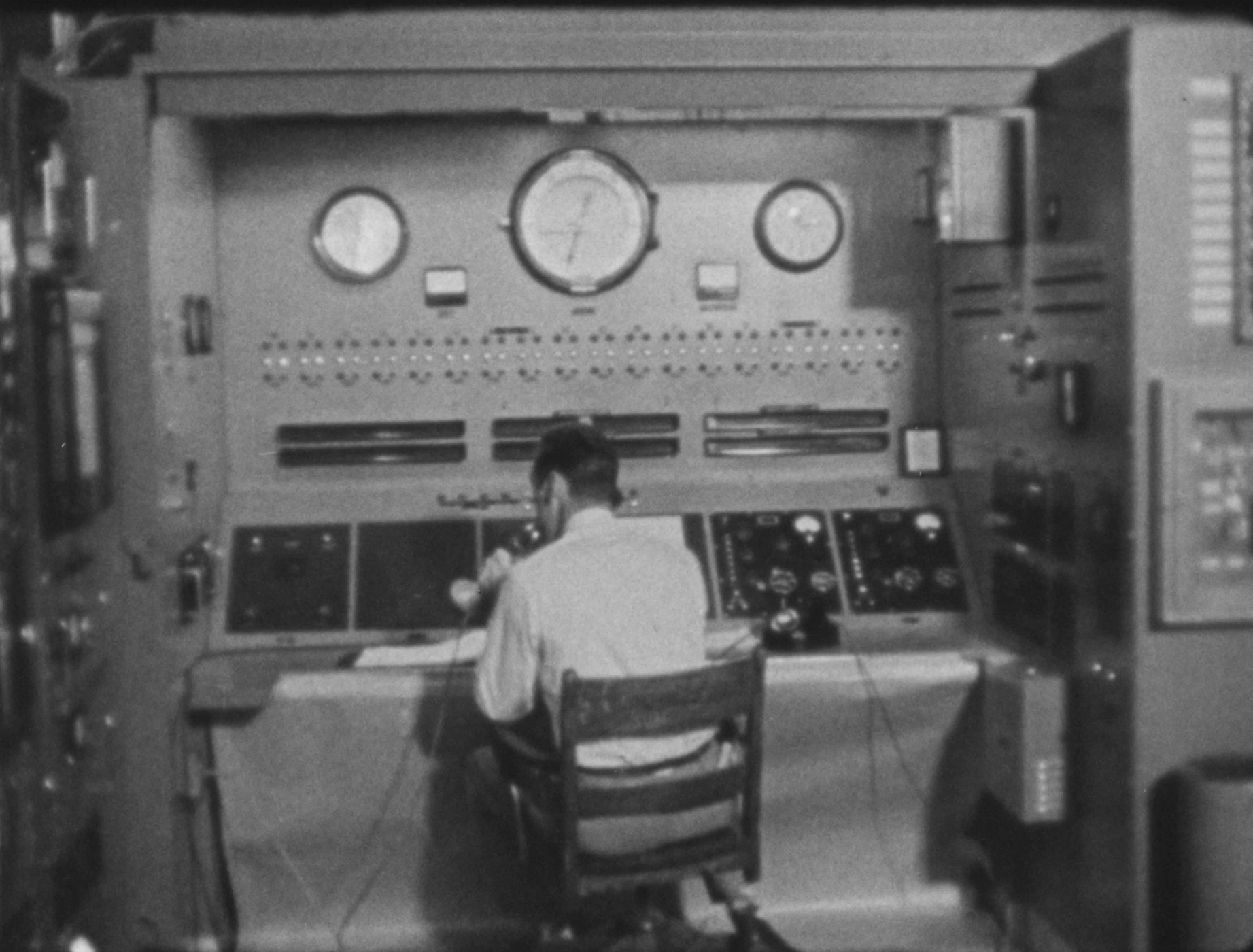
| 04:06 | sufficiently to clear the indicator lights on the panel board in the reactor control room upstairs. |
| 04:12 | Unaware of this condition, an assistant was asked to raise a bank of four rods from the reactor. |
| 04:18 | in carrying out this order the assistant by mistake failed to maintain proper air pressure |
| 04:27 | at the heads of the shutoff rods with these seven rods out of the core the reactor rose quickly |
| 04:33 | above critical the assistant scrammed the reactor but since the accelerating air to the shutoff |
| 04:39 | rods had previously been released only one rod fell slowly into place the power continued to |
| 04:47 | rise but at a reduced rate. At about 20 megawatts, the rate increased, probably because cooling |
| 04:53 | water had then boiled out of some rod channels. The heavy water was then dumped from the calandria. |
| 05:01 | The power level fell after reaching 80 megawatts. In the excursion, cladding of a number of |
| 05:09 | fuel rods as well as some uranium melted. Outer sheaths burst and a number of calandria |
| 05:16 | tubes failed. At least one of the fuel rods blew apart and uranium fused together with |
| 05:23 | aluminum in some tubes of the Calandria. Cooling water, air, heavy water, helium gas, and intensely |
| 05:36 | radioactive fuel rod material mixed together and gushed into the basement. The NRX was |
| 05:43 | not designed to provide for repairs in the event of major damage. Moreover, restoration would have |
| 05:48 | been much simpler without the presence of so much radioactivity. There were many grams of fission |
| 05:53 | products in the metal and oxide in the reactor. Months later, this material still indicated an |
| 05:59 | activity of one curie per gram. Restoration of the NRX was started under these conditions. |
| 06:05 | Cooling water had to be kept on highly irradiated rods in the reactor. Immediate consideration had |
| 06:10 | to be given to the 100,000 gallons of water collecting in the basement. Since it was highly |
| 06:15 | contaminated with long-lived fish and products, it was pumped into holding tanks. During the period |
| 06:21 | when continued cooling was required, about 1 million gallons of contaminated water containing |
| 06:26 | 10,000 curies of fish and products had to be dealt with. With storage tanks at capacity, |
| 06:34 | this pipeline had to be built in zero weather to carry water to a disposal area. |
| 06:40 | Here it seeped away through a mixture of sand and clay to a small creek where tests showed no radioactivity. |
| 06:49 | General contamination was present during removal of the steel cover plate, top water header, master plate, |
| 06:57 | four biological concrete shields, and the topmost steel shield. |
| 07:03 | The underside of the second steel thermal shield measured four Roentgens per hour in contact. |
| 07:11 | We had planned to use the third steel shield as protection for the workman during removal of damaged rod from the calandria. |
| 07:18 | It proved to be difficult to cut holes through this steel shield. |
| 07:23 | So it was removed, covered with a tarpaulin and buried at the disposal area. |
| 07:31 | Since the calandria had to be replaced, different methods of removing the damaged fuel rods were tried. |
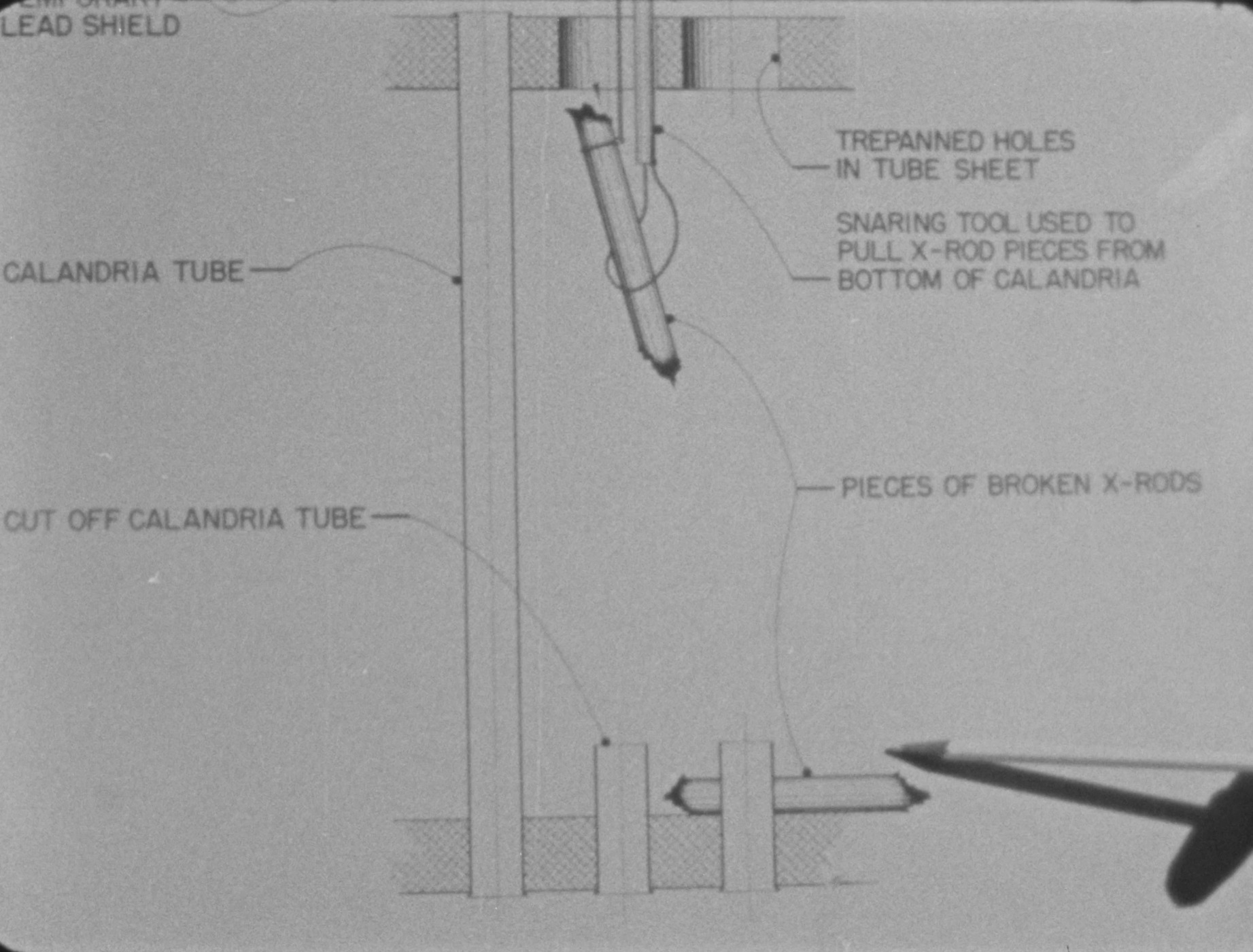
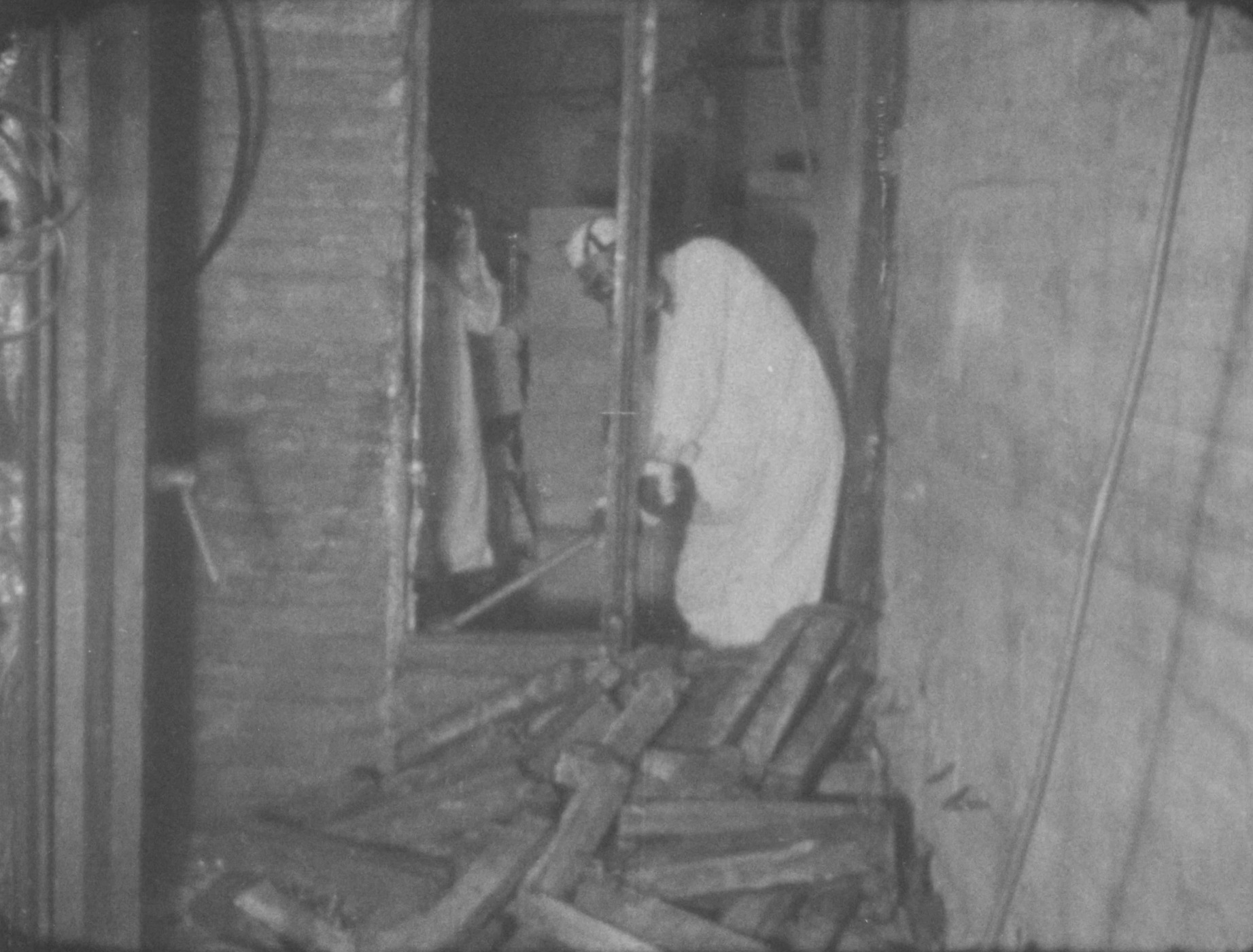
| 07:46 | Using this temporary lead shield as a protection for the workmen, we trepanned the top tube sheet. |
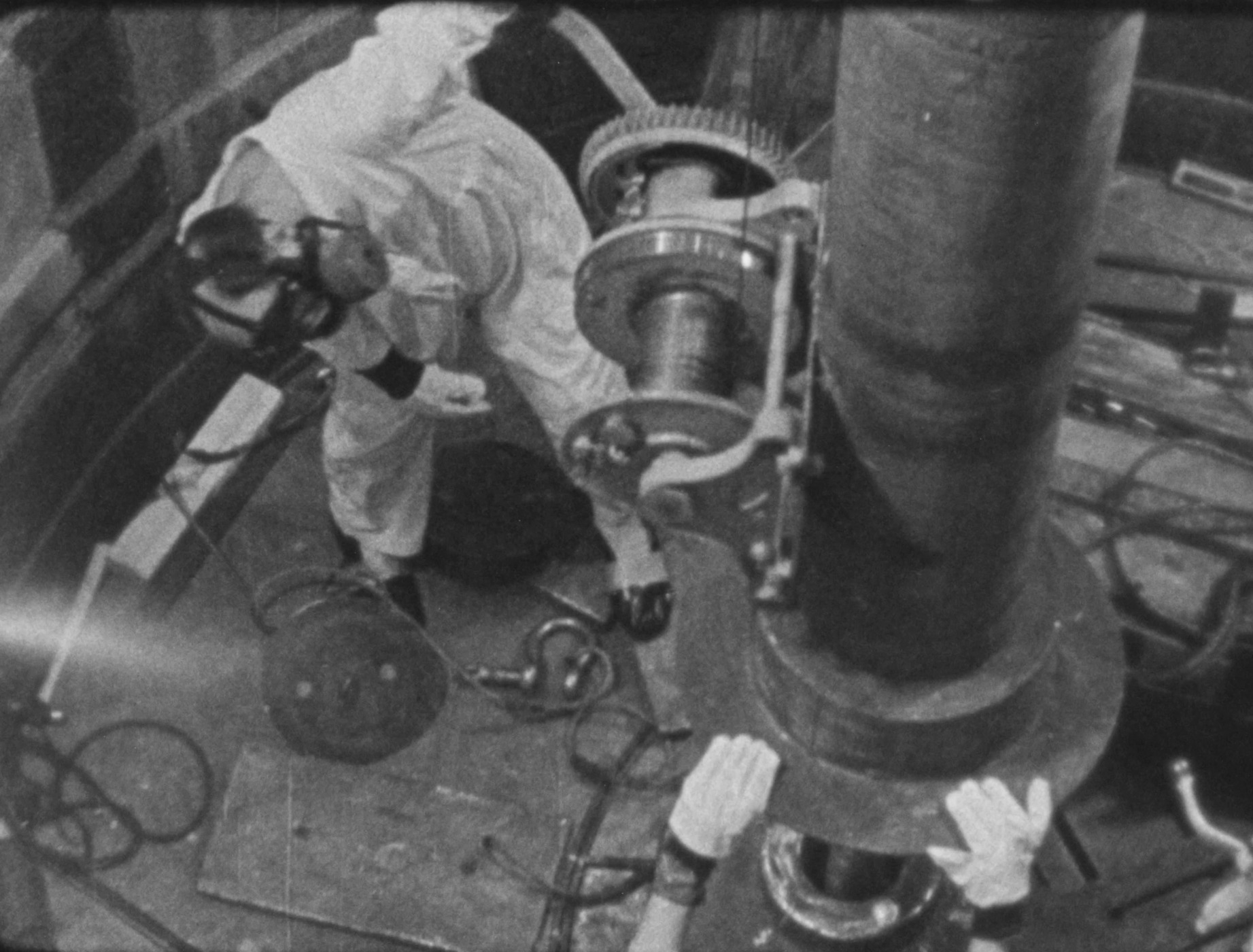
| 07:54 | With this cutting tool and tube clamping device, the plan was to cut the calandria tube three |
| 08:06 | inches from the bottom tube sheet. |
| 08:09 | This was to prevent the highly irradiated material in the bottom of the calandria from |
| 08:13 | spilling into the basement. |
| 08:16 | It didn't work out as planned. |
| 08:19 | The uranium fuel rod and aluminum calandria tube had fused together. |
| 08:24 | cutting tool had not cut through the fuel rod, and this device pulled the fused rod |
| 08:29 | and calandria tube forcibly from the bottom tube sheet. Contamination spilled into the |
| 08:34 | basement. When that happened, this clamping tool was designed to pull the remainder of |
| 08:43 | the damaged rods and tubes bodily from the bottom tube sheet. Fish and products falling |
| 08:48 | into the basement were no longer a consideration. |
| 08:55 | And with this arrangement, we snared a number of active pieces of uranium lying on the bottom |
| 09:01 | tube sheet. |
| 09:04 | Damaged rods and active pieces were pulled from the calandria into this flask for shielding |
| 09:09 | before disposal. |
| 09:11 | The bottom water header had been removed, and after the damaged rods were taken out |
| 09:16 | of the calandria, the lead masonite shield was lowered and removed through the basement. |
| 09:21 | Supporting rods were attached to the shield up through the calandria where the overhead |
| 09:25 | crane lowered it. A high-pressure water hose was then used to flush the calandria of all |
| 09:33 | the bits and pieces which could not be snared. These went into a tray located in the space |
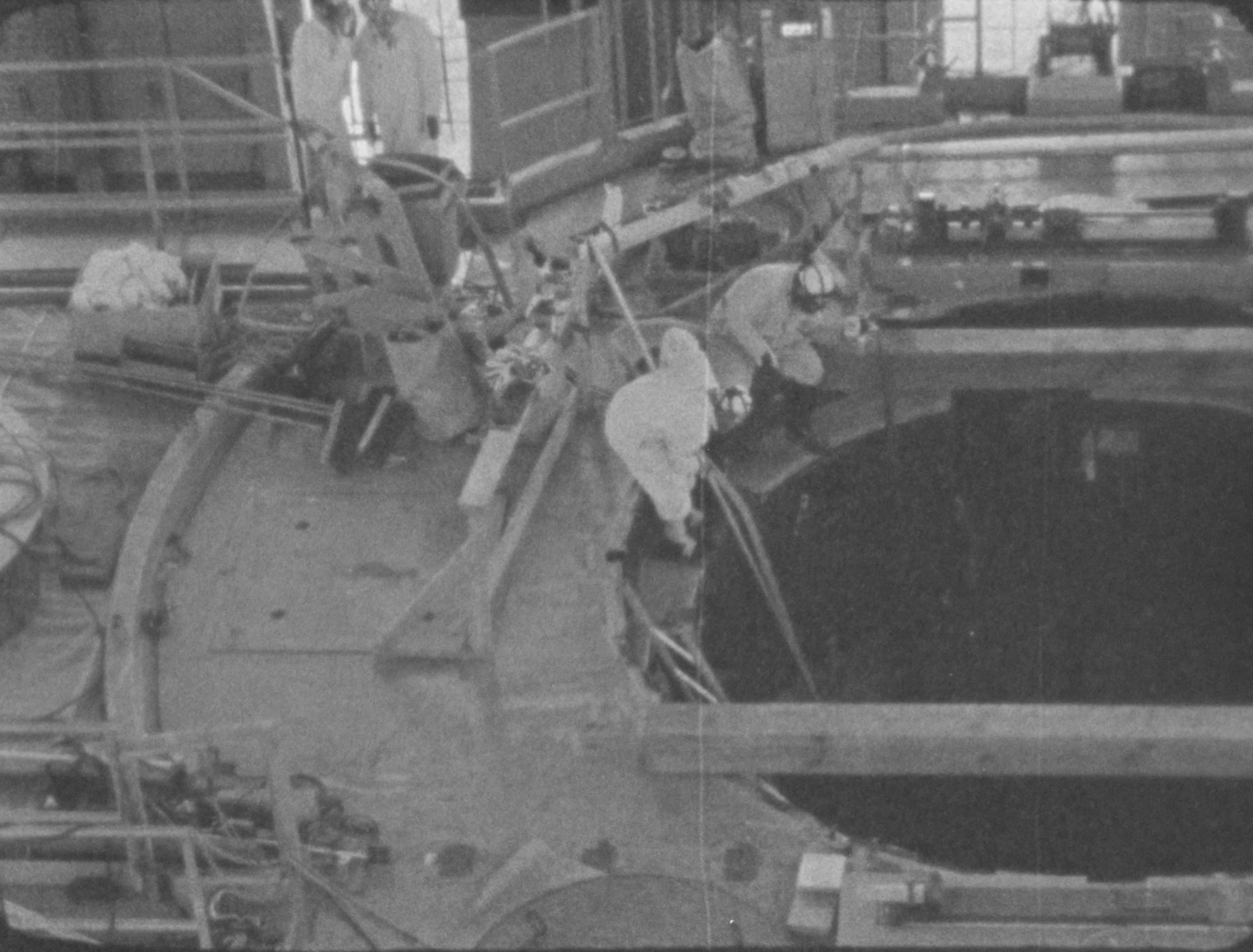
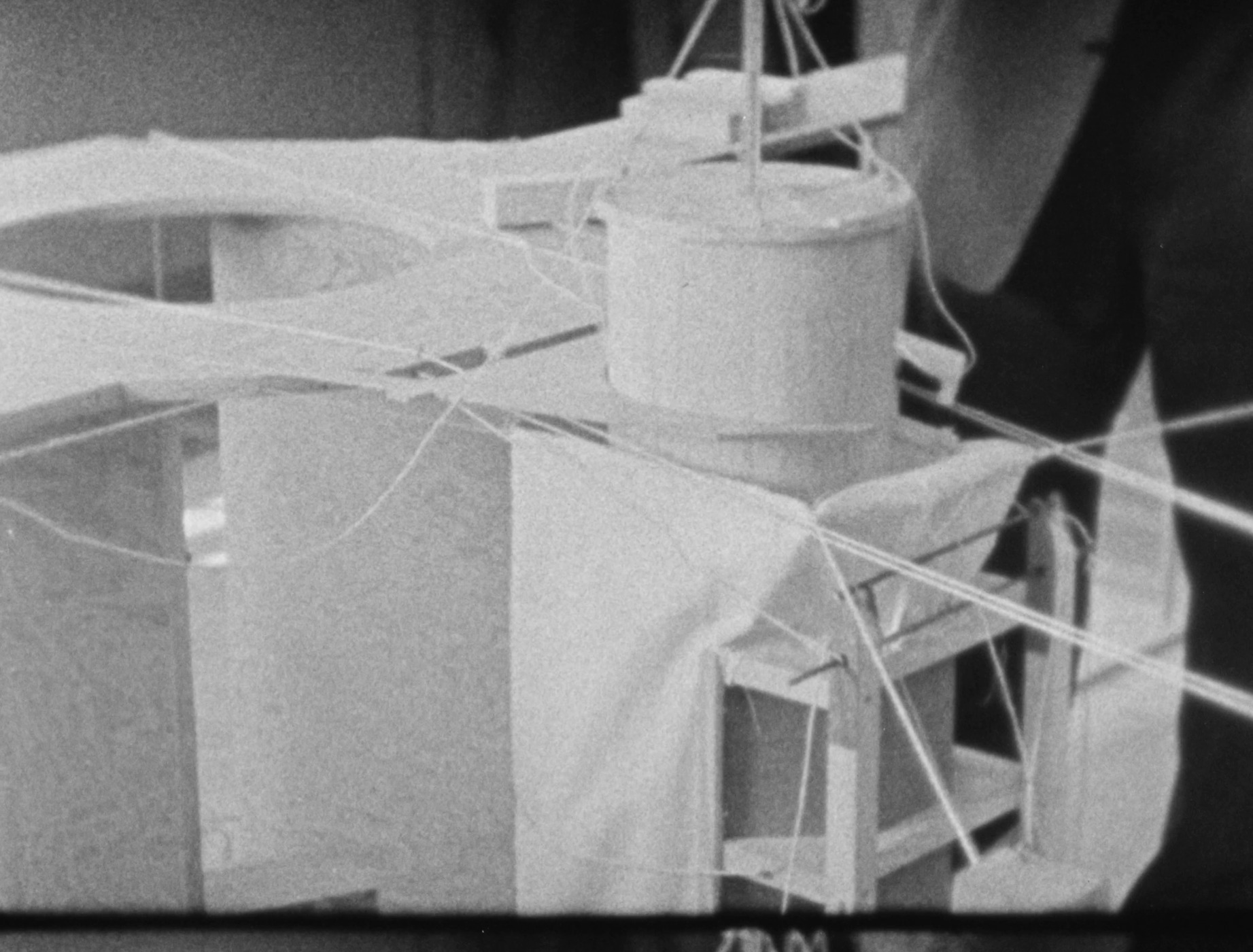
| 09:37 | below. To remove the calandria, 70 men were briefed with a scale model in |
| 09:45 | plywood. The procedure was rehearsed several times until each staff member |
| 09:49 | knew exactly what he had to do. Engineers were not satisfied that the training |
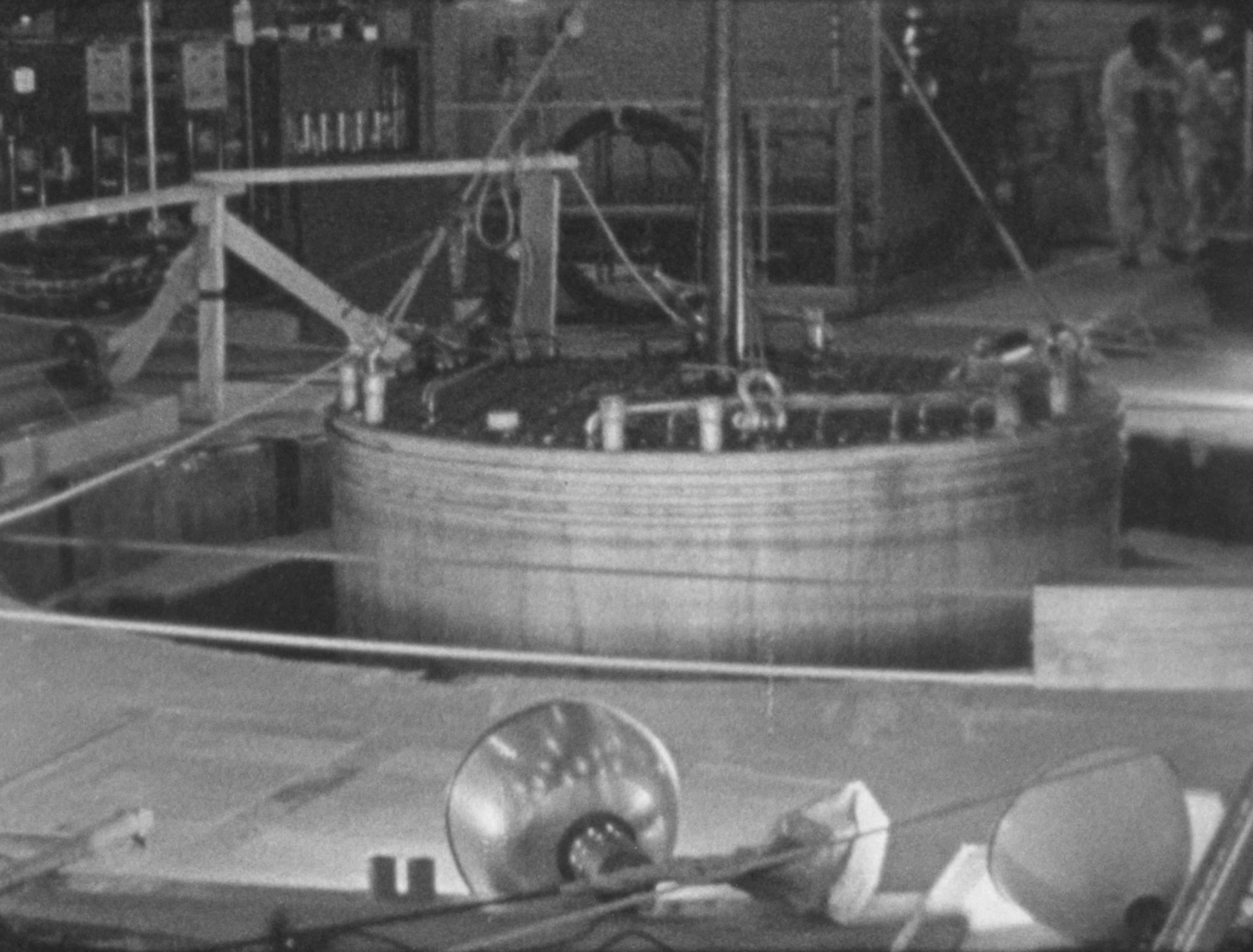
| 10:00 | with the plywood model was sufficient. A steel dummy of the same diameter was |
| 10:04 | made and filled with sand to the gross weight of the calandria. The dummy run |
| 10:09 | was made the night before removing the actual calandria. A practice run will |
| 10:14 | turn up errors such as these workmen standing near the dummy. This type of |
| 10:19 | training is recommended in a hazardous undertaking such as this where the real |
| 10:23 | calandria measured 100 renkins to 300 renkins per hour in contact. The actual |
| 10:33 | operation began the next day. An announcer in the reactor control room |
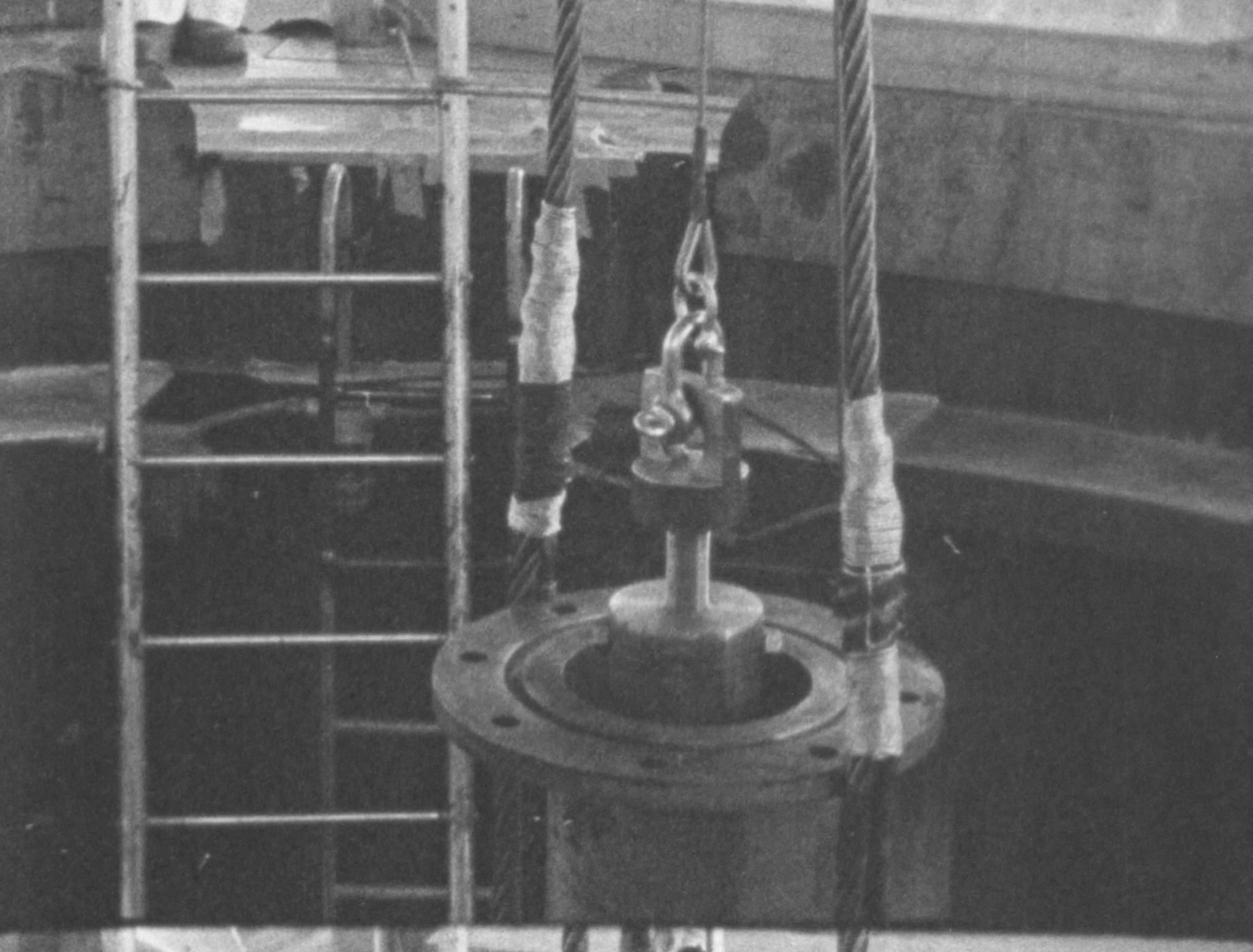
| 10:37 | called out each of the 28 steps involved in the removal. The lifting jig was |
| 10:42 | lowered. Dogs attached to the top tube sheet at the calandria and the stained |
| 10:47 | tank rose above the reactor structure. The lift was halted for four minutes to |
| 10:52 | take photographs and radiation measurements. We wanted particularly to |
| 10:56 | find out the condition of the expansion joint in the calandria. Photos showed it |
| 11:00 | be in good condition. The crane operator was about 75 feet away protected by a shielded cab. |
| 11:06 | He could not see the calandria and had to be guided by signals. He resumed the hoisting and |
| 11:12 | easily managed the radioactive calandria through the guide ring and onto the skid below just as |
| 11:18 | had handled the dummy the evening before. |
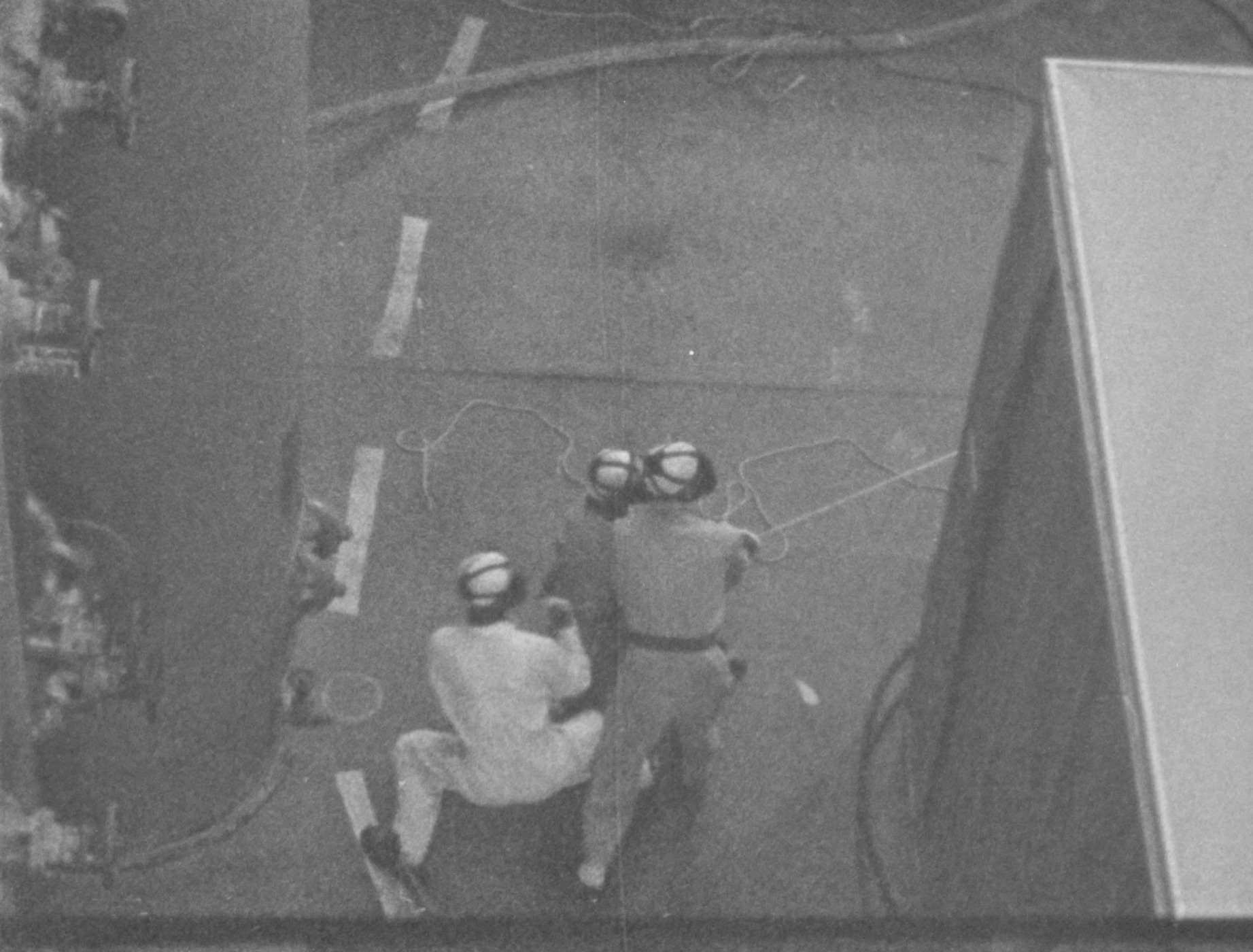
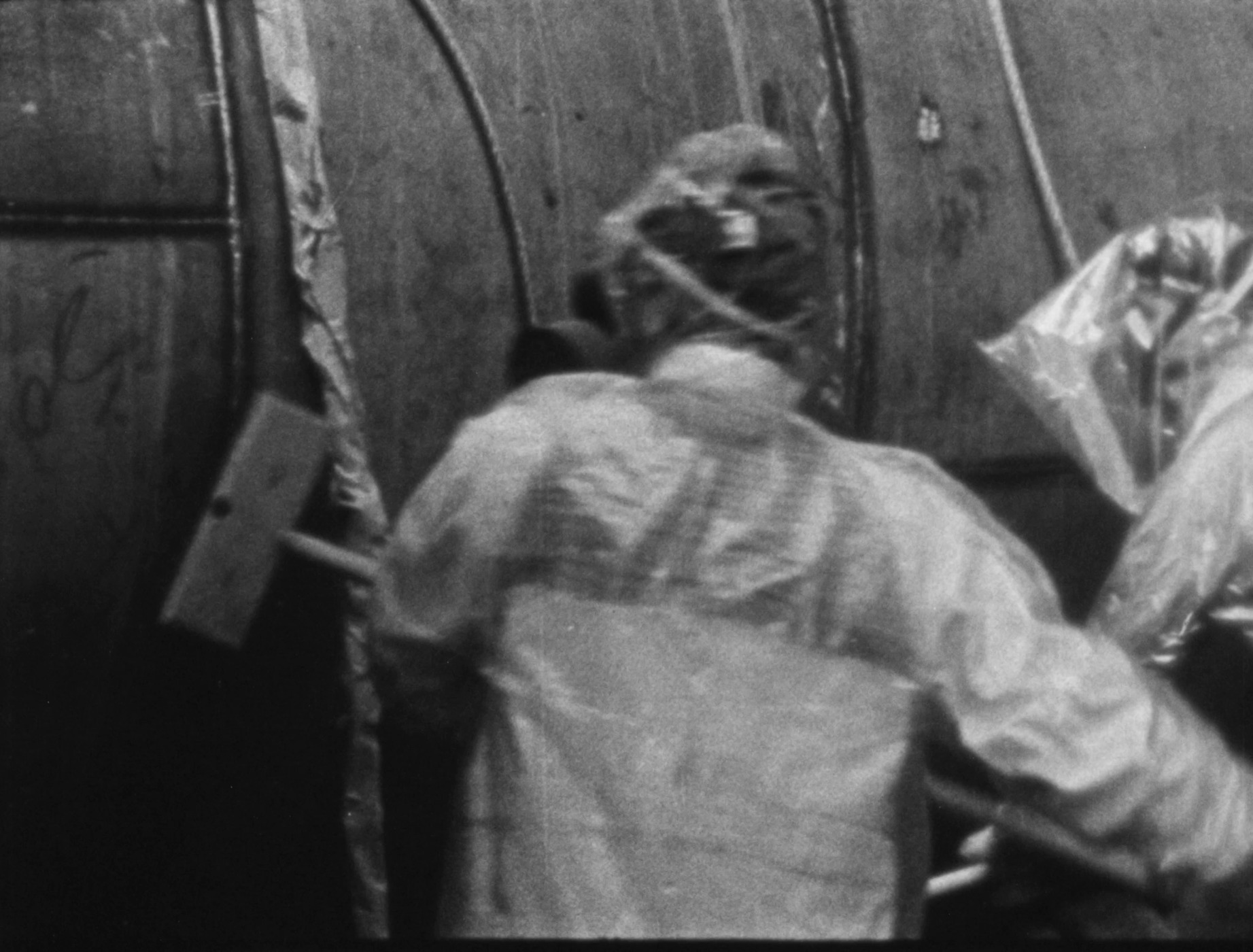
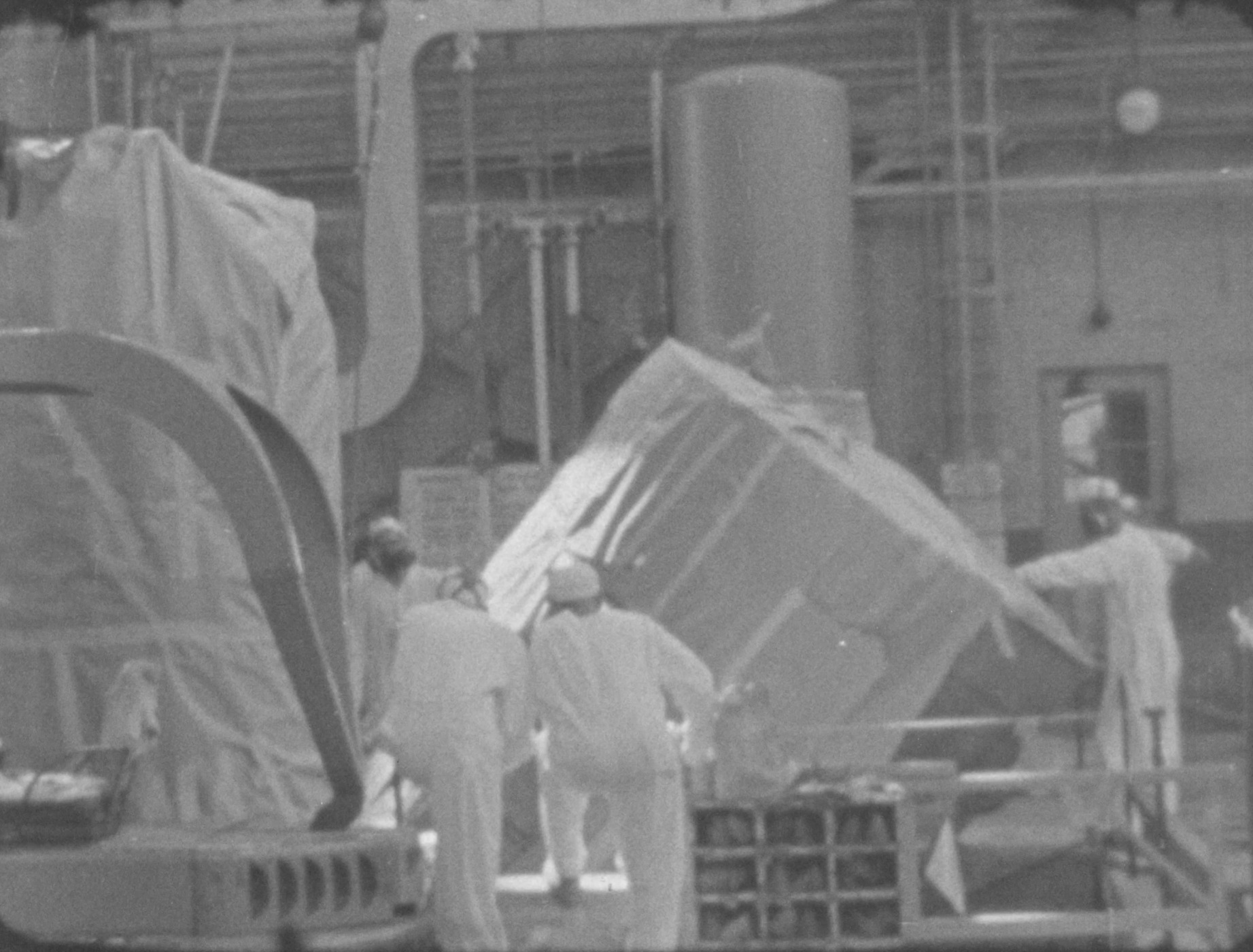
| 11:29 | Workmen shielded behind blocks of concrete, pulled draw ropes to enclose the calandria |
| 11:35 | and decrease the spread of radioactivity. |
| 11:38 | The yoke was lowered to back the crane hook off the attachment to the lifting jig, then |
| 11:42 | the calandria was lowered to the horizontal position. |
| 11:45 | The skid supporting the calandria was attached to a road grater, equipped with a lead shield to protect the operator. |
| 11:52 | A long blast of the plant whistle warned men on duty that the calandria was being towed out through the plant. |
| 11:58 | As this procession went by these buildings, continuous radiation measuring instruments went completely off scale. |
| 12:03 | The usually well-guarded main gate was strangely unattended and wide open as the calandria moved to the disposal area. |
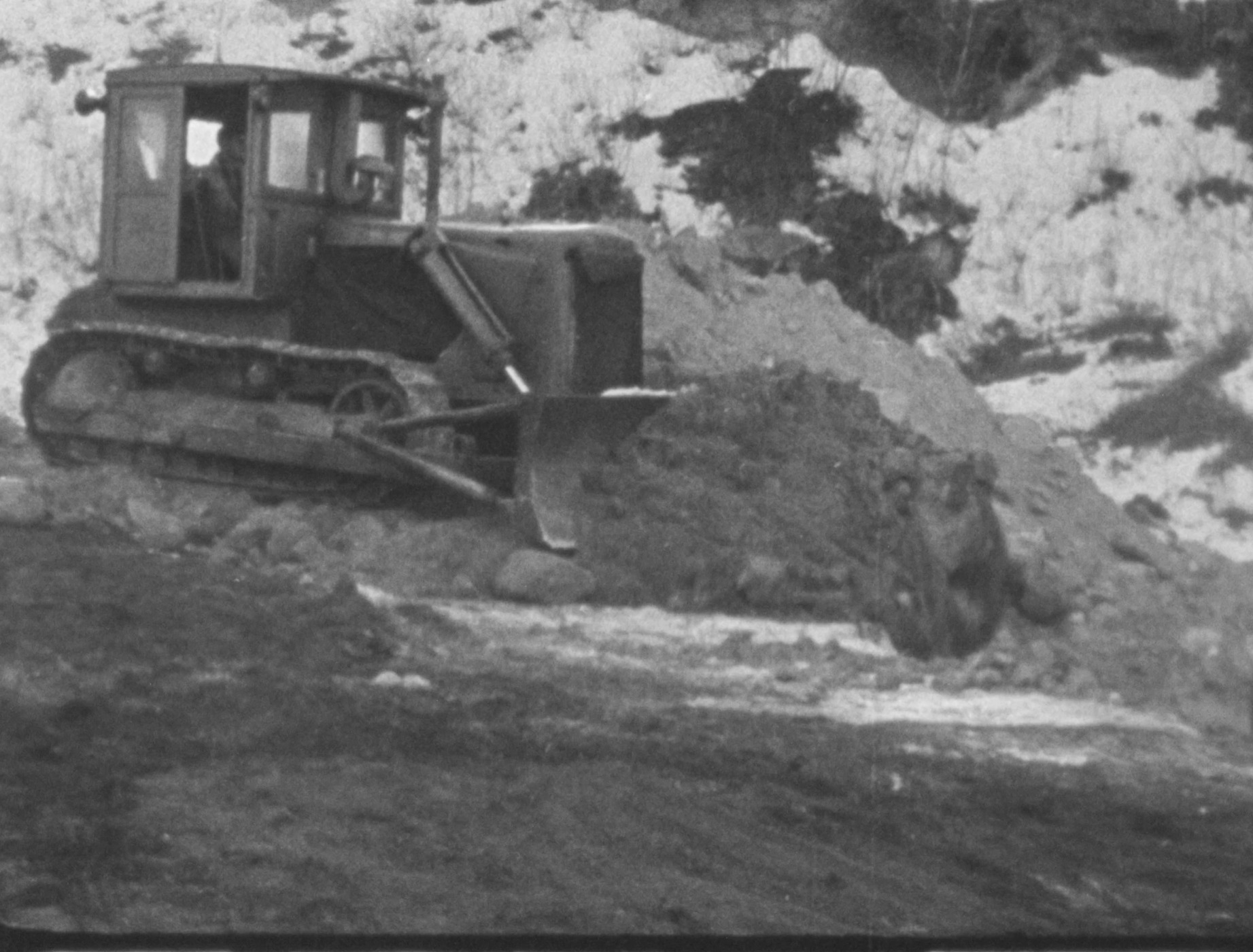
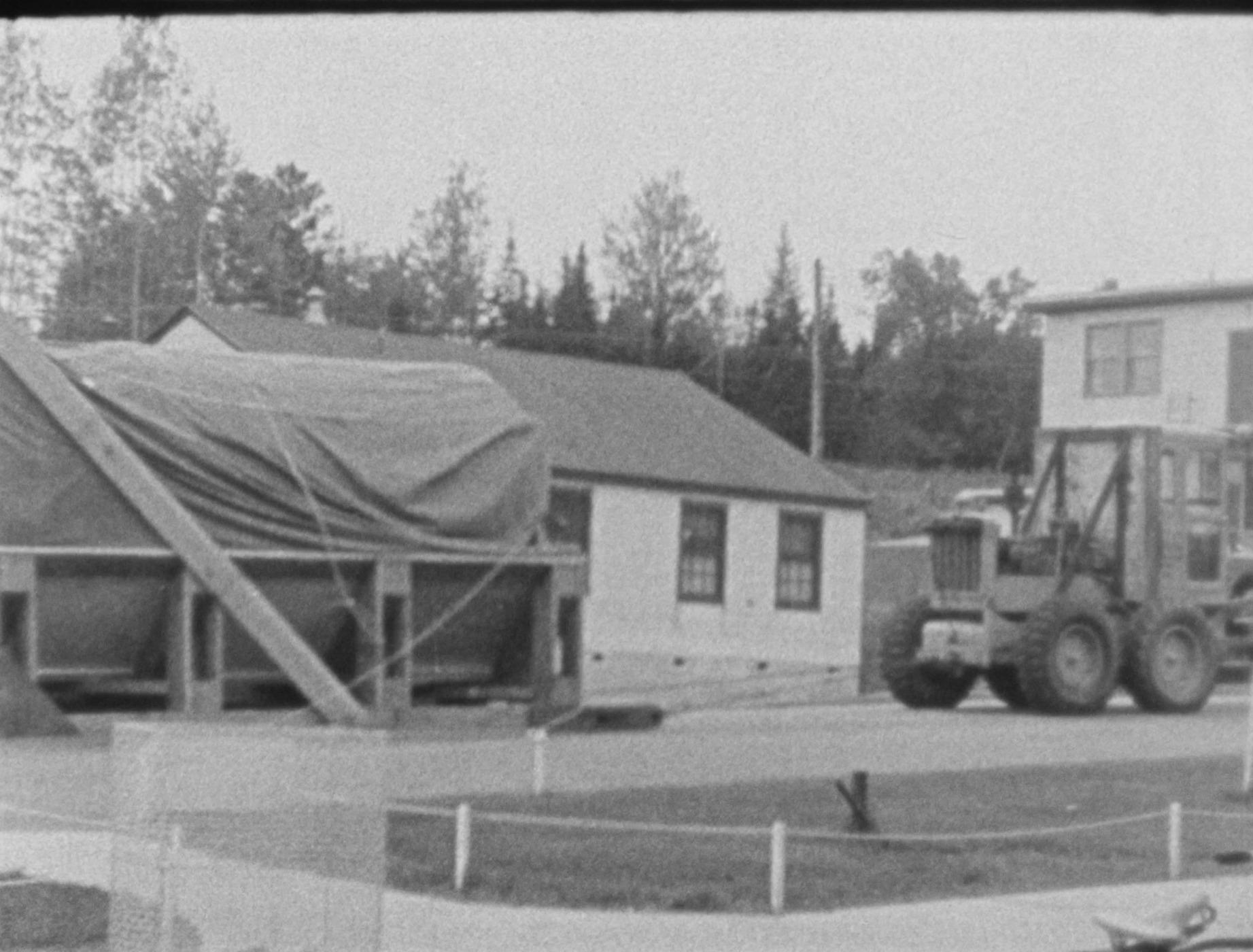
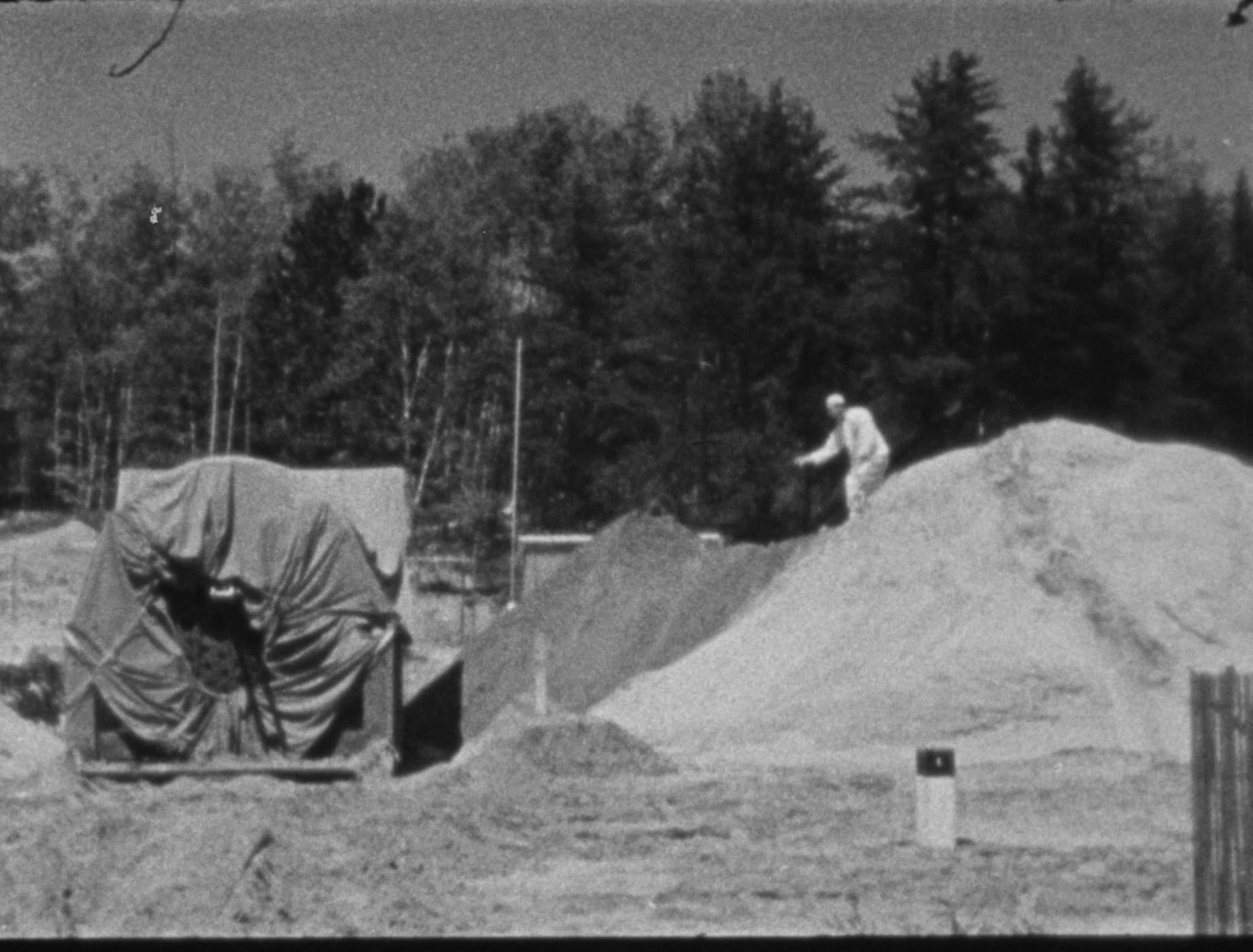
| 12:09 | The calandria was placed in a slot in the sand and covered completely except for one end facing |
| 12:17 | the woods. This end was left exposed so we could later take samples of the aluminum tube sheet for |
| 12:23 | study and research. Some water remained in the calandria when it was removed. On the way to the |
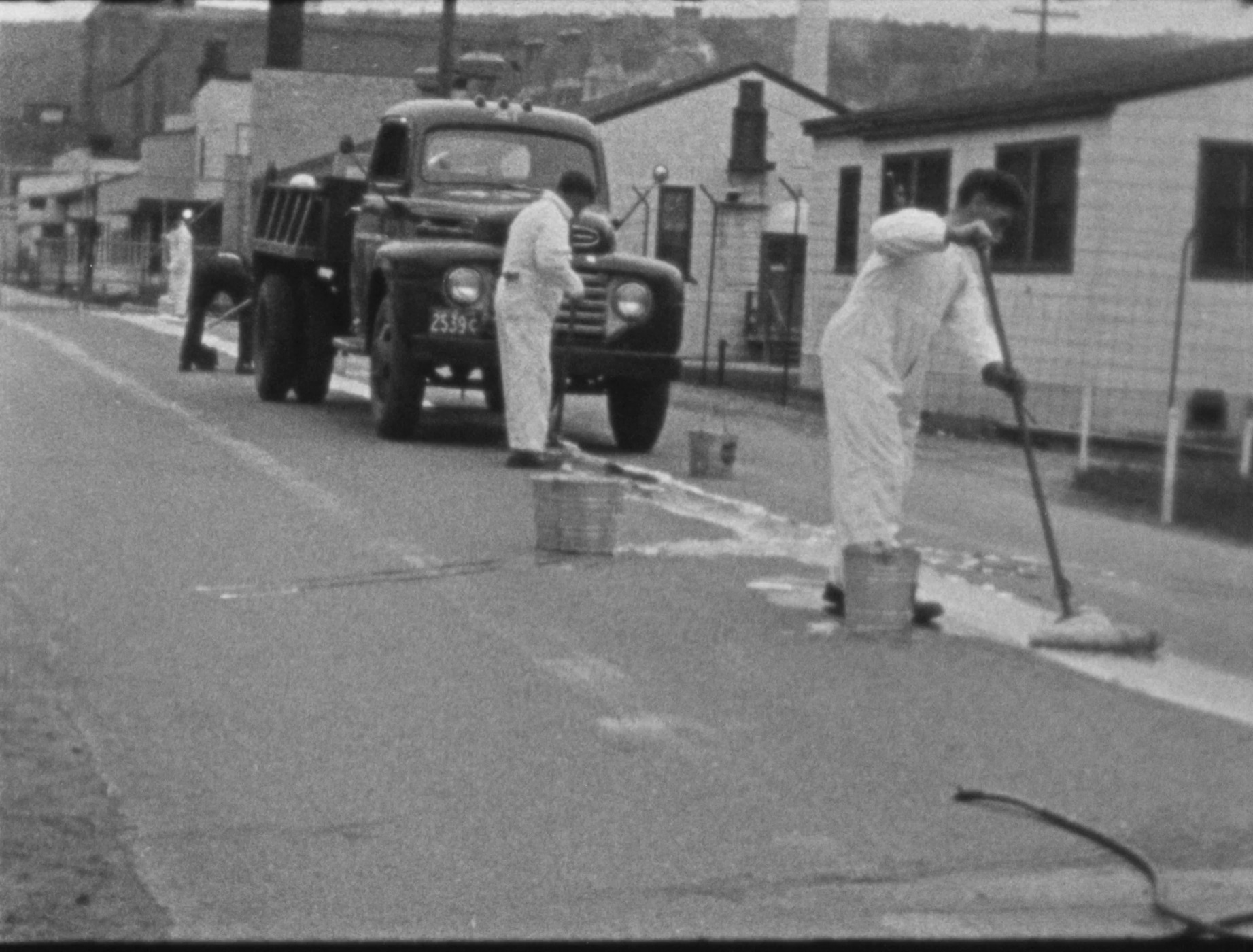
| 12:31 | disposal area, some of this leaked out through the tarpaulin around the calandria. These workmen |
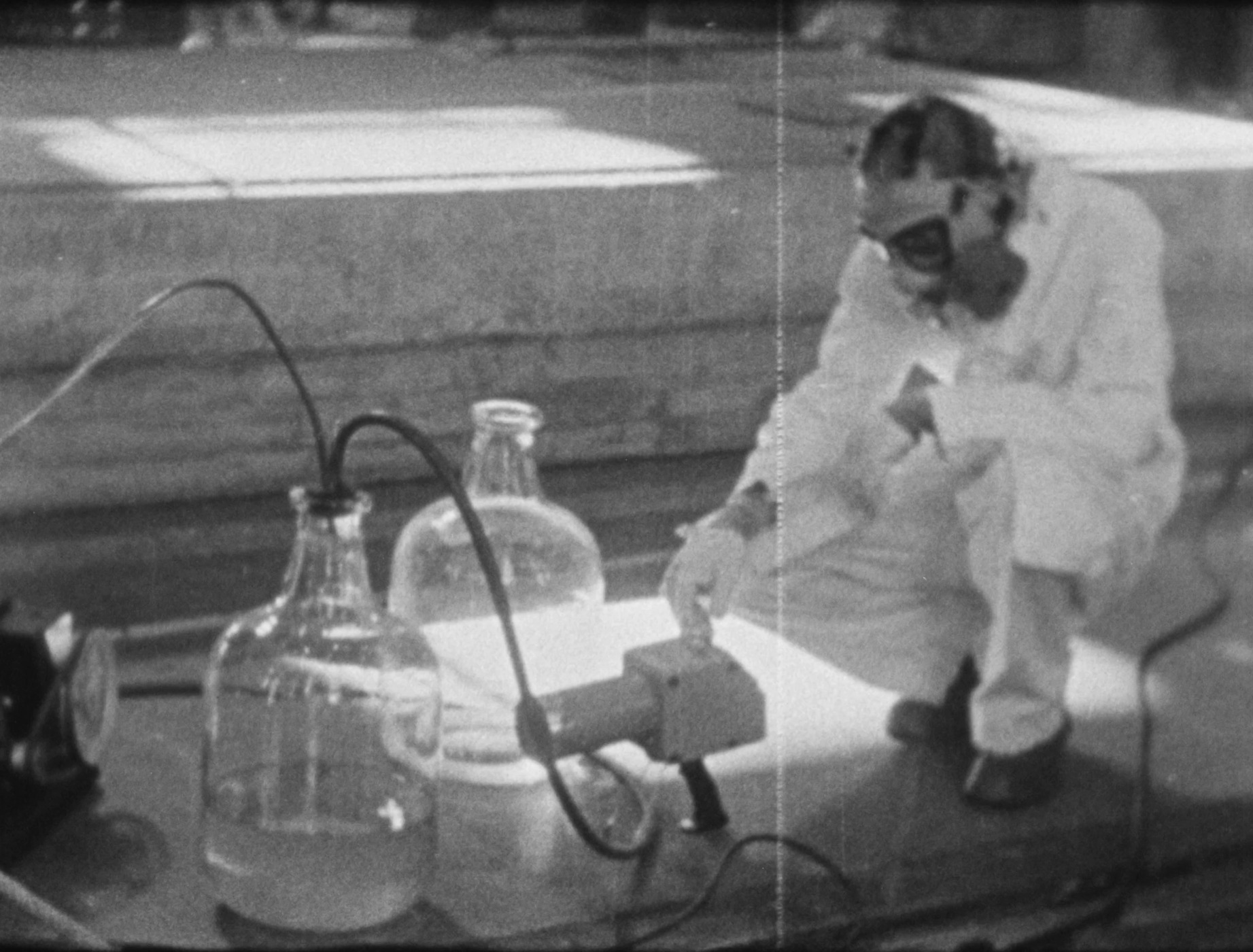
| 12:38 | scouring flushing and monitoring the road to make sure all the radioactive contamination is removed |
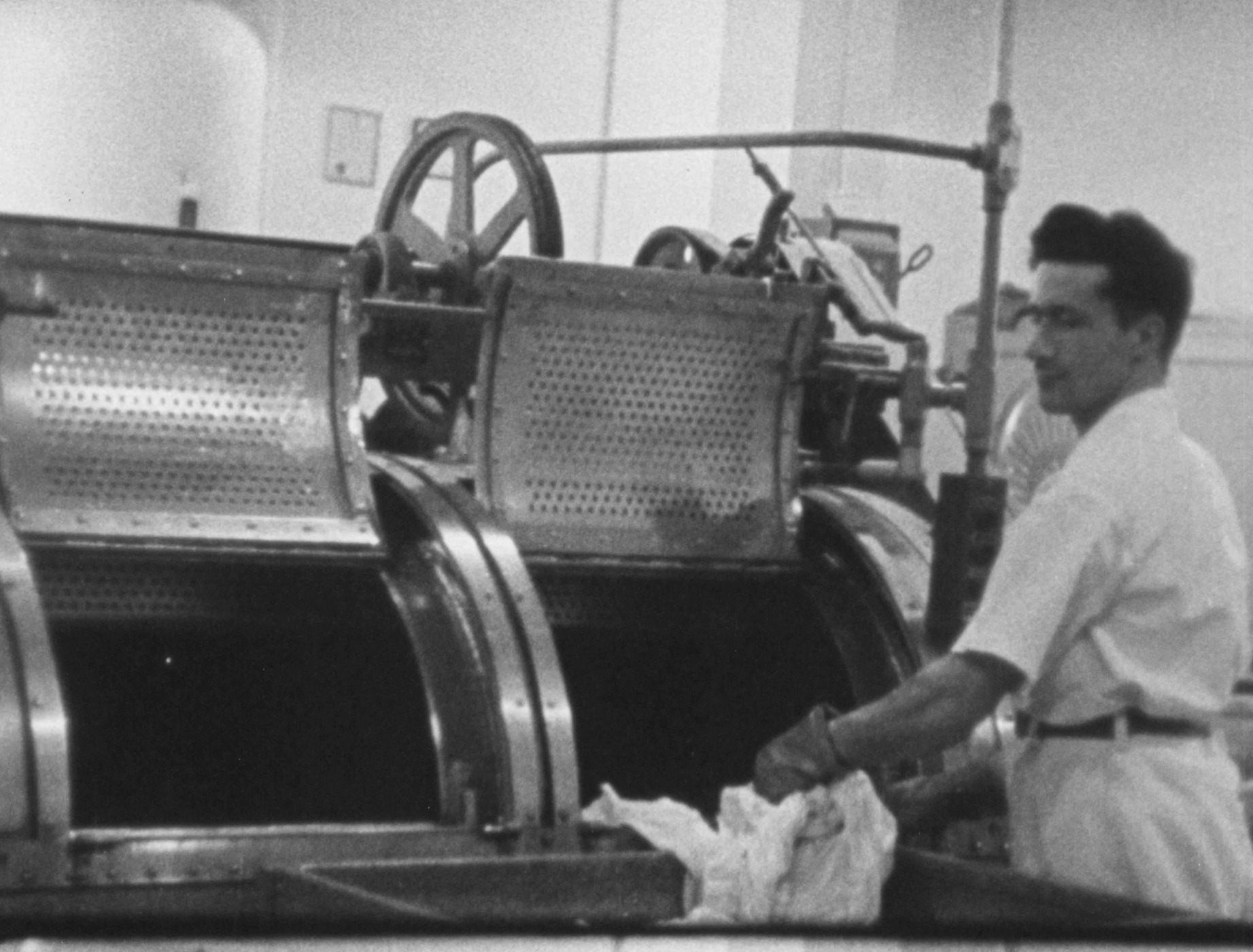
| 12:48 | laundering became a major problem during the dismantling of the reactor |
| 12:53 | every item of apparel had to be completely sorted cleaned and checked |
| 12:57 | for residual contamination before it was returned to service clothing costs in the first five days |
| 13:04 | after the accident went up by a factor of 20 times. |
| 13:08 | Later these costs were reduced to about twice the usual level |
| 13:12 | by adopting better methods of handling. |
| 13:19 | Throughout the dismantling of the reactor each piece was decontaminated |
| 13:23 | after it was removed. A large concrete pit adjacent to the reactor called the |
| 13:27 | swimming pool was used to decontaminate large pieces |
| 13:30 | of equipment. A temporary shelter with a removable top |
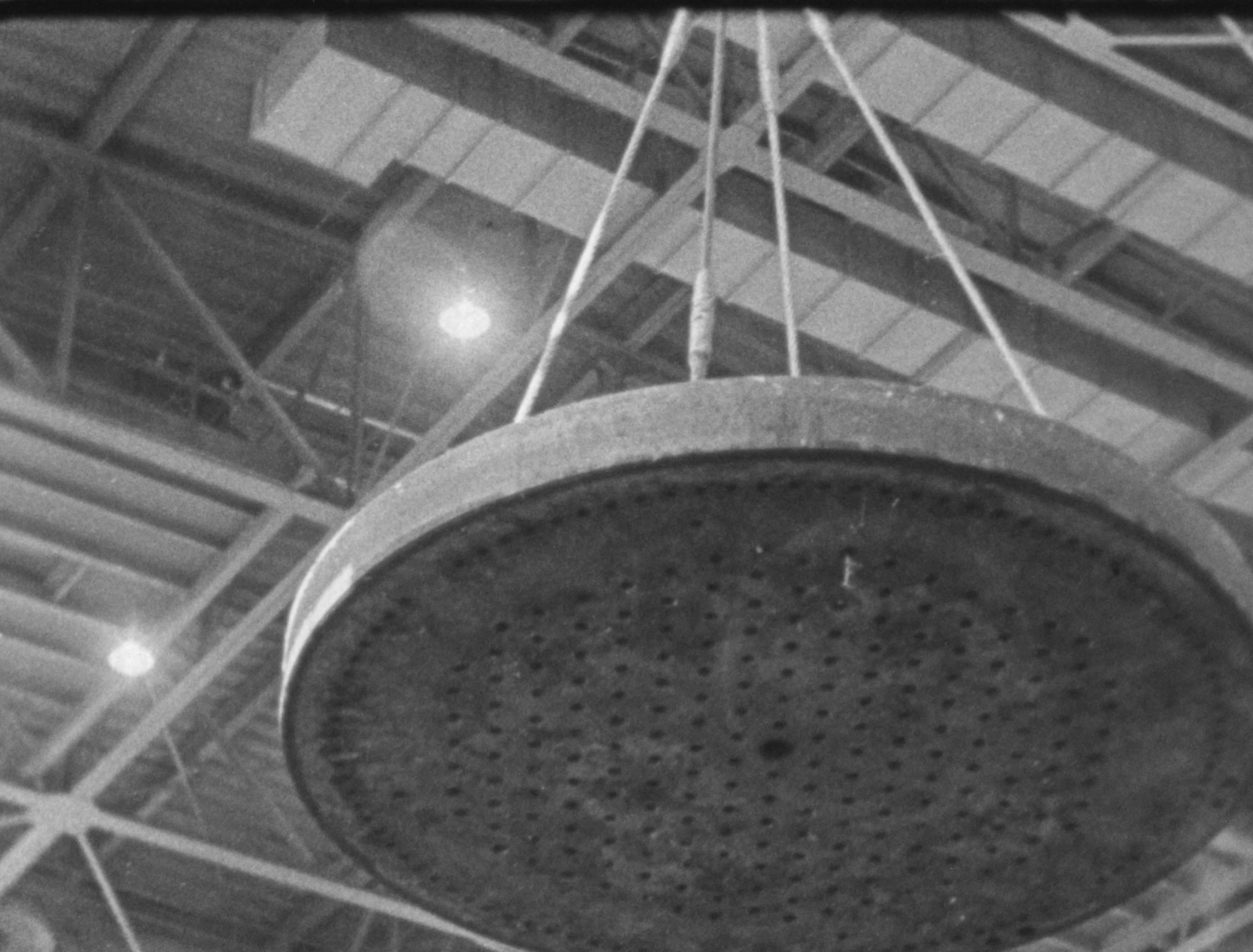
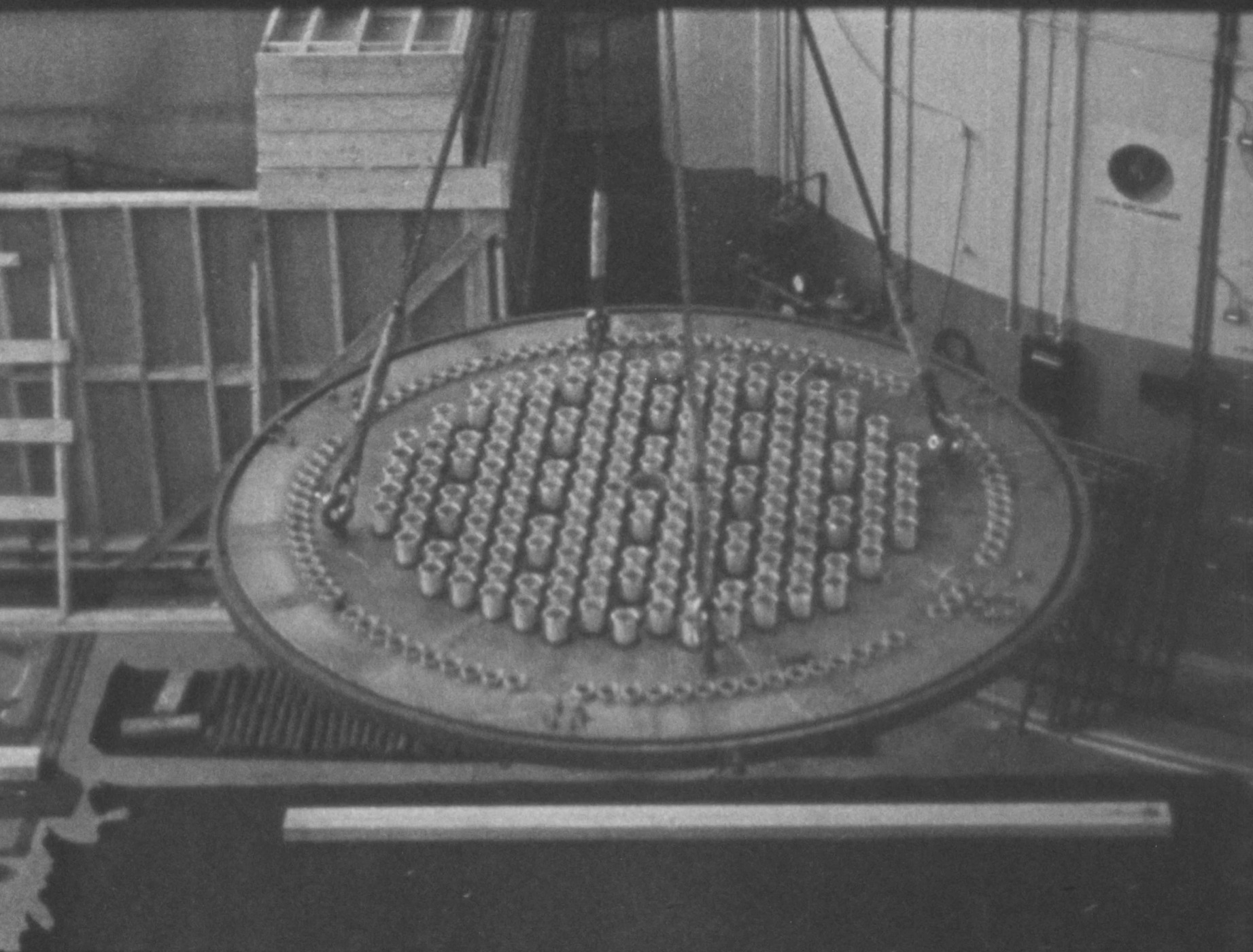
| 13:34 | over the pit allowed these large pieces to be handled by crane. This is the master plate |
| 13:39 | coming up from the swimming pool. Heavy water which had been dumped into the storage tank, |
| 13:48 | including some that had overflowed into the helium gas holder during the accident, was |
| 13:52 | removed and decontaminated by the use of ion exchange resins. The heavy water cooler, pump, |
| 14:04 | storage tanks were also removed and decontaminated. The concrete floor and |
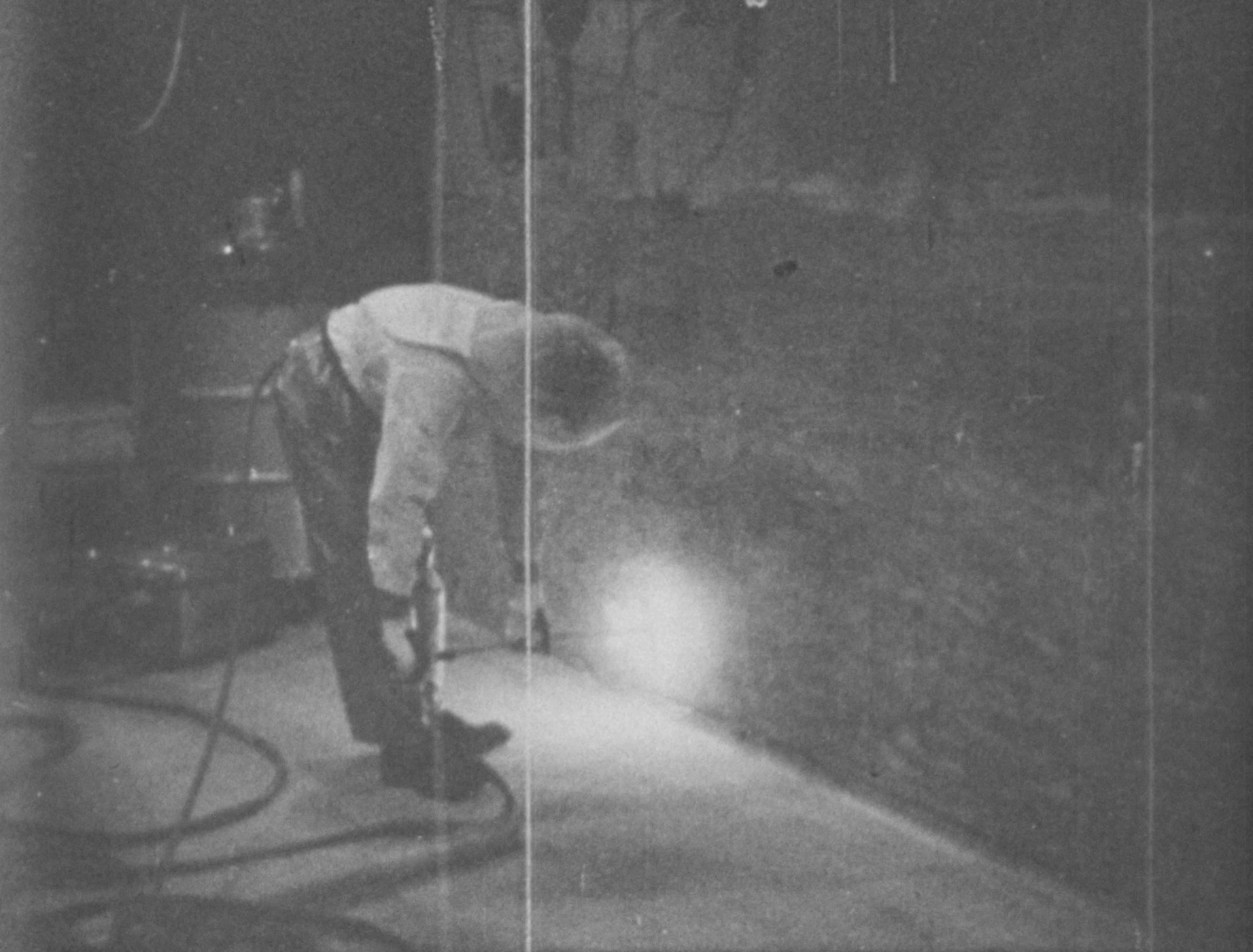
| 14:12 | walls under the reactor were heavily contaminated. Whenever possible this |
| 14:16 | concrete was flame primed before chipping, grinding, and sandblasting. It |
| 14:21 | was found that contamination was much easier to remove when the concrete was |
| 14:26 | dry rather than wet. Each device has a vacuum attachment to carry off the dust |
| 14:32 | and grit, and workmen are still wearing respirators. Generally, removing a half inch of concrete |
| 14:38 | eliminated the radioactivity. However, in the basement where activity remained after |
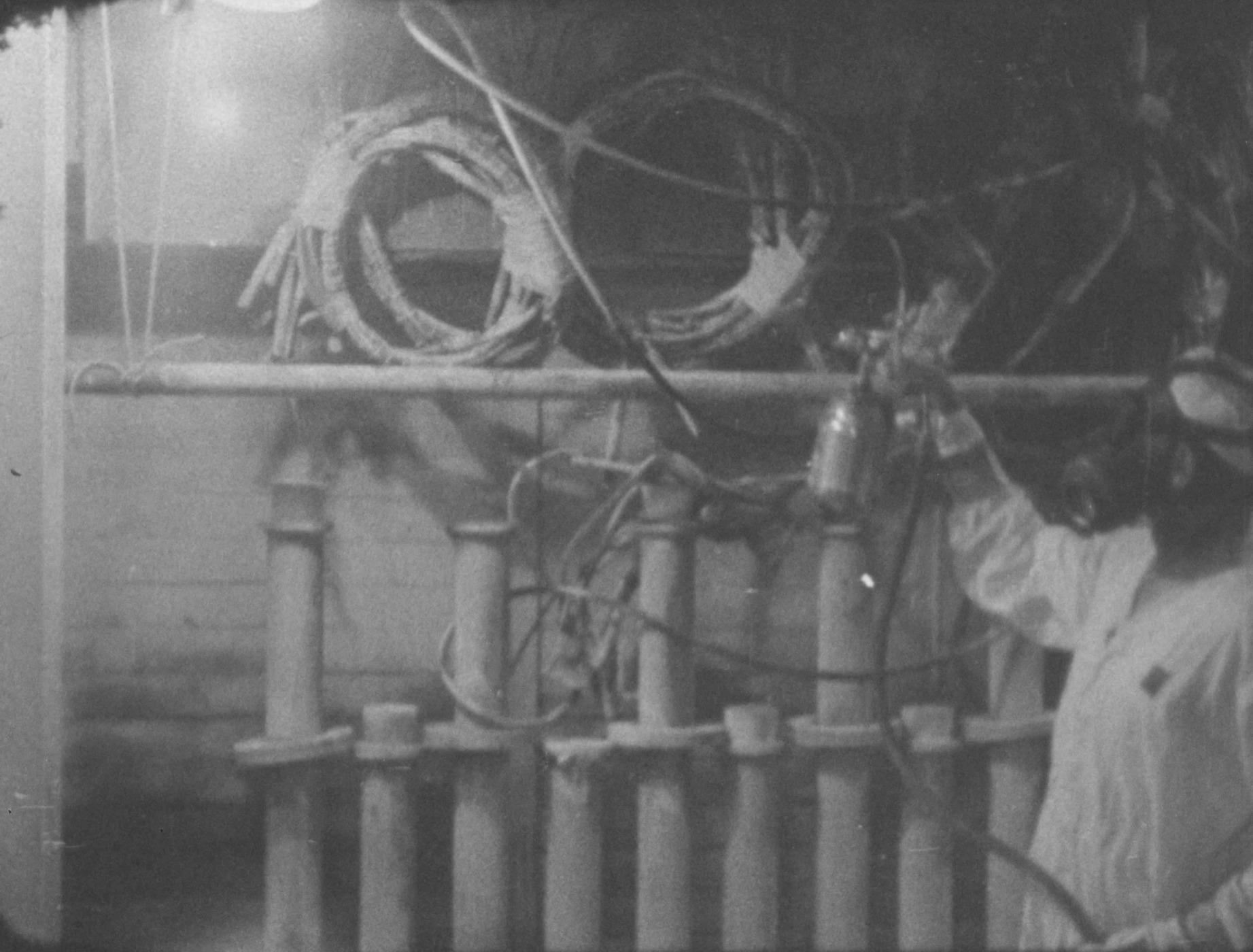
| 14:43 | sandblasting, a six-inch layer of concrete was placed on the floor and walls. A vinyl-based |
| 14:50 | paint was sprayed to fix low levels of activity and to cover new concrete surfaces which were |
| 14:55 | left exposed. This paint forms a glossy surface which is easily decontaminated. |
| 15:02 | We found it easier to decontaminate the lead from the walls and floor in the lower header room by melting it down, skimming it, and remolding new sections. |
| 15:13 | In addition, the walls and floor of the new location for the heavy water storage tanks and coolers were re-lined with lead in case of any future spill of heavy water. |
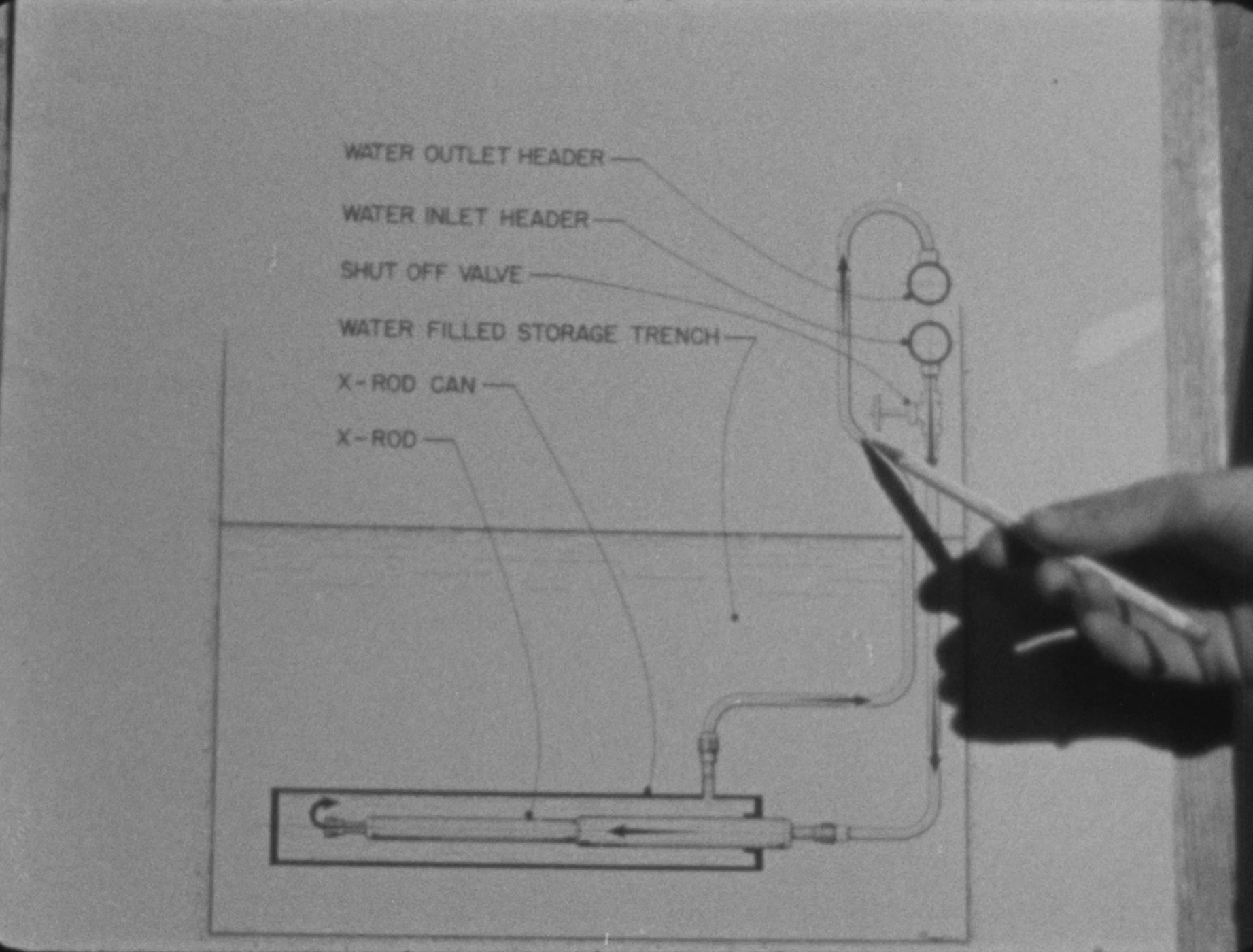
| 15:24 | A number of undamaged fuel rods had been irradiated from 1,000 to 3,000 megawatt days per ton. |
| 15:33 | This is the method we used to preserve these rods during the 14-month period required to |
| 15:38 | restore the reactor. |
| 15:40 | If these rods had been exposed to stagnant water, they would have corroded and be of |
| 15:45 | no further use in the reactor. |
| 15:48 | Ruptured rods were stored in a trench system after removal from the pile. |
| 15:52 | Here they are being photographed for detailed study later. |
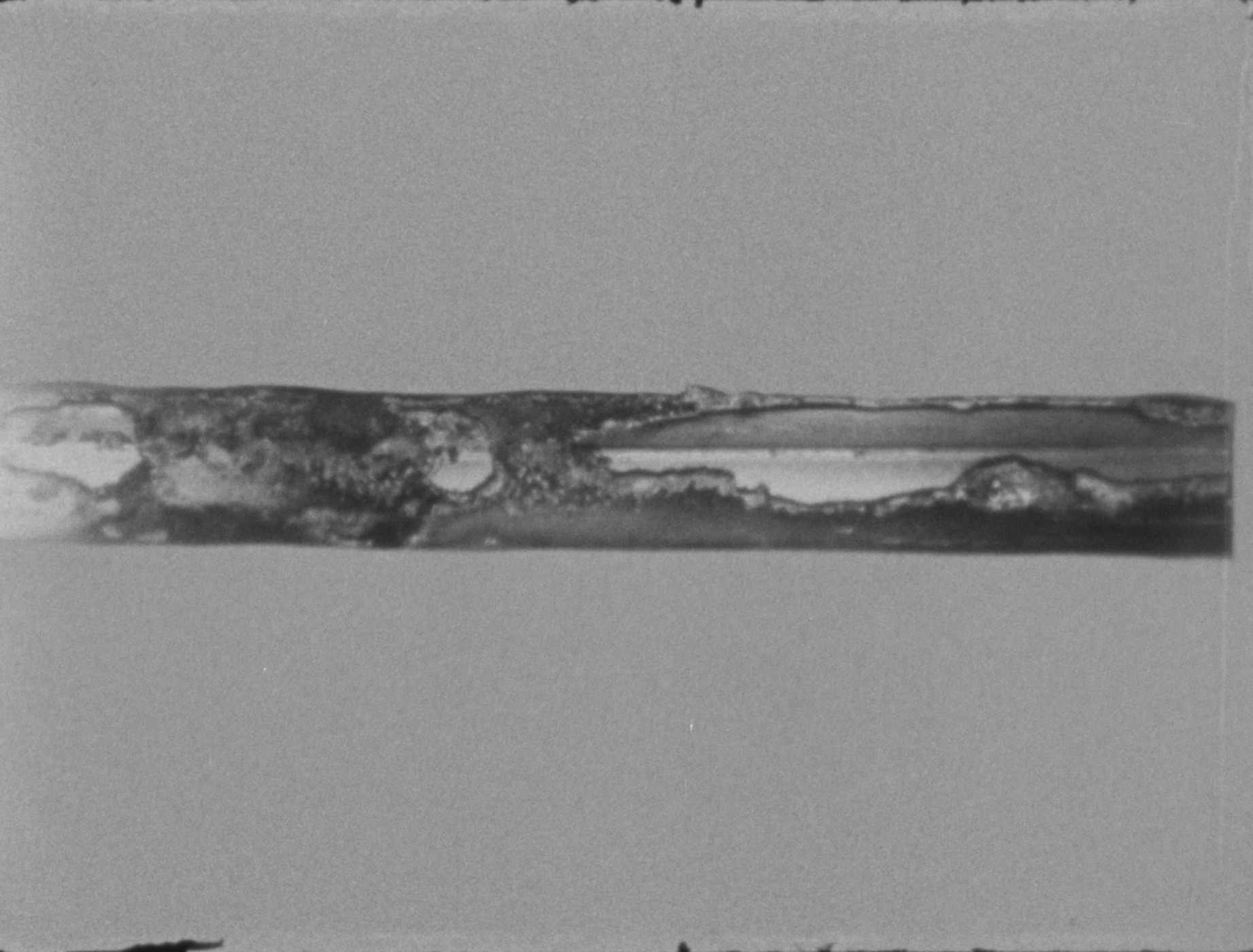
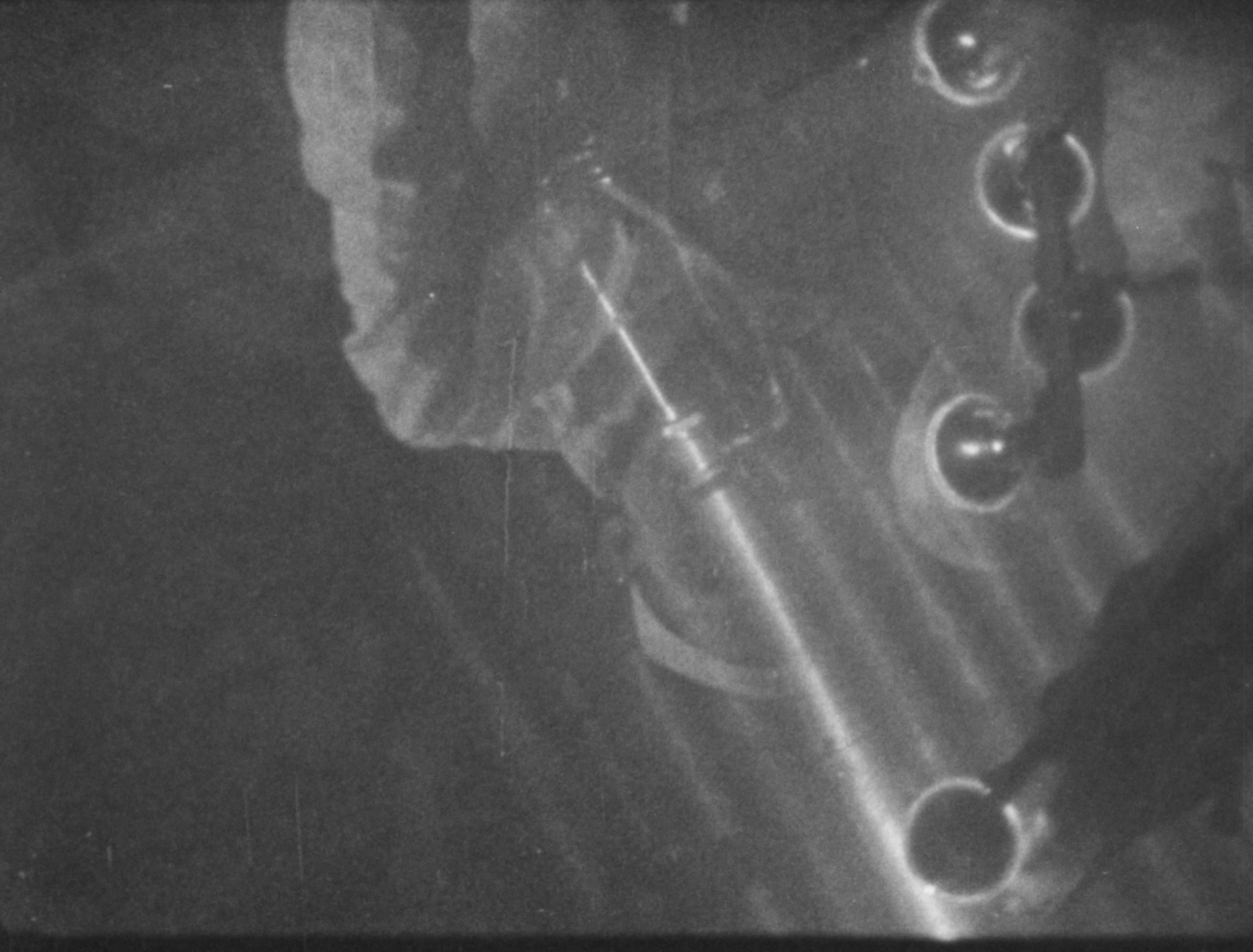
| 15:58 | This is a photograph made with the use of a pinhole camera. |
| 16:03 | The negative is also a pinhole photograph made with gamma rays streaming from radioactive |
| 16:08 | bits. |
| 16:10 | By superimposing the negative over the photograph, radioactive material is readily located at |
| 16:17 | these two points in the piping leading to the pumps. |
| 16:22 | The helium gas holder had been decontaminated and put back in place. |
| 16:26 | Now the heavy water coolers and the heavy water storage tank were similarly installed |
| 16:32 | in the location, which was equipped with lead walls and floor. |
| 16:38 | Radiation in contact with the first thermal shield below the calandria was 500 roentgens |
| 16:42 | per hour. |
| 16:43 | To permit NRX to operate at 40 megawatts compared to 30 megawatts before the accident, a new |
| 16:49 | stainless steel water-cooled sandwich was built to go over the first thermal shield below the |
| 16:54 | calandria it was designed to carry away excess heat when operating the reactor at the higher power |
| 17:02 | this shield is being checked for alignment with the new calandria before installation |
| 17:11 | the first job on the new calandria was to check it for leaks Helium at seven pounds pressure was applied to the vessel, and a helium leak detector |
| 17:21 | is used around the rolled joints in the tube sheets. |
| 17:30 | Three tubes had to be re-rolled several times. |
| 17:33 | As a result, these tubes became so thin that they had to be replaced. |
| 17:43 | In pulling the tubes, these black marks were the first indication that graphite had been |
| 17:48 | used in the fabrication of the calandria. |
| 17:51 | We had learned many years before that aluminum in contact with graphite will set up an electrolytic |
| 17:56 | reaction. |
| 17:57 | If this graphite were allowed to remain, the calandria would have a limited life. |
| 18:06 | This last-minute discovery caused a major delay in the program. |
| 18:15 | The calandria was moved from the reactor building to shops, where the men are pulling the tubes |
| 18:19 | without wearing respirators. |
| 18:30 | A hole was cut in the calandria shell, in order to clean out every particle of graphite |
| 18:35 | which might be inside. |
| 18:38 | We found that vigorous wiping with cloths was superior to vacuuming. |
| 18:45 | New tubes were received within two weeks of placing the order. |
| 18:52 | They were put into the calandria with the use of shim stock material |
| 18:56 | to prevent galling between the tubes and the tube sheets. |
| 19:01 | Plugs for gas and water passages were completely cleaned |
| 19:05 | and screwed into the tube sheets. |
| 19:10 | Then the vessel was completely checked to assure that there were no leaks |
| 19:14 | before it was transferred to the reactor building. |
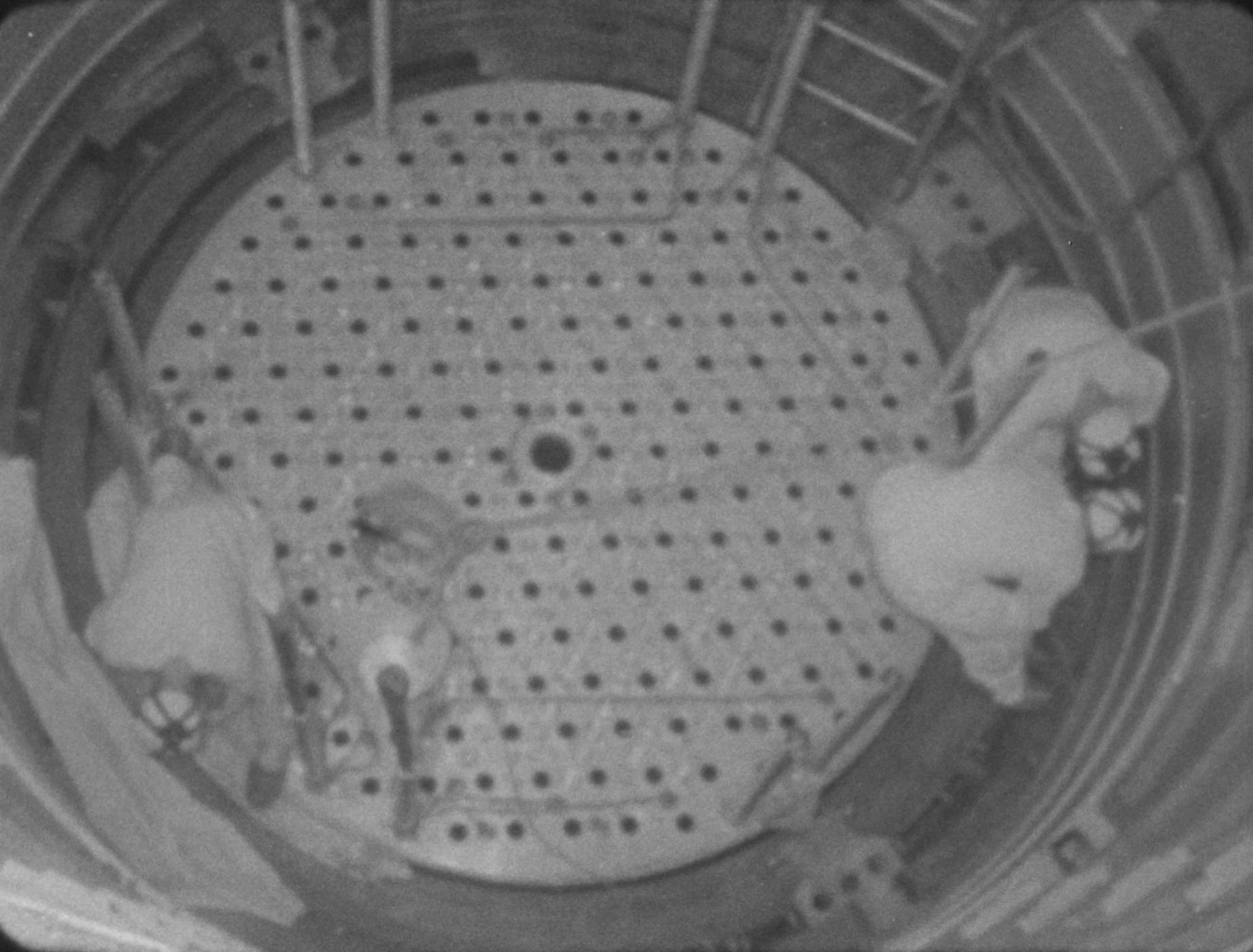
| 19:19 | The calandria is now in place and this man is installing the alignment bracket on it. |
| 19:27 | The radiation coming up around this circle was 20 R per hour. |
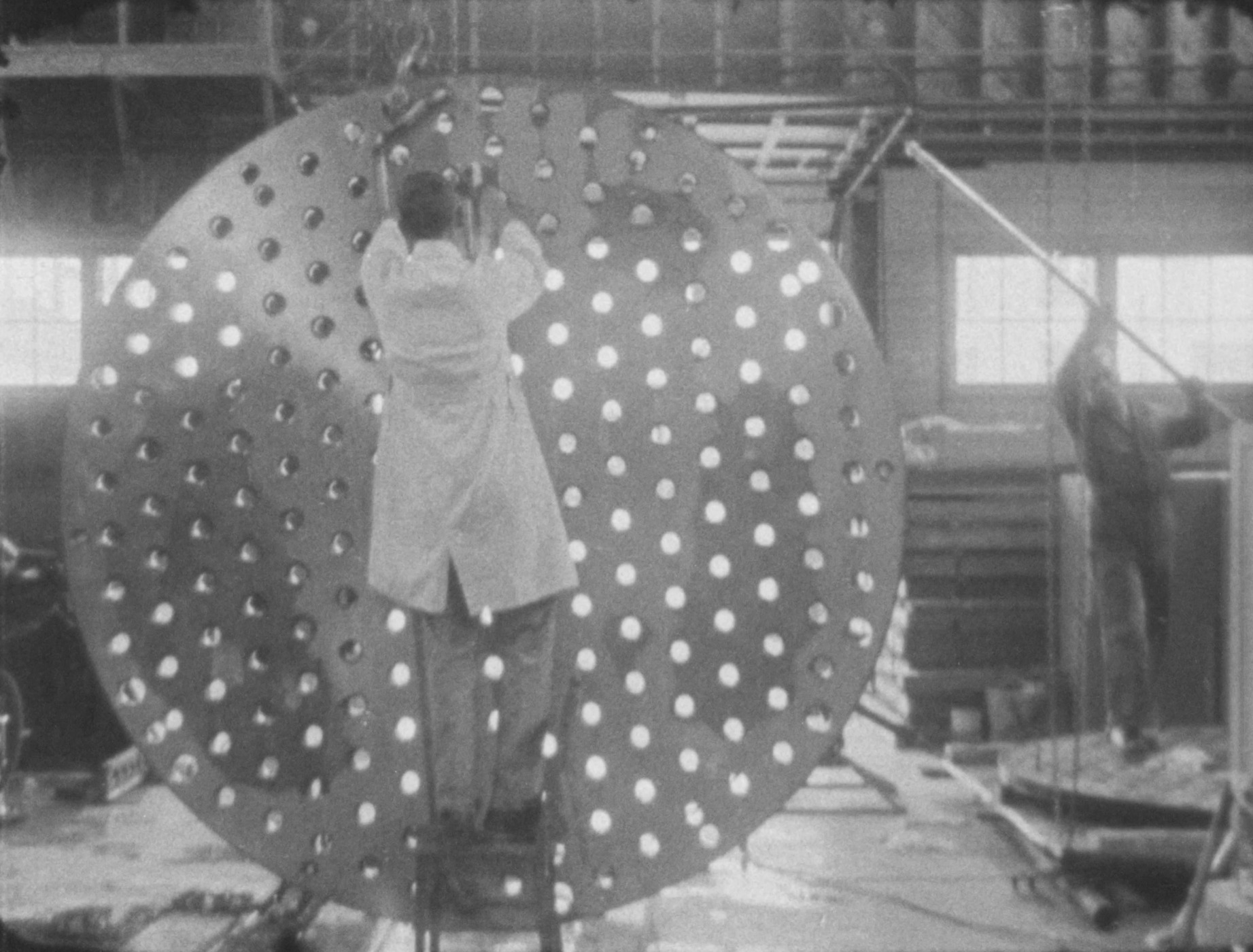
| 19:34 | A new aluminum shield had been obtained to replace the third steel shield, which was previously buried. |
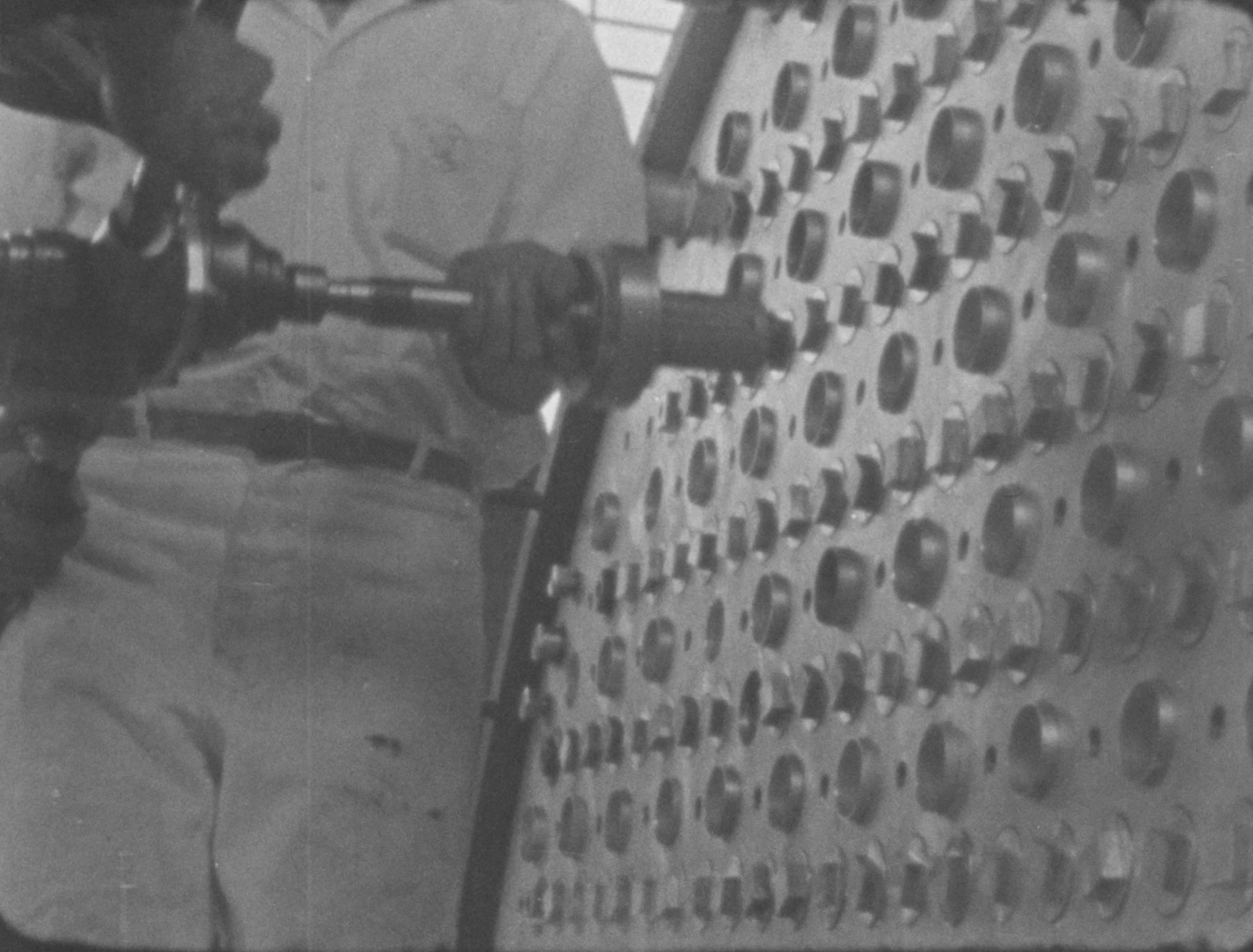
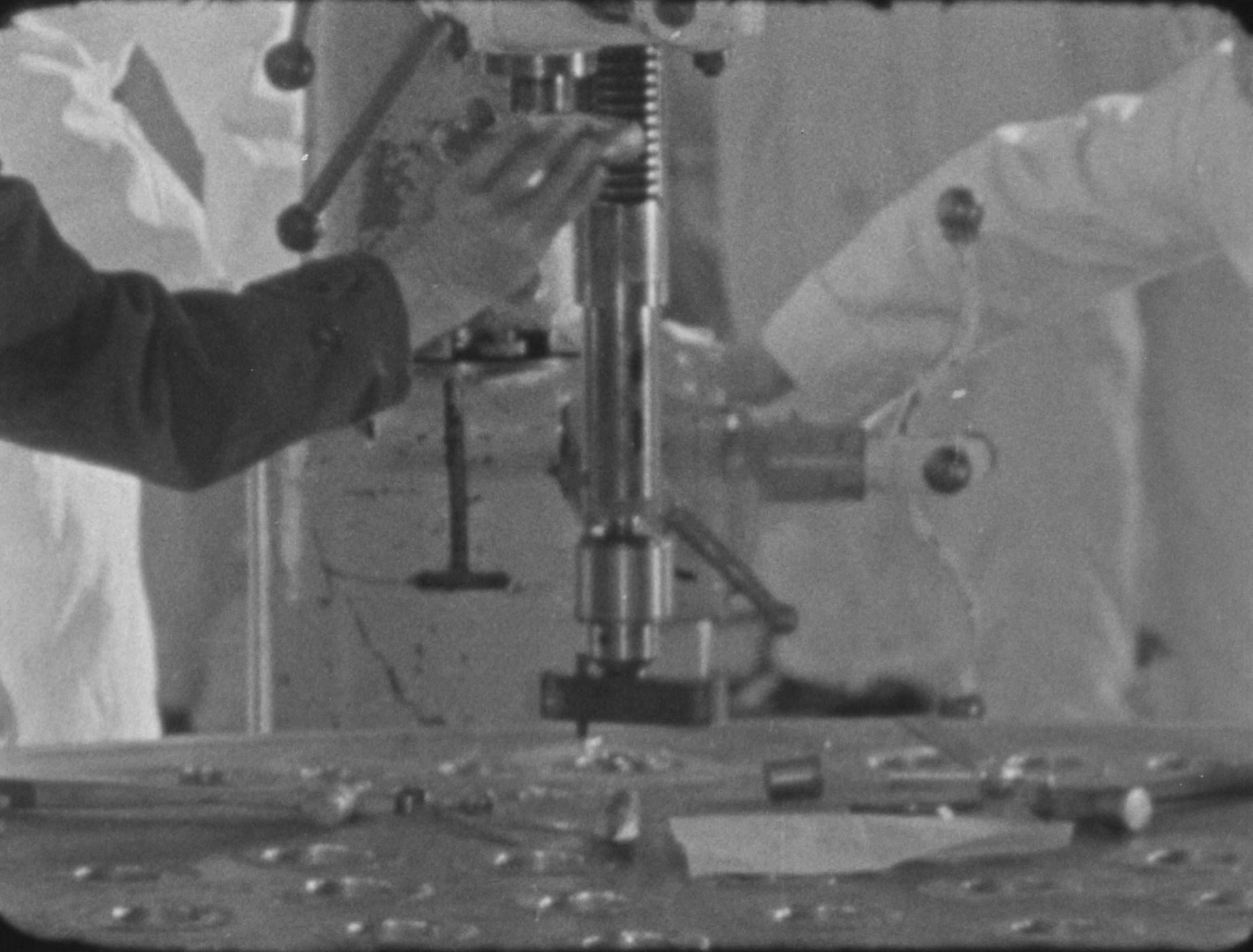
| 19:39 | Four holes in this shield were out of alignment with the calandria tubes as a result of welding stresses |
| 19:44 | and had to be re-drilled to center them properly. |
| 19:48 | The half-life of irradiated aluminum is very much shorter than that of iron-59 and cobalt-60 formed in steel when irradiated. |
| 19:57 | Hence, the aluminum shield can be removed much more quickly and safely. |
| 20:04 | The new aluminum shield was put into the reactor. |
| 20:07 | A steel shield followed. |
| 20:09 | Now the topmost thermal shield is being moved for installation. |
| 20:23 | Gas and water connections are being made above this shield. |
| 20:27 | Notice that the men are no longer wearing respirators. |
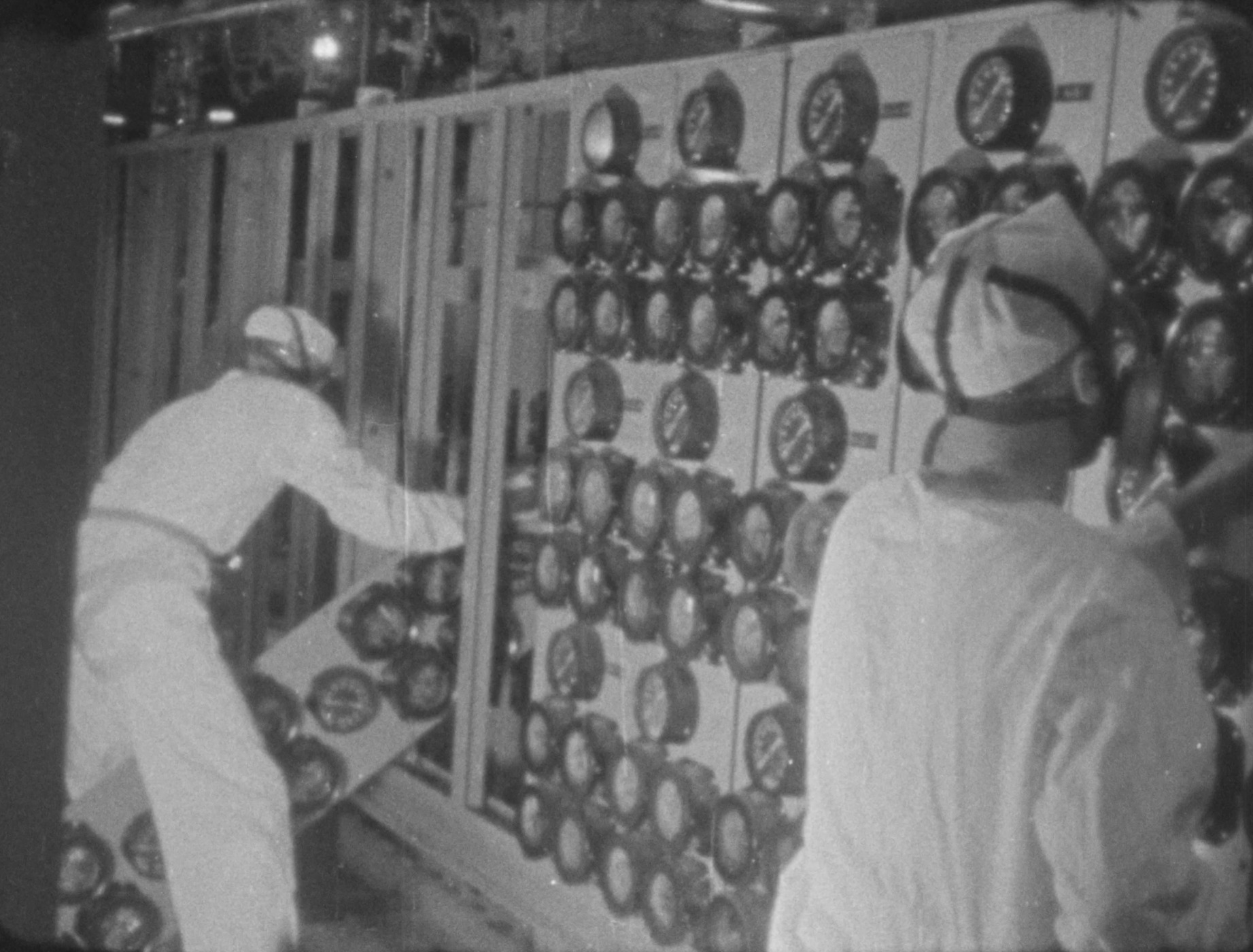
| 20:34 | Meanwhile, in the basement, these pressure switches, which had been individually decontaminated, |
| 20:40 | are being reinstalled. |
| 20:44 | During the accident, the contaminated water rose halfway up these panel boards. |
| 20:50 | The four concrete biological shields were returned to position, and followed by the |
| 20:55 | master plate. |
| 20:57 | Top and bottom water headers, control rod, shell off rods, and fuel rods were put back |
| 21:03 | into place and the reactor was started again. |
| 21:15 | During the restoration the safety system was carefully reviewed. Today NRX is |
| 21:23 | equipped with two independent means of shutting down the reactor. There are now |
| 21:27 | six individually operated shut-off rods of improved design. They cannot be raised |
| 21:32 | faster than one in thirty seconds. |
| 21:35 | Moreover, when the reactor is down to change fuel rods, |
| 21:38 | four of the shutoff rods are kept in an elevated position |
| 21:41 | as a safety bank. |
| 21:44 | These rods fall into the reactor if an unplanned increase |
| 21:47 | in reactivity occurs during shutdown. |
| 21:50 | A second change allows heavy water to be dumped |
| 21:53 | automatically on the scram and at a much increased dump rate. |
| 21:58 | Triplicated scram channels are used. |
| 22:04 | To reduce unnecessary shutdown, coincidence signals are required on a channel to scram |
| 22:08 | the reactor. |
| 22:10 | This permits servicing a single instrument while the reactor is operating with no loss |
| 22:15 | in safety. |
| 22:17 | The runaway caused a major disruption in the work of Chalk River. |
| 22:23 | Mechanically, a few uranium rods melted and damaged the calandria tubes. |
| 22:29 | Radioactive contamination prolonged the repair enormously, but at no time was out of control. |
| 22:36 | No case of harmful overexposure resulted. |
This digitization was sponsored by me.
Additional NRX Links
- Gray, Reconstruction of the NRX Reactor at Chalk River, September 1953
- AECL, The accident to the NRX reactor on December 12, 1952
- Cross, THE CHALK RIVER ACCIDENT IN 1952
- Mummah, President Jimmy Carter and a Canadian nuclear meltdown, 2021
- Why Not the Best – Jimmy Carter autobiography
- Jimmy Carter and the NRX Accident – How Legends Grow
- NRX Wikipedia page
See Also
- Our Digital Reactor History Museum
- Our Reactor Development History Page
- Our Old Videos page with a running list of the available and yet-to-be-scanned films out there.
If you’re interested in helping to get some of these scanned, check out our digitization GoFundMe and/or contact us!
About Dr. Nick Touran, Ph.D., P.E.
Nick Touran is a nuclear engineer with expertise in advanced nuclear reactor design, reactor development, and the history of nuclear power. After getting a Ph.D. at the University of Michigan, he spent 15 years at TerraPower in Seattle working on core design, business development, software development, and configuration management. He is now a consultant involved in advising and assisting numerous reactor development and deployment efforts. He is also a licensed professional engineer in Nuclear Engineering.
Nick has been active in public education around nuclear since 2006 as the founder of whatisnuclear.com. He has spoken at numerous institutions, schools, and public events, and was once featured on NPR’s Science Friday. Recently, he has coordinated the digitization of over 45 historical nuclear films.
Reader comments